6 Wall Flower Decor Ideas That Make Any Room Feel Like A Secret Garden
You want a room that feels like a secret garden—soft light, petals that don’t wilt, and a wall that whispers “stay a while.” You hate that flat, lifeless corner that eats every frame you hang and turns your cozy dream into beige purgatory. Imagine dappled shadows, velvety greens, and blooms that feel alive—without a single vase to babysit. These 6 wall flower decor ideas fix the “blank wall” struggle within a weekend and under a reasonable budget cap, each one crafted to make your space feel finished, photogenic, and actually livable.
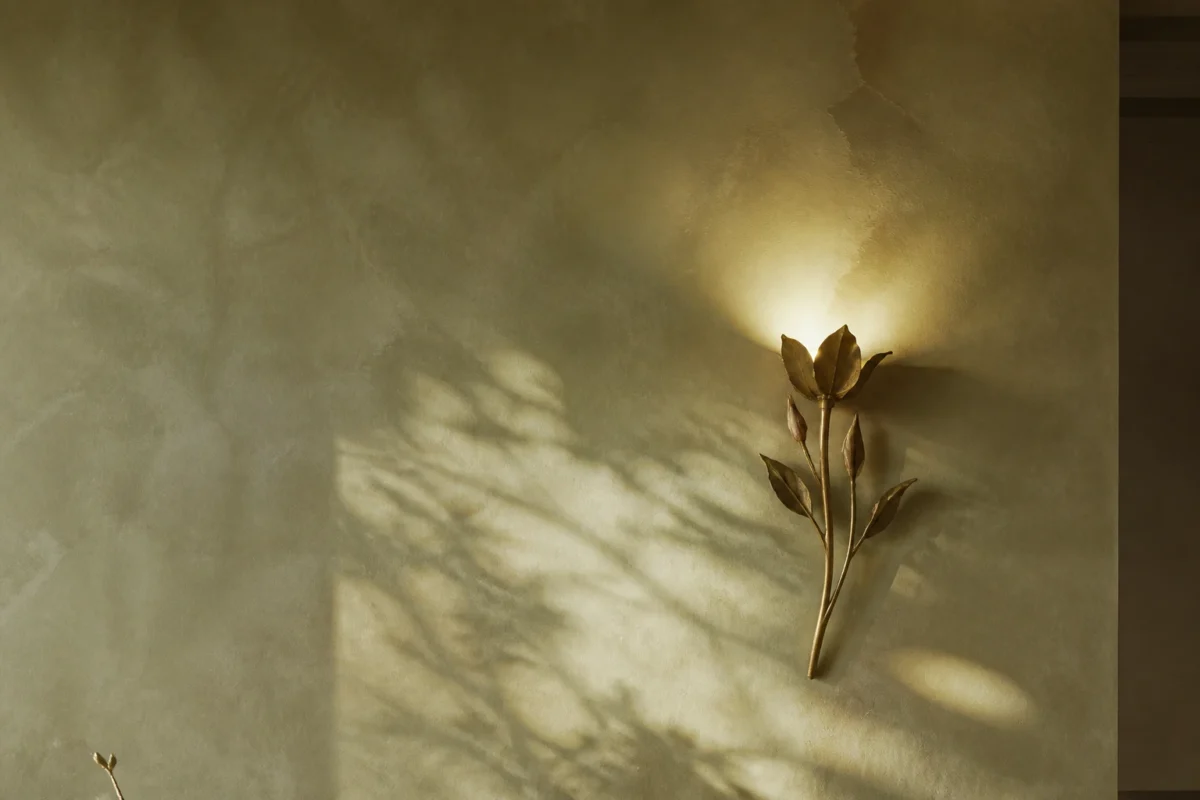
We’ll layer color, texture, and lighting so your home feels intentional, not staged. Expect sage, blush, midnight moss, hand-touched wall textures, and floral silhouettes that cast magical shadows. Every idea is buildable, renter-friendly variants included, and perfectly Pinterest-ready. If you love romance with a practical streak, these are your people and these are your walls.
1. Limewash Plaster Wall With Warm Dappled Light and a Curved Iron Bloom Sconce
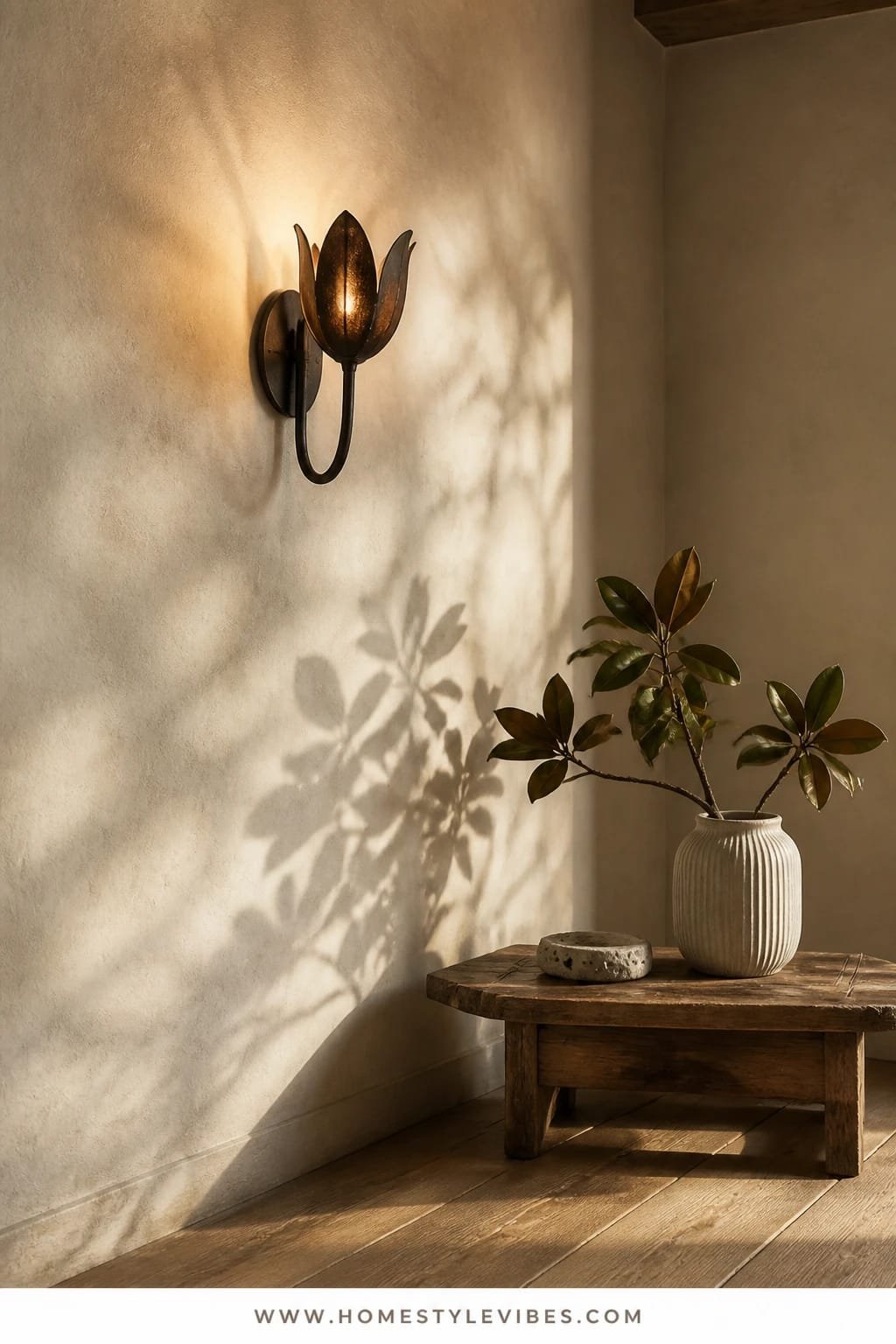
We’ve all been there: that one wall looks stale no matter how many art prints you try. It absorbs every ounce of charm in the room. This design fixes the flatness by combining a hand-rubbed limewash wall, a warm-glow statement sconce shaped like an abstract bloom, and plant-like shadows that dance at night. The mood lands in modern Mediterranean meets quiet romantic—soft, tactile, and glow-forward.
Here’s why it works in real homes: limewash instantly adds depth without heavy pattern, which helps small rooms feel layered rather than cramped. The curved iron sconce acts like jewelry—sculptural and unexpected. Lighting is the hero here. Aim the sconce upward to get petal-like shadows and a gentle pool of light. Take a photo at dusk and watch the wall come alive with depth and nuance.
Variations: choose a budget-friendly premixed limewash paint and a plug-in sconce with cord covers if you rent. Try a charcoal or deep moss tone for moodier rooms. If your space is tiny, go lighter—like pale sage—to keep the airiness. Family-friendly hack: wipeable ceramic limewash blends exist and handle fingerprints better than traditional formulas.
Budget Breakdown:
- Limewash paint and mineral primer: $70 – $160
- Curved iron bloom sconce (hardwired): $180 – $450
- Dimmer switch: $25 – $60
- Painter’s supplies and brush set: $25 – $50
Total Estimated Cost: $300 – $720
Best For: Small living rooms, reading corners, or bedrooms craving warmth. Works beautifully in Mediterranean, transitional, and eclectic interiors.
Key Design Elements:
- Main materials: mineral-based limewash, iron, warm white bulbs
- Color palette: sage, stone, cream, and aged bronze
- Lighting strategy: dimmed, up-lit sconce for shadow play
- Furniture silhouettes: rounded arms, nubby textiles, low-line side table
- Texture layers: plastered wall, linen throw, ceramic catchall
- Accent details: fern fronds in a narrow vase, woven tray, aged brass frames
How To Recreate This Look:
- Start with a clean, primed wall and roll on the mineral primer recommended for limewash.
- Add two to three limewash coats using cross-hatched strokes for movement.
- Install the curved iron sconce on a dimmer; choose a 2200–2700K bulb for warmth.
- Layer a small curved-edge table and a linen-shaded lamp nearby for extra glow.
- Style with a slim vase of eucalyptus and a vintage-style frame in muted brass.
Why This Looks Expensive: The artisanal finish and sculptural sconce read custom. Light washing across limewash creates tonal variation that photographs like a boutique hotel wall.
Watch Out: Don’t use a bright white bulb. Cool light flattens the nuance in limewash and makes the wall look chalky instead of luminous.
Pro Styling Tip: Shoot at golden hour with the sconce on low; let the shadow edges blur for a dreamy, editorial effect.
Keep scrolling—this next idea leans into petal texture without a single stem to water.
2. Fluted Wood Paneling With Soft Blush Glow and a Floating Petal Shelf Ledge
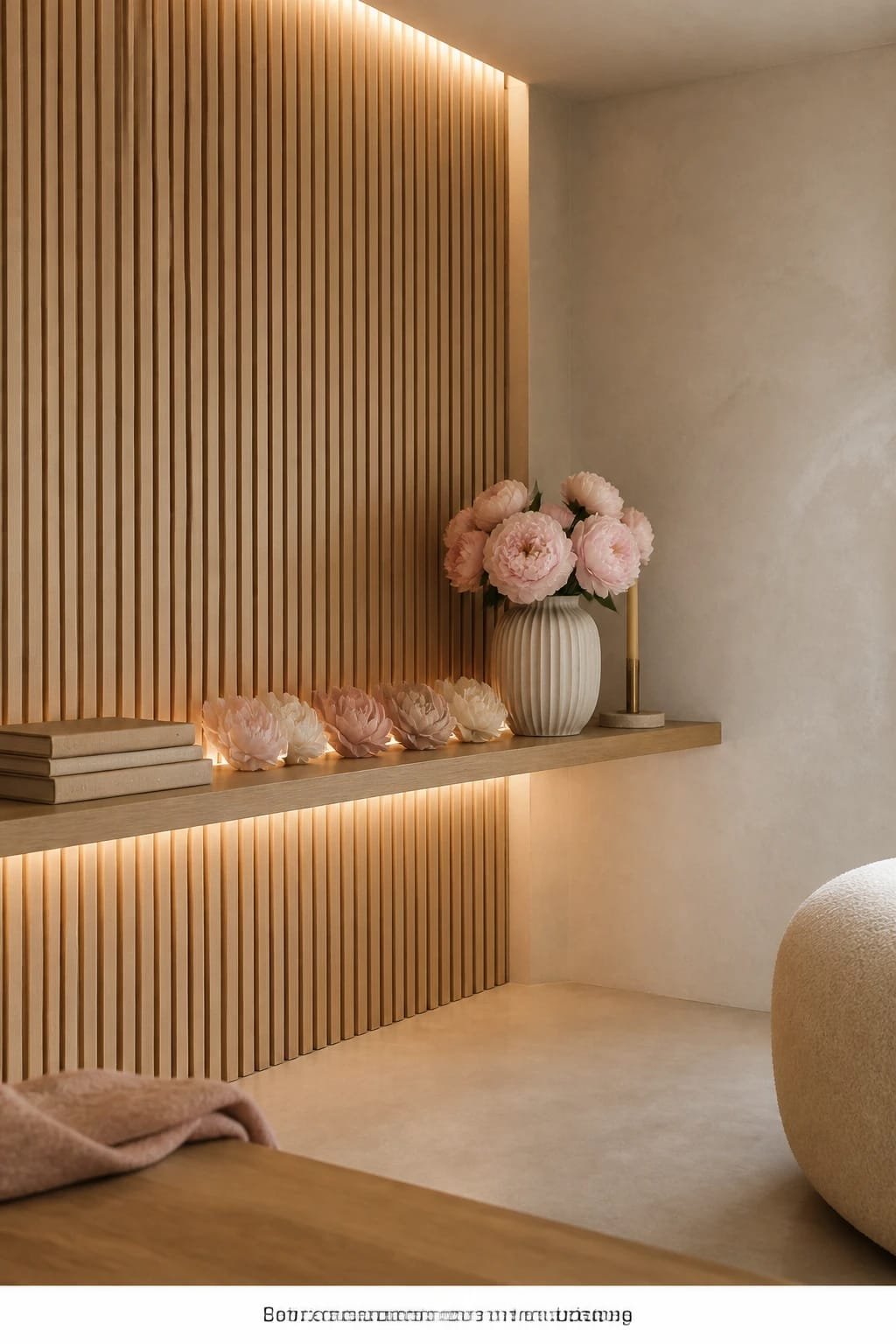
It’s that one corner that always feels off—like the room forgot to put on accessories. You’ve tried prints and macramé, but it still looks flat. Fluted wood sets up rhythm and dimension while a slim ledge displays handmade ceramic blossoms. Add a soft blush LED cove glow and the whole wall hums with warmth. The vibe is Scandinavian meets romantic studio: clean lines with a tender, rosy undertone.
Why it works: vertical fluting elongates walls, making low ceilings feel taller. It’s forgiving in family spaces because the texture hides scuffs. A floating shelf ledge invites seasonal rotation—swap in pressed-flower tiles in spring, sculptural leaves in fall. It photographs beautifully thanks to the ribbed shadows and blush backlight that adds believable depth.
Variations: for a renter, use peel-and-stick fluted panels or wallpaper that mimics slats. For tight budgets, do just one center panel like a runway for your petal shelf. Prefer dark and moody? Choose walnut stain and switch blush to amber. Tiny rooms benefit from white-oak tones and a very gentle pink glow—just a whisper.
Budget Breakdown:
- Fluted MDF or wood slat panels: $180 – $520
- LED strip with dimmer (blush or warm white): $35 – $120
- Floating shelf ledge (48–72 inches): $45 – $150
- Decorative ceramic blossoms/pressed floral tiles: $40 – $160
Total Estimated Cost: $300 – $950
Best For: Entry nooks, dining room feature walls, studio apartments wanting a styled backdrop.
Key Design Elements:
- Main materials: fluted wood, matte ceramics, soft LED
- Color palette: white oak, blush, milk white, and warm brass
- Lighting strategy: hidden LED cove or under-shelf glow
- Furniture silhouettes: slim console, rounded stool, delicate frames
- Texture layers: ribbed wood, linen runners, chalky ceramics
- Accent details: brass picture light, dried bunny tails, micro vases
How To Recreate This Look:
- Measure and mount fluted panels across your chosen width, keeping seams tight.
- Run an LED strip along the top or underside of the shelf to backlight the flutes.
- Install a floating shelf centered; keep it thin for a modern profile.
- Arrange ceramic blossoms and small stems in asymmetric clusters.
- Add a slim console or bench beneath with a textural runner for grounding.
Why This Feels Designer: Movement from the flutes plus that micro-blush glow reads thoughtful and high-touch, like a boutique lobby detail.
One Thing To Avoid: Don’t overfill the shelf. Negative space lets each bloom read as intentional, not cluttered.
Pro Styling Tip: Angle one blossom slightly off-center and place a single bud vase lower-left to create a natural visual “S” curve in photos.
Remember, this isn’t about recreating a showroom. It’s about building a space that actually feels like yours. If one idea resonates more than the others, that’s your starting point. You don’t need all of them.
3. Hand-Painted Mural With Morning Light and a Vintage Cane Headboard Anchor
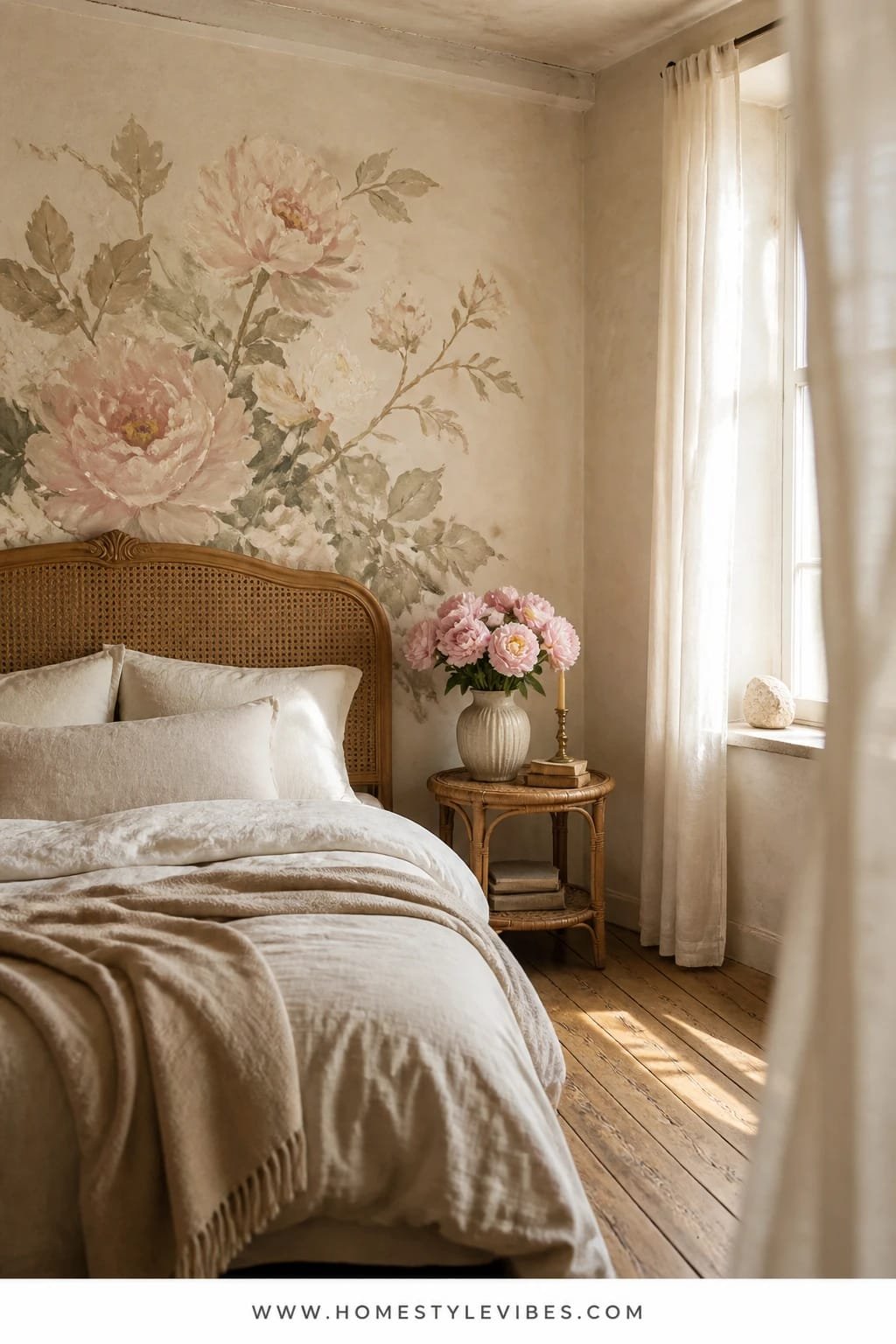
You want romance, but decals always feel too crisp and predictable. A hand-painted floral mural—loose, imperfect, soft—lets you tell a story across the wall. Pair it with a vintage cane headboard to ground the airiness and catch morning light. The mood skews cottage-core meets Paris flea market, equal parts charm and texture.
Why it works: hand-painted petals add movement and authenticity. Imperfection is the point. In real homes, this reads relaxed and lived-in instead of showy. Light becomes part of the composition; early sun wakes up the petals, while evening lamps give them a parchment-like quality. Photos love the contrast between woven cane and soft brushwork.
Variations: beginner-friendly? Stencil abstract blooms with two tones max. Renter? Paint on removable canvas or large MDF board and hang like art. Darker version: muted mulberry petals on mushroom walls. Budget? Use sample pots and a 1-inch angled brush for painterly strokes.
Budget Breakdown:
- Sample paint pots (3–6 colors): $30 – $90
- Quality brushes and artist tape: $20 – $45
- Vintage or new cane headboard: $160 – $600
- Matte sealer (optional): $15 – $35
Total Estimated Cost: $225 – $770
Best For: Bedrooms and guest rooms; medium walls where you can see the whole composition at once.
Key Design Elements:
- Main materials: matte wall paint, woven cane, linen
- Color palette: chalky sage, dusty rose, mushroom, ivory
- Lighting strategy: soft bedside lamps, no cool bulbs
- Furniture silhouettes: rounded headboard, slim nightstands
- Texture layers: cane weave, washed linen duvet, velvet cushion
- Accent details: antique brass knobs, ceramic bedside lamps, trailing ivy
Why This Reads High-End: Brushy, organic shapes look custom, not store-bought. Pairing with cane adds heritage texture that suggests provenance, even if it’s new.
How To Recreate This Look:
- Sketch your bloom outlines lightly with pencil—think big shapes first.
- Block in petals with your mid-tone; add a slightly darker outline on one side and a highlight on the other.
- Keep stems and leaves a tonal mix of sage and mushroom for cohesion.
- Anchor with the cane headboard, centered under the most detailed cluster.
- Style with linen bedding, one velvet cushion, and a single trailing plant.
The Most Common Mistake: Over-detailing every petal. Leave some shapes looser so the eye can rest and the wall doesn’t feel busy.
Pro Styling Tip: In photos, tuck a corner of the duvet and crumple it slightly—soft wrinkles echo the brushwork and keep it human.
4. Botanical Molding Grid With Olive Night Glow and a Velvet Chaise Statement
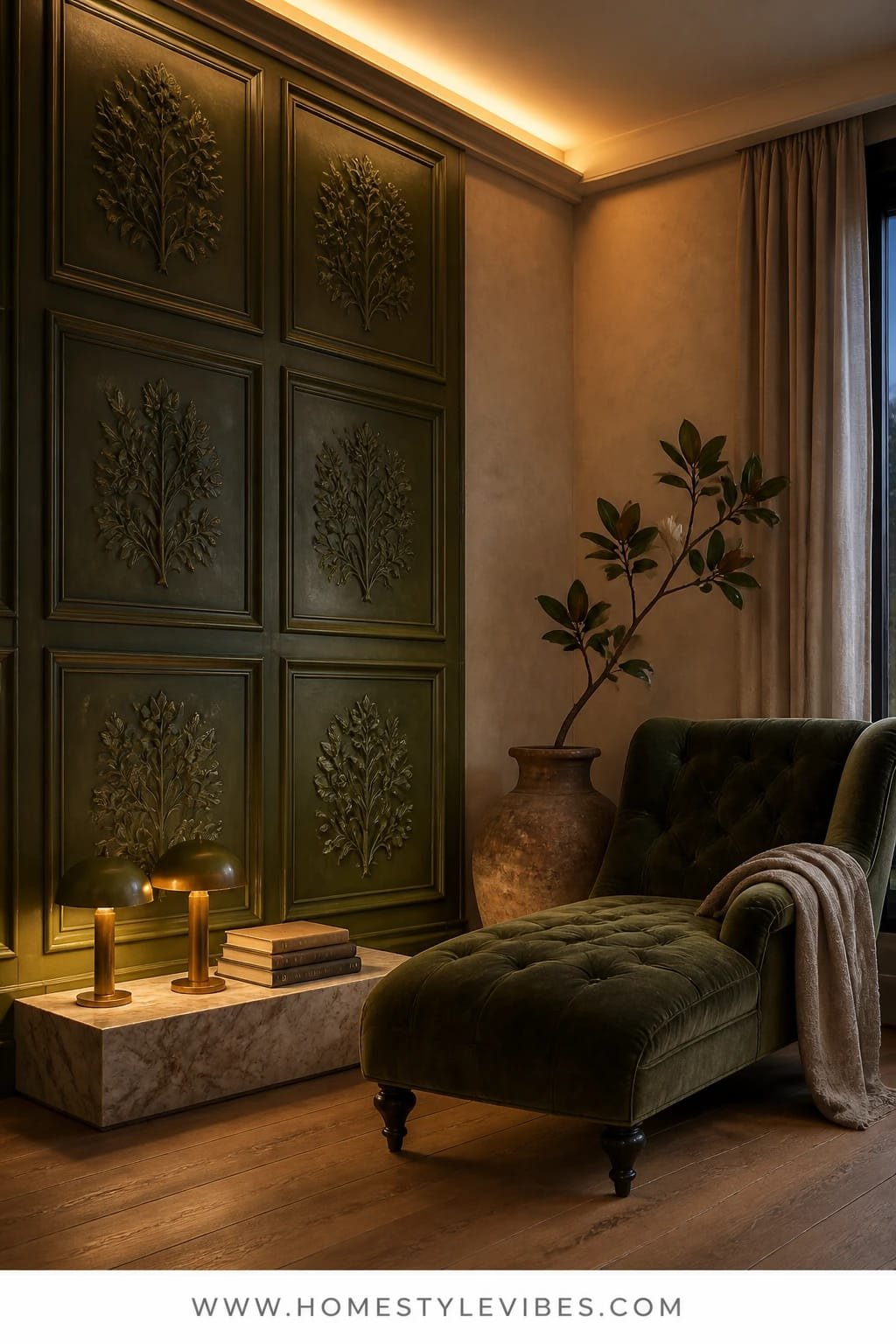
You’ve framed a dozen botanical prints but the wall still feels scattered. A crisp molding grid turns chaos into a gallery, and raised resin florals inside each panel feel like pressed petals come to life. Painted in deep olive with night-glow lamps, the wall becomes a moody jewel box. Add a velvet chaise as your statement piece and you’ve got instant salon energy—classic with a wink.
Here’s why it works in real homes: the grid creates order and resale-friendly symmetry. Dark olive reads sophisticated, not gloomy, when you pair it with warm bulbs and soft textiles. Photographs sing because the panels create rhythm while the velvet chaise absorbs light like a stage curtain—dramatic but approachable.
Variations: small-space version uses a half-wall grid (chair-rail height) with floral medallions. Renter-friendly peel-and-stick molding exists; paint it then remove later. If you fear dark paint, try olive halfway up with creamy white above. Family setting? Choose performance velvet to resist spills.
Budget Breakdown:
- MDF molding and chair rail: $120 – $300
- Resin floral appliqués or pressed-metal florals: $80 – $240
- Paint and primer: $70 – $140
- Velvet chaise: $350 – $1,100
- Wall sconces or plug-in picture lights: $90 – $280
Total Estimated Cost: $710 – $2,060
Best For: Living rooms, dining rooms, or den corners where you want a statement backdrop for reading or cocktails.
Key Design Elements:
- Main materials: MDF molding, resin florals, velvet
- Color palette: olive, cream, antique brass, blackberry
- Lighting strategy: wall sconces or picture lights aimed down for soft wash
- Furniture silhouettes: swooped chaise, delicate side table
- Texture layers: velvet, silk-trim pillow, matte paint
- Accent details: brass gallery lights, footed bowl, fig branches
Why This Looks Intentional: Structure first, ornament second. The grid organizes the wall so every floral detail feels curated, not random.
How To Recreate This Look:
- Map a grid using painter’s tape; aim for balanced rectangles that align with furniture height.
- Install molding, fill nail holes, sand, and prime.
- Attach floral appliqués centered within select panels.
- Paint the entire wall and molding in a single deep olive for a unifying effect.
- Place the velvet chaise just overlapping one panel; flank with a warm-toned sconce.
Don’t Do This: Avoid cool, bluish bulbs against olive—they turn it muddy. Stick to 2700–3000K for a delicious glow.
Pro Styling Tip: Angle the chaise 10–15 degrees so its curves cut across the grid lines—your photos will instantly feel more dynamic.
Quick reality check: perfection isn’t the goal. I once mismeasured a molding grid by half an inch and lived to tell the tale. With paint and a good sconce, no one noticed but me.
5. Textured Grasscloth With Golden Hour Wash and a Sculpted Petal Mirror
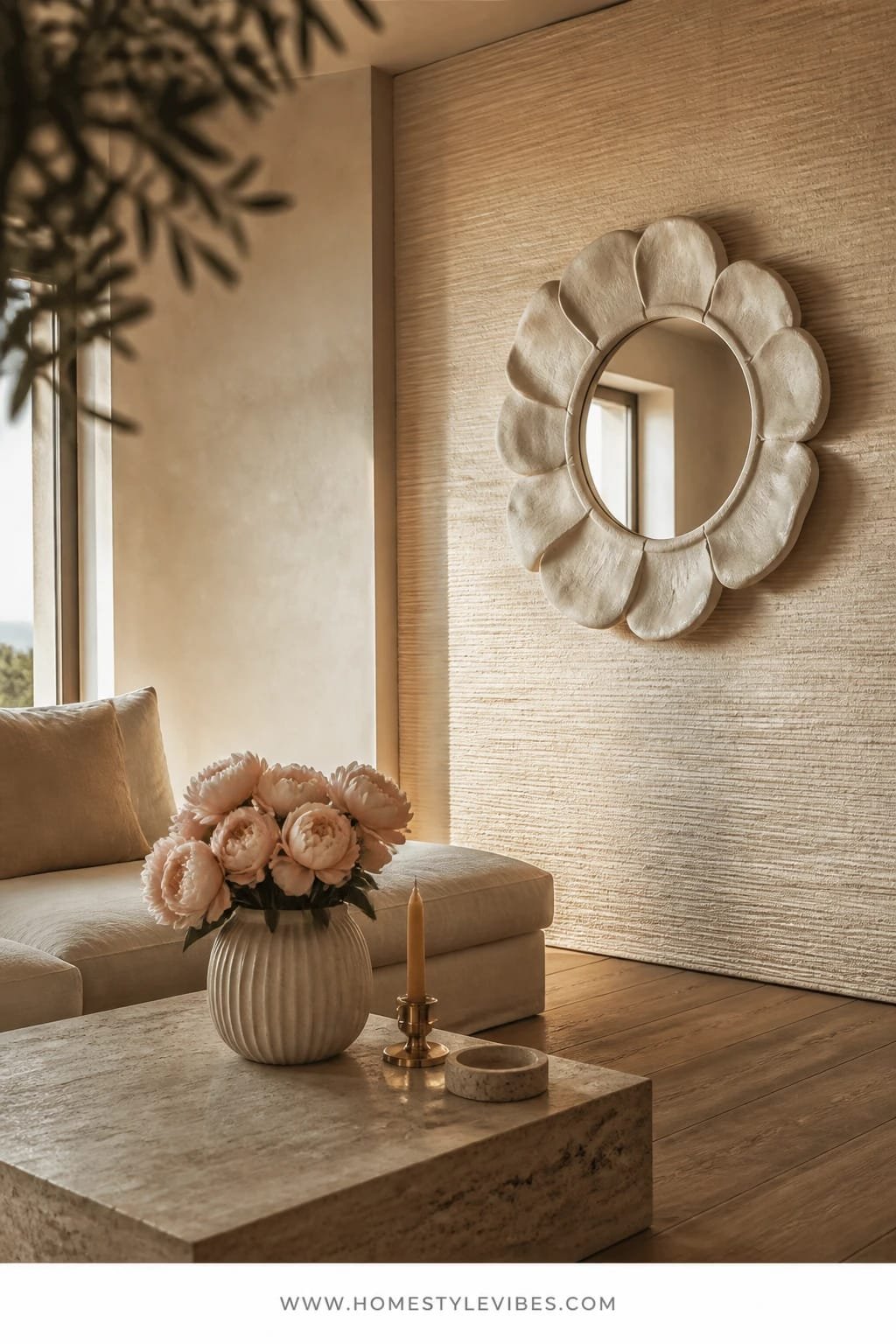
You love natural materials but fear they’ll feel too rustic. Grasscloth solves that with its refined weave and subtle sheen that catches light at dusk. Layer in a sculpted petal mirror—think plaster or resin—for a floral nod that never wilts. The room lands in coastal-meets-Parisian apartment: relaxed, elegant, and tactile.
Why it works in real homes: grasscloth hides minor wall flaws and adds instant dimension. Paired with a petal mirror, it becomes a focal point that bridges traditional and modern furniture. Light glides across the weave, which looks incredible on camera. Even a simple console beneath feels styled when the texture is doing heavy lifting.
Variations: budget version uses faux grasscloth wallpaper with a realistic print. Darker version: espresso or indigo grasscloth with a white petal mirror for striking contrast. Renter-friendly? Go peel-and-stick wallpaper and a lightweight resin mirror. Small space? Choose narrow-weave grasscloth so the texture reads subtle, not busy.
Budget Breakdown:
- Grasscloth or faux grasscloth wallpaper: $180 – $600 (feature wall)
- Petal mirror (plaster/resin): $120 – $480
- Wall-mounted picture light (optional): $90 – $220
- Installation tools or pro labor: $30 – $350
Total Estimated Cost: $420 – $1,650
Best For: Entryways, dining nooks, or above a credenza. Ideal if you want visual texture without committing to bold color.
Key Design Elements:
- Main materials: grasscloth, plaster/resin, brass
- Color palette: sand, chalk white, soft gold, olive leaf
- Lighting strategy: picture light or nearby lamp to graze the weave
- Furniture silhouettes: slim console, tapered legs, curved lamp base
- Texture layers: woven wallpaper, linen shade, ceramic bowl
- Accent details: branchy greenery, marble catchall, rattan stool
Why This Looks Expensive: Natural fiber texture plus a sculptural mirror mimics boutique hotel foyers. The woven surface refracts light, which reads luxe on camera.
How To Recreate This Look:
- Prep the wall smooth; grasscloth shows bumps.
- Hang wallpaper carefully; align seams but accept slight variation—it’s part of the charm.
- Center the petal mirror at eye level; leave 6–8 inches above the console.
- Add a picture light or place a lamp so light grazes diagonally across the texture.
- Style minimally: one branch, one bowl, one book stack.
Watch Out: Avoid heavy cleaning sprays on real grasscloth. Spot-clean with a dry cloth and keep it away from splash zones.
Pro Styling Tip: When photographing, angle your camera slightly so the weave catches a diagonal highlight—instant editorial depth.
6. Greenery Trellis Wall With Soft Moonlight and a Carved Wood Console Anchor
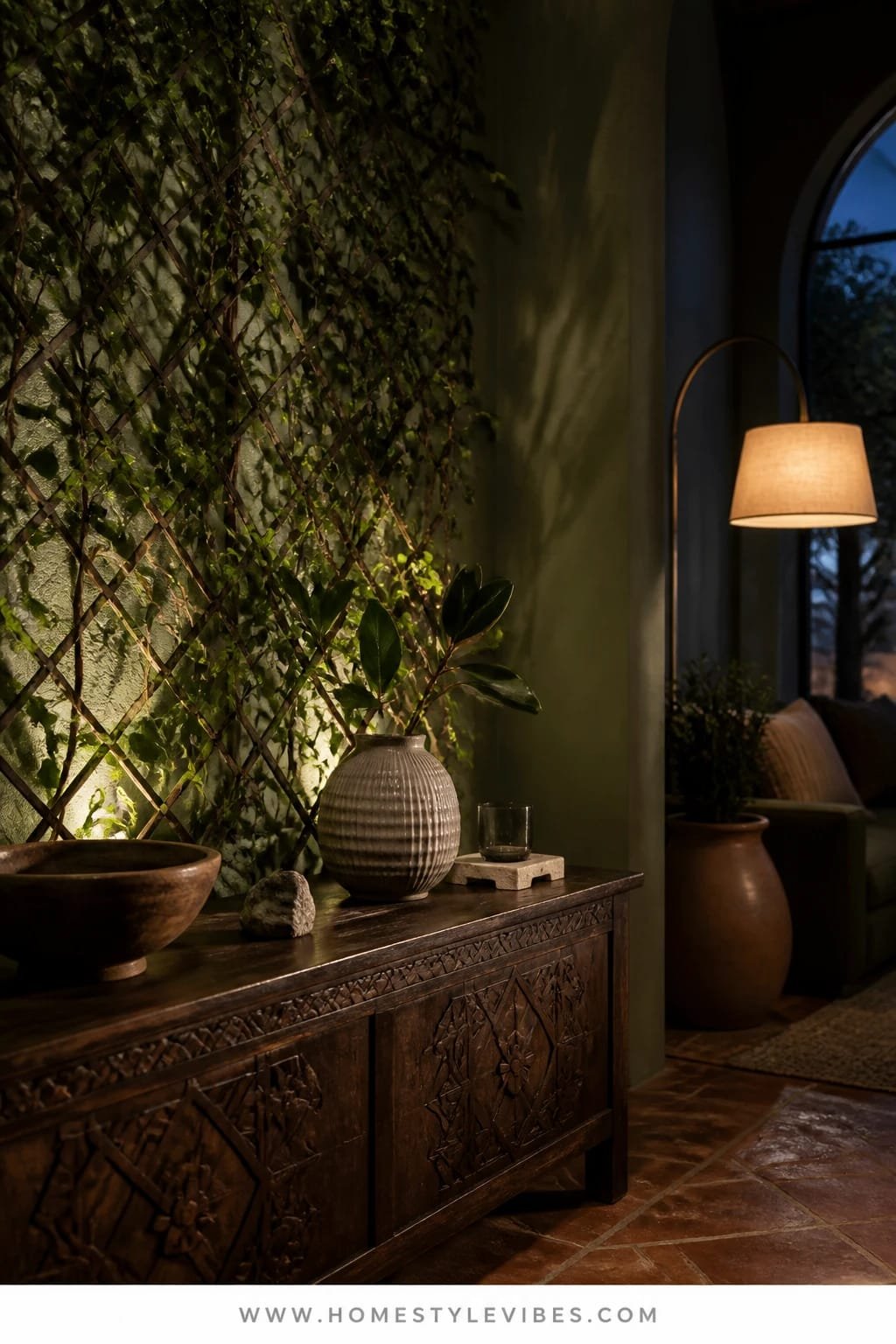
You crave that secret-garden vibe, but real vines are commitment and constant trimming. A decorative trellis with lifelike greenery climbers gives you the romance without the upkeep. Wash it with soft moonlight from a floor lamp or hidden uplight, and anchor it with a carved wood console. The mood is courtyard-at-midnight: layered greens, gentle shadows, and a hint of old-world craft.
Why it works: the trellis adds dimensional pattern, and the greenery blurs hard corners. It’s renter-friendly if you use Command-style hooks. In photos, the layered leaves cast delicate shadows that feel cinematic. Surprisingly practical too—dust them quarterly with a cool blow-dryer or microfiber glove. Add a carved console and the look gains soul, as if it’s been there forever.
Variations: budget version uses PVC lattice painted matte and mid-grade faux vines. Small space hack: do a half-width trellis centered above a console. Darker vibe: choose deep green leaves with burgundy tips and black-stained trellis. If you want fragrance, place a small diffuser with a green-tea or jasmine note nearby. I tried this trick in my own hallway last fall and honestly couldn’t believe how many neighbors asked if the vines were real.
Budget Breakdown:
- Wood or PVC trellis panels: $60 – $220
- Faux climbing greenery (high-quality): $80 – $260
- Carved wood console: $180 – $700
- Uplight or slim floor lamp: $45 – $190
- Hardware/adhesive hooks: $12 – $30
Total Estimated Cost: $377 – $1,400
Best For: Hallways, living room accent walls, renters who want drama without paint. Perfect for evening ambience lovers.
Key Design Elements:
- Main materials: wood trellis, high-quality faux greenery, carved wood
- Color palette: deep green, warm walnut, cream, antique gold
- Lighting strategy: low uplight to create layered leaf shadows
- Furniture silhouettes: carved console, slender legs, scalloped edge
- Texture layers: leaves, carved details, woven basket
- Accent details: brass bowl, cluster of taper candles, small stone bust
Why This Feels Designer: Dimensional grid + organic leaves = controlled wildness. The carved console adds pedigree so the faux greenery reads intentional, not theme-y.
How To Recreate This Look:
- Measure and mount trellis; if renting, use removable hooks and zip ties.
- Attach greenery in S-curves—not straight lines—for a natural climb.
- Place an uplight on the floor behind the console to project leaf shadows.
- Anchor with a carved console and one substantial decor piece at center.
- Finish with a small tray and two tall candlesticks for vertical rhythm.
The Most Common Mistake: Overstuffing the foliage. Let negative space show so the trellis pattern breathes and the shadows stay legible.
Pro Styling Tip: For photos, dim the overheads and rely on the uplight; shoot slightly from the side so the leaf shadows rake across the wall.
Pause here. If your head’s spinning, take a breath. You only need one idea to make a secret-garden moment. Start small, then build as your confidence grows.
Quick Checklist
- Limewash paint in a nature-inspired hue
- One sculptural floral or bloom-shaped sconce
- Fluted wood or peel-and-stick ribbed panels
- LED strip for blush or amber backlighting
- Hand-painted floral mural or stencil plan
- Vintage cane headboard or woven anchor piece
- Molding grid layout with floral appliqués
- Performance velvet chaise or statement seating
- Grasscloth or faux grasscloth wallpaper
- Petal-edged plaster or resin mirror
- Decorative trellis panel and quality faux climbers
- Carved wood console or slim credenza
- Warm 2200–3000K bulbs and dimmers
- One or two sculptural ceramics for restraint
- Microfiber duster or cool blow-dryer for maintenance
Frequently Asked Questions
How much should I budget if I only want to try one wall flower decor idea?
Plan for $300–$800 for a single-feature wall with quality materials and lighting. If you already own a lamp or console, you can land closer to $200–$400 with smart swaps.
I’m not artistic—can I still do the hand-painted mural?
Yes. Use oversized stencils or limit yourself to two tones and abstract petal shapes. Keep edges soft and embrace imperfection; it reads intentional and romantic.
Will these ideas work in a small apartment without feeling crowded?
Absolutely. Prioritize texture over busy pattern, keep palettes tonal, and choose one statement piece per wall. Fluted panels, limewash, and a slim petal mirror are all small-space friendly.
How do I maintain materials like grasscloth and faux greenery?
Dust grasscloth gently with a dry cloth and avoid moisture. For faux greenery, use a microfiber glove or a cool blow-dryer to whisk dust off leaves every few months.
I rent—what are my removable options?
Try peel-and-stick fluted panels, faux grasscloth wallpaper, a plug-in sconce with cord covers, trellis panels hung with removable hooks, and a large art canvas for a painted mural effect.
Closing Thoughts
Pick one corner. That’s all it takes to start turning your home into a secret garden—one limewashed glow, one sculptural petal mirror, one trellis casting soft shadows. Luxury doesn’t demand a huge budget; it asks for texture, warm light, and restraint. When you layer those three, rooms feel finished and quietly captivating.
The truth is, our eyes crave softness and depth. Give them a tactile wall, a gentle lamp, and one beautiful statement piece. Then step back and breathe. You’ve got this—seriously. Your garden wall is waiting, and it’s going to make every morning coffee and late-night scroll feel a little more magical.

About the Author

Krisztina P.Rendes, Founder of Home Style Vibes
Founder of Home Style Vibes
Krisztina Puskásné Rendes created Home Style Vibes as a cozy-modern lifestyle space where homemaking meets inspiration. Her goal is to help women create beautiful, organized, and peaceful homes they truly love — without overwhelm. You’ll find here heart-driven content on home decor, cleaning tips, easy family recipes, organization and decluttering, DIY home projects, plants, and seasonal ideas — all designed to bring more calm, comfort, and style into everyday life.