6 Dried Flower And Wheat Stem Arrangement Ideas For Elegant Fall Style
You want that warm, golden, richly layered fall look that makes your home glow in photos and feel even better in person. You hate that your current “arrangement” looks like three stems in a jar and a candle that smells like a hayride gone wrong. The dream? Cozy bright autumn—think amber candlelight, wheat sheaves, rust and burgundy florals, glossy pumpkins, and the kind of layered abundance that whispers, “stay for pie.” These six dried flower and wheat stem arrangement ideas fix the common frustrations—awkward scale, flat color, and arrangements that shed everywhere—with simple, elegant moves you can pull off in under an hour and for under $120 per setup.
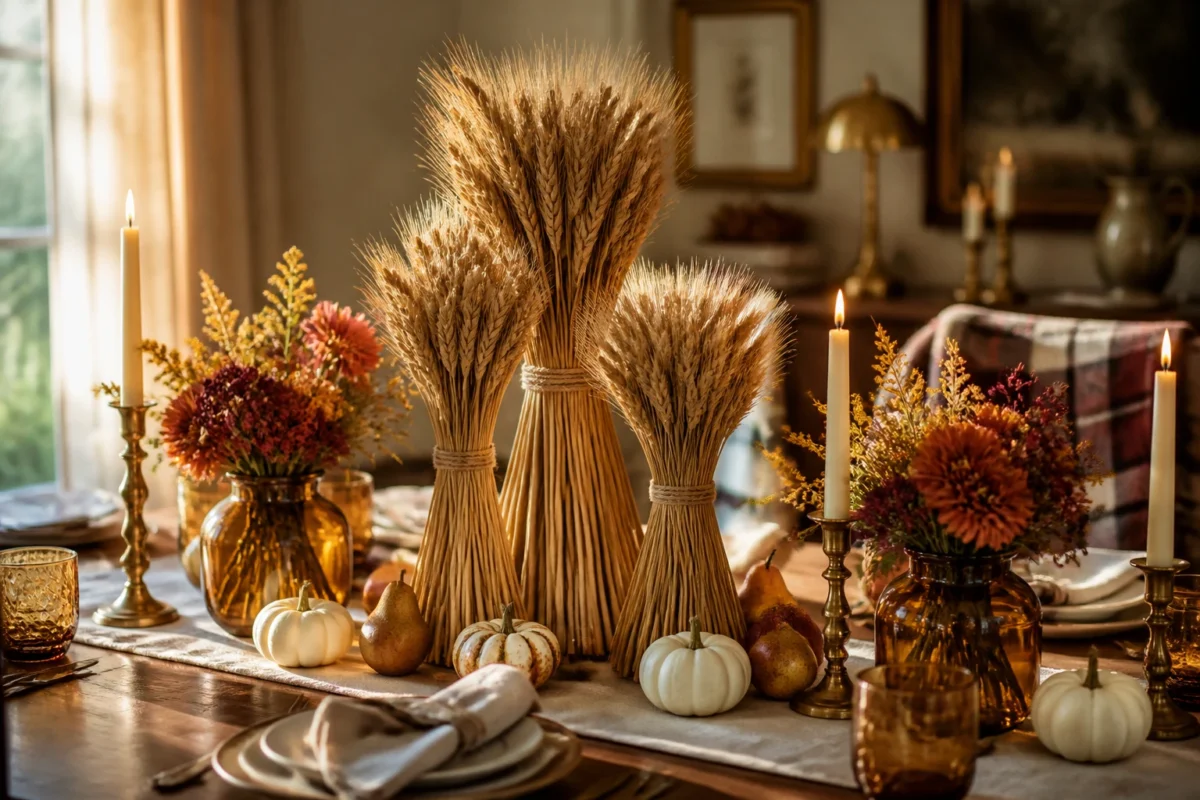
Each idea stays indoors and uses the good stuff: dried blooms, wheat, seasonal fruit, candles, soft textiles, and sculptural vessels. We’re talking amber glow, plaid layers, brass accents, and those dreamy, photogenic scenes that make Pinterest boards jealous. If you love a home that feels finished from September through Thanksgiving, this collection is your new fall playbook—abundant, warm, and very achievable.
1) Wheat Sheaf Trio With Amber Glass On The Dining Table
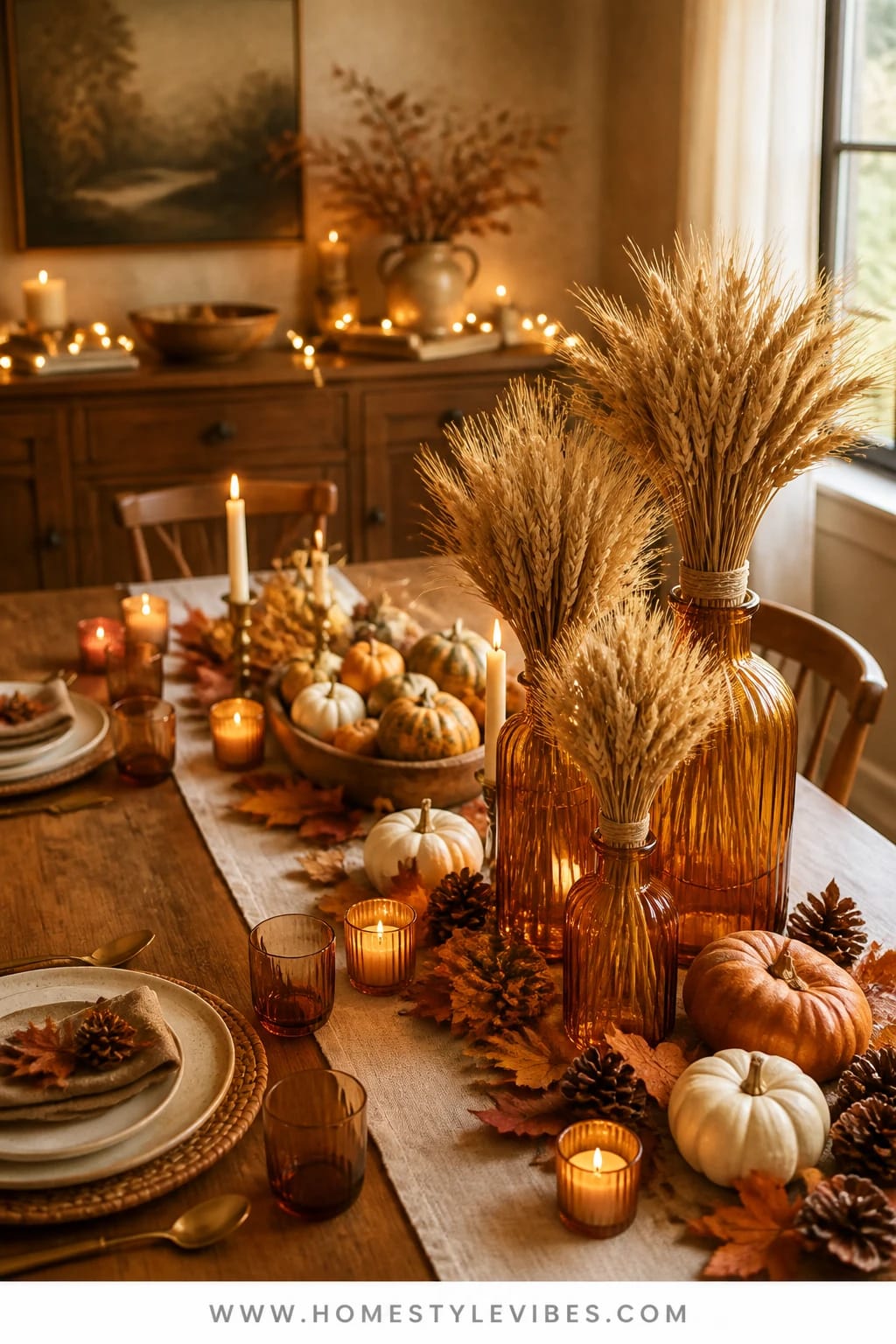
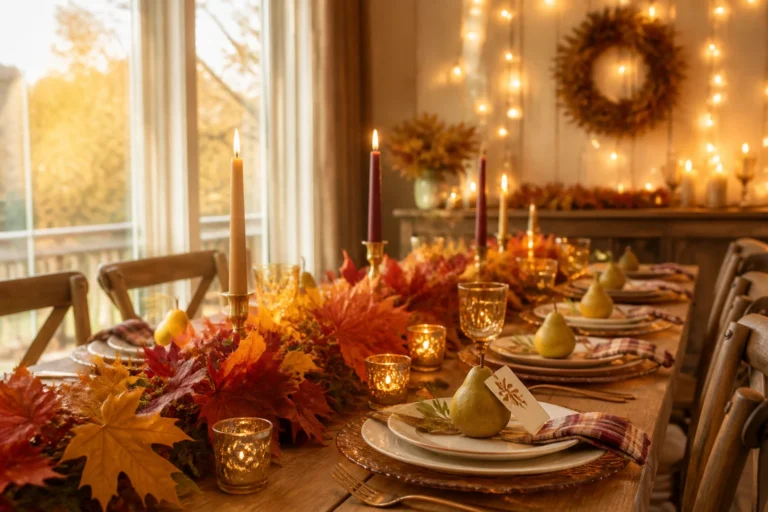
We’ve all been there: a beautiful dining room that somehow looks bare once summer lilies are gone. You’ve tried a single vase, but it just disappears on a long table. This wheat sheaf trio solves the “scale and presence” problem while bringing that golden, cozy bright autumn glow to center stage. A cluster of tied wheat bundles in staggered heights set in amber glass creates a low, candle-friendly centerpiece that feels lush without blocking faces during dinner.
It works because wheat gives instant height and volume, and amber glass amplifies candlelight into a honeyed, photogenic glow. In real homes, it’s practical—no water, no drooping stems, and easy to store for next year. Lighting is key here: late-afternoon light through a window warms the wheat, and a handful of votives add sparkle. The palette leans warm—caramel, rust, soft brown—with a little brass somewhere to nod to tradition. Photos love the repetition of form (three sheaves), the tonal glow of amber, and the texture-on-texture story that reads rich in a single shot.
Variations: For a budget version, use two wheat sheaves and a third element like a low wooden bowl of pears. For small tables, downsize to mini sheaves tied with velvet ribbon and one petite amber vase. Prefer a quieter look? Swap the amber glass for clear glass and keep the ribbon tones in oatmeal or taupe.
Budget Breakdown:
- Dried wheat sheaves (3 bundles): $24–$48 total
- Amber glass vases or bottles (3): $30–$60
- Velvet or twill ribbon: $6–$12
- Tea lights or votives (unscented): $6–$15
- Brass or wood tray (optional): $18–$40
Total Estimated Cost: $66 – $175
Best For: A long dining table in an open-plan home; perfect from early September through Thanksgiving, especially if you host weekly family meals and want centerpieces that stay fresh.
Key Design Elements:
- Main seasonal props: Wheat sheaves, dried bunny tails, amber glass bottles
- Color palette: Caramel, rust, chestnut, soft gold
- Lighting strategy: Window light by day; tea lights and low votives by night for an amber glow
- Textile layers: Simple linen runner, plaid napkins, soft rust table accents
- Natural elements: Bosc pears, dried seed pods as bowl fillers
- Accent details: Thin brass ribbon or twine, small wooden tray to ground the trio
How To Recreate This Look:
- Start with a runner in oatmeal or flax to visually anchor the centerpiece.
- Add three amber glass vessels in staggered heights—think small, medium, tall.
- Layer in wheat sheaves: tie tightly at the waist with velvet or twill ribbon.
- Place two sheaves inside vases and one standing independently, secured with a clear elastic at the base if needed.
- Style with a ring of votives and a small bowl of pears or acorns at one end for asymmetry.
Why This Looks Expensive: Restrained color, repeated forms, and natural materials read intentional and classic. The amber glass acts like jewelry—subtle shine without shouting.
Watch Out: Skip heavily scented candles at the table. They clash with dinner and make the arrangement feel more gift-shop than gathered home.
Pro Styling Tip: Place the tallest sheaf slightly off-center so the camera catches layered heights and candle reflections in the amber glass—instant depth.
2) Rust Hydrangea And Wheat In A Brass Urn On The Mantel
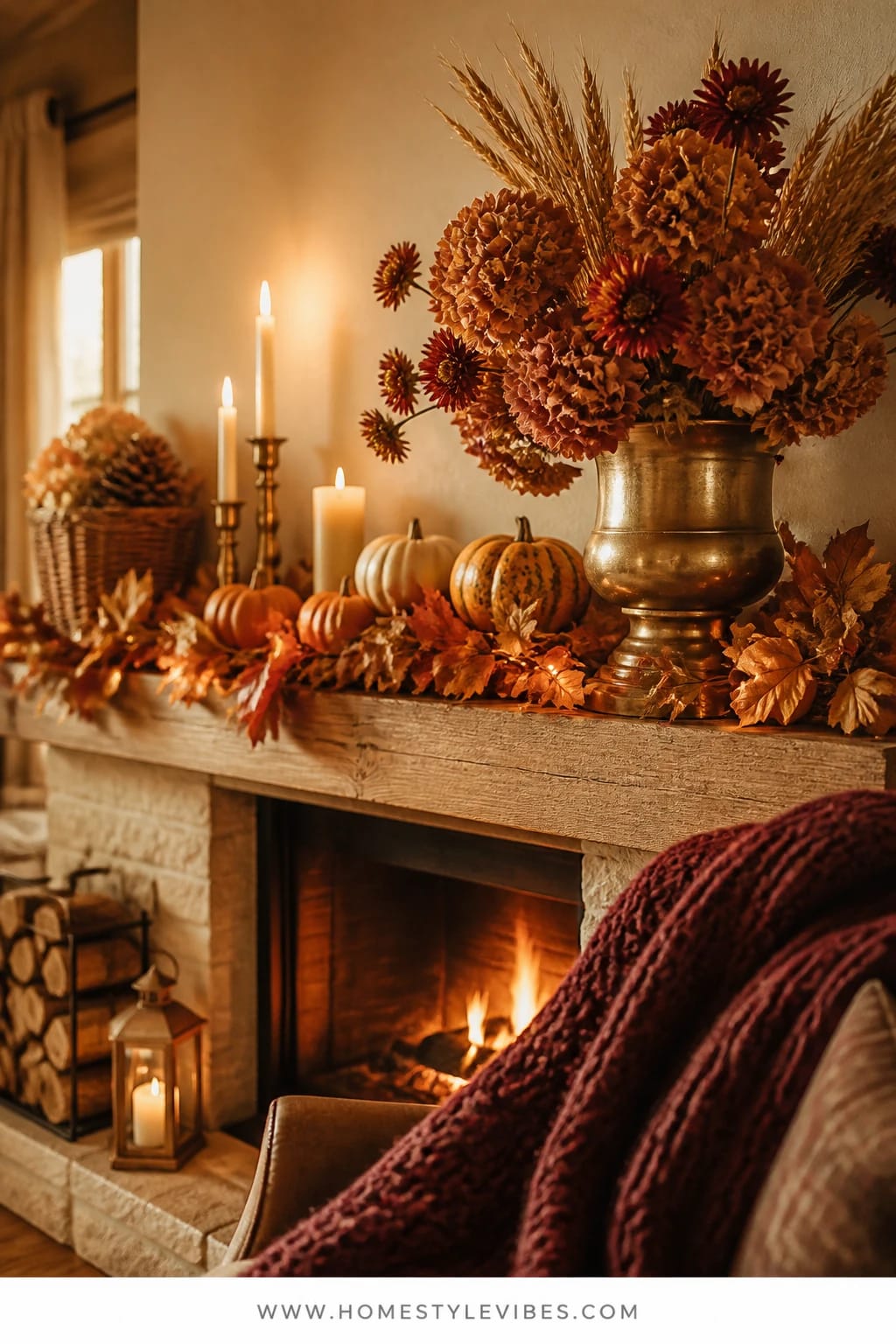
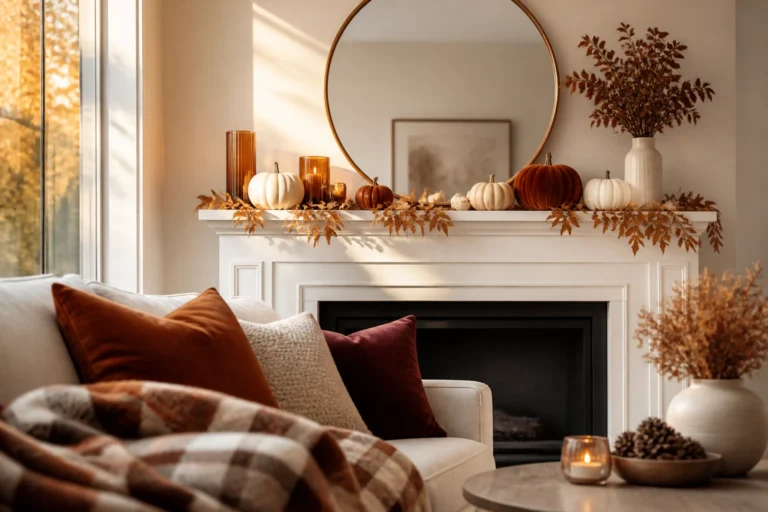
It’s that one mantel that always feels flat after summer art gets swapped. You’ve tried a garland, but it never sits right and your candlesticks look like tiny soldiers. A generous brass urn filled with dried rust hydrangea, wheat stems, and burgundy strawflower gives the drama you need—sculptural, tall, and rich in texture without looking busy. It’s the cozy bright autumn mood, anchored in warm metallics and saturated florals.
This works in real homes because it’s station-keeping: one big anchored arrangement, then a supporting cast (two taper candles, a stack of vintage books, maybe a mini pumpkin). The light story here matters—mantels flourish under lamp light and candle glow, so the brass urn catches warm highlights that make everything look editorial. The arrangement photographs beautifully because the hydrangea create volume, wheat adds height, and deep rust/burgundy provide color saturation against a painted wall or stone surround.
Variations: For a more neutral look, choose buff hydrangea with pale wheat and white tapers. For a tight budget, thrift the urn and use fewer blooms, focusing on an asymmetrical silhouette with the wheat reaching high on one side.
Budget Breakdown:
- Vintage or reproduction brass urn: $35–$120
- Dried hydrangea (rust/burgundy) 5–7 heads: $25–$50
- Wheat stems bundle: $8–$15
- Strawflower or amaranth accents: $10–$20
- Pair of brass candlesticks + tapers: $20–$50
Total Estimated Cost: $98 – $255
Best For: Living rooms with a fireplace focal point; ideal for anyone who wants one high-impact piece that carries the room through Halloween to Thanksgiving.
Key Design Elements:
- Main seasonal props: Dried hydrangea, wheat, strawflower, mini pumpkin accent
- Color palette: Rust, burgundy, camel, antique brass
- Lighting strategy: Table lamp glow on the hearth, golden candlelight at dusk
- Textile layers: Wool throw on a nearby chair, plaid pillow for a color echo
- Natural elements: A single gourd or dried pomegranate cluster
- Accent details: Stacked books with rich-toned spines, brass snuffer on display
How To Recreate This Look:
- Start by placing the urn slightly off-center on the mantel to create movement.
- Add 3–4 hydrangea heads to establish the arrangement’s “mass.”
- Layer wheat at varying heights, keeping the tallest stems toward the back corner.
- Tuck in strawflower for saturated burgundy notes near the front.
- Style with two candlesticks on the opposite side and a small pumpkin or book stack to balance weight.
Why This Feels Designer: The asymmetry looks artful, and the brass urn adds age and patina—instant authority in a room.
One Thing To Avoid: Don’t push the urn flat against the wall. Give it 1–2 inches of breathing space so stems can fan and shadows can play.
Pro Styling Tip: Angle the urn 10–15 degrees toward the room; cameras (and eyes) pick up more hydrangea face and less stem chaos.
Curious how to make dried florals feel lush, not dusty? Keep reading—the next idea solves the “too wispy” problem with confident color and generous layering.
3) Burgundy Dried Roses And Wheat In An Amber Carafe On The Kitchen Island
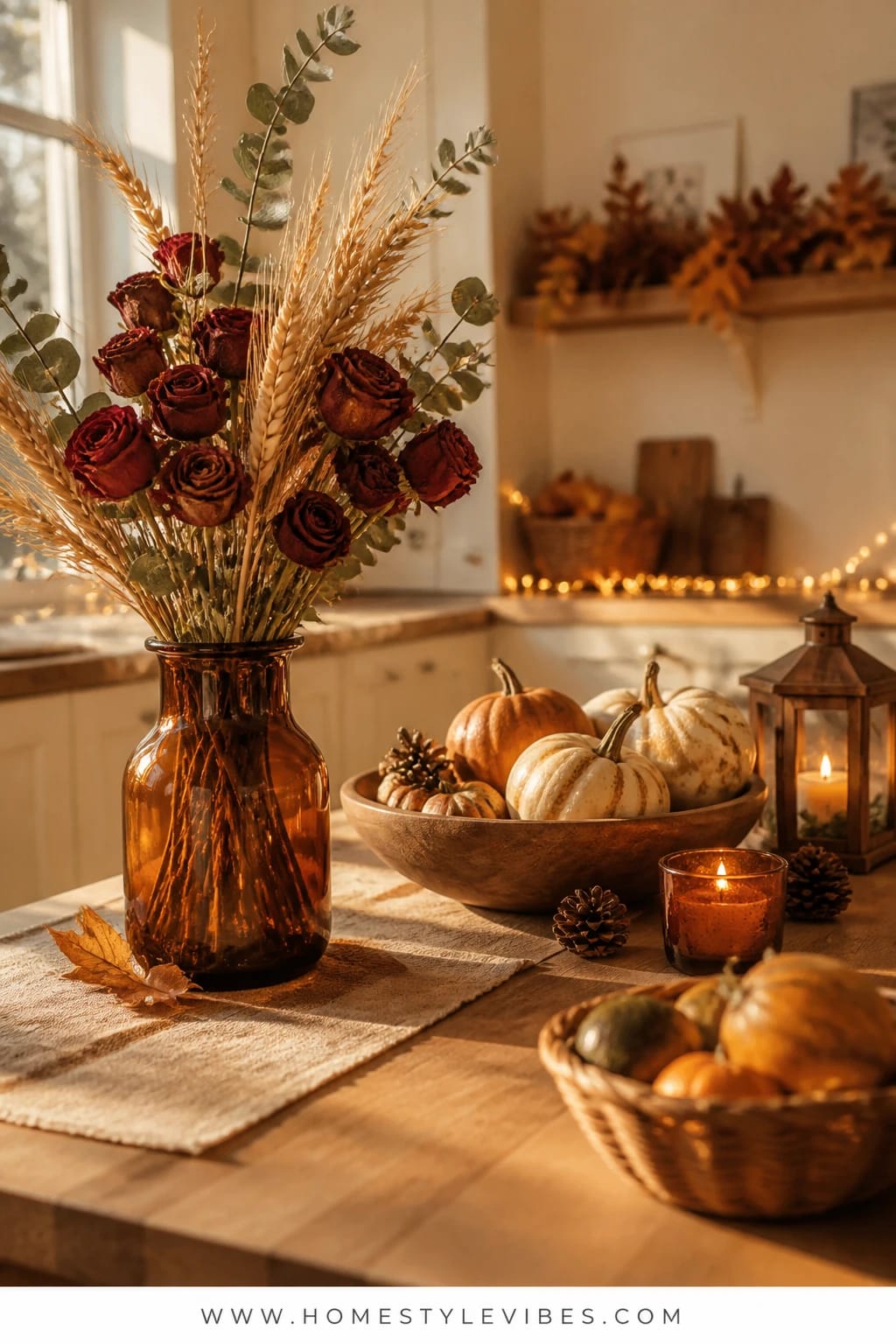
Open kitchens look beautiful but eat small decor alive. You set a tiny vase on the island and it vanishes between the fruit bowl and your mail pile. A grounded amber carafe filled with dried burgundy roses, wheat stems, and sprigs of eucalyptus delivers rich autumn color and tactile contrast right where life happens. The cozy bright autumn vibe shines here—warmth, a little romance, and zero fuss.
Why it works: the amber carafe has weight and presence without getting in the way of chopping or homework. The burgundy roses carry saturated color across a big visual field, and the wheat adds lift. Under warm pendants, the amber glass pools with light so the whole thing glows at night. It photographs well because the carafe silhouette is simple, the palette is deep and balanced, and the rose heads read clearly from across the room.
Variations: If you cook daily and need to move things easily, set the arrangement on a round wooden board beside a woven trivet. For a lighter look, use rose hips and paler bunny tails with the wheat and keep the carafe clear instead of amber.
Budget Breakdown:
- Amber glass carafe or wide bottle: $20–$40
- Dried burgundy roses (1–2 small bundles): $18–$36
- Wheat stems: $8–$15
- Dried eucalyptus or olive: $10–$18
- Wood board or lazy susan (optional): $15–$35
Total Estimated Cost: $56 – $144
Best For: Busy kitchens with pendant lighting; families who need beauty that can slide aside for a baking session in two seconds.
Key Design Elements:
- Main seasonal props: Dried roses, wheat, eucalyptus
- Color palette: Deep burgundy, amber, warm wood, soft green
- Lighting strategy: Warm pendants overhead, a nearby sconce or candle at night
- Textile layers: Copper or linen tea towels, rust-striped runner on the island
- Natural elements: A wooden fruit bowl with apples or pears
- Accent details: Small brass salt cellar or honey pot nearby for a cohesive vignette
How To Recreate This Look:
- Start with a clean surface and place a wooden board to define the vignette’s footprint.
- Set your amber carafe at the back-left corner of the board to allow workspace in front.
- Add rose stems first to create the color “heart,” keeping some heads slightly lower for depth.
- Layer wheat around and above the roses to lift the gaze.
- Tuck in eucalyptus near the back and one or two pieces toward the front for movement.
Why This Reads High-End: The palette is tight and grown-up, and the carafe shape looks intentional—not like a repurposed soda bottle. Less noise, more statement.
The Most Common Mistake: Overfilling until the roses get lost. Leave air between stems so each note—burgundy, wheat, green—shows clearly.
Pro Styling Tip: Photograph from a stool-height angle so pendant reflections sparkle on the amber glass and the roses pop against cabinetry.
Remember, this isn’t about recreating a showroom. It’s about building scenes that feel like you—warm, a touch old-soul, and easy to live with. If one idea jumps out, start there and let the others wait. You don’t need everything at once.
4) Pampas, Wheat, And Marigold Tint In A Stoneware Pitcher On The Entry Console
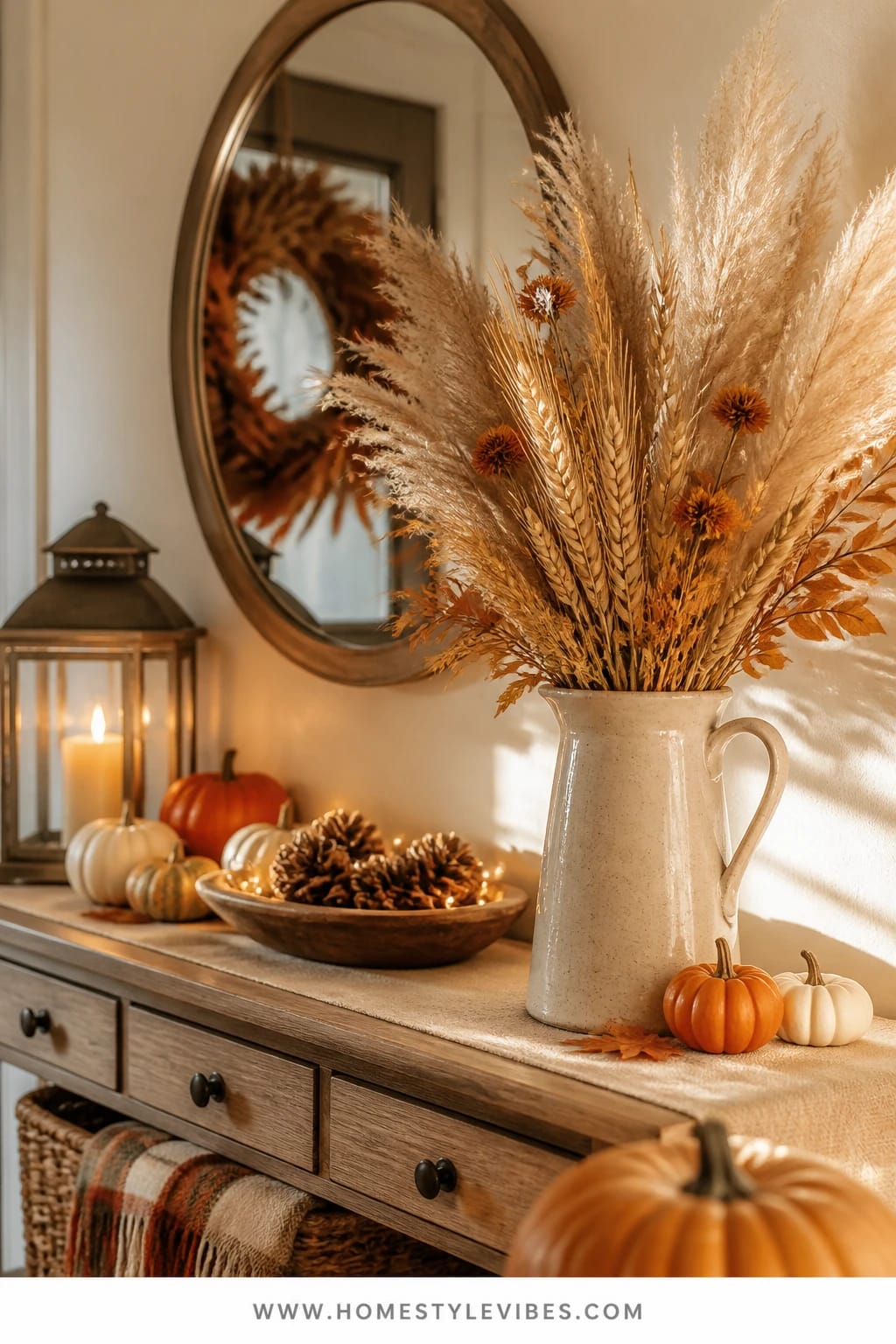
That first surface guests see—the entry console—can skew cluttered fast: keys, sunglasses, mail avalanche. You’ve tried a small vase, but it drowns beside the catchall. A tall stoneware pitcher packed with feathery pampas, golden wheat, and a hint of dried marigold or safflower claims the vertical space and welcomes with that cheerful, cozy bright autumn hello. It feels like stepping into candlelight even in daylight.
Real-life win: the pitcher’s handle makes relocation easy for deep cleaning days, and pampas plus wheat are nearly indestructible with regular comings and goings. Lighting-wise, this setup loves a table lamp on a dimmer—soft pools of light catching those feathery plumes. Photographs adore the gradient from creamy pampas to wheat to tiny hits of marigold. It reads airier than the previous sections, perfect for smaller entries where a heavy urn might overwhelm.
Variations: Prefer a neutral minimal twist? Skip marigold, keep pampas and wheat, add a pale linen runner beneath. For a budget version, use tall foraged grasses mixed with purchased wheat for just a little spend and lots of height.
Budget Breakdown:
- Stoneware or ceramic pitcher: $25–$60
- Pampas stems (5–7): $20–$45
- Wheat stems: $8–$15
- Dried marigold/safflower: $8–$16
- Shallow catchall bowl (optional): $12–$28
Total Estimated Cost: $73 – $164
Best For: Narrow entry consoles or long hallway drop zones; great if you love height and softness without a ton of color.
Key Design Elements:
- Main seasonal props: Pampas, wheat, marigold/safflower
- Color palette: Cream, pale wheat, honey gold, warm stone
- Lighting strategy: Entry table lamp on a dimmer, possibly a candle in a hurricane for safety
- Textile layers: Slim runner, basket underneath for scarves
- Natural elements: Bowl of acorns or a small gourd cluster to the side
- Accent details: Ceramic tray for keys, matte brass picture frame behind
How To Recreate This Look:
- Start by centering a linen runner on the console to prevent scratches and define the arrangement zone.
- Place the stoneware pitcher on the rear third for height without blocking eye contact.
- Add pampas first, fanning slightly to form a soft arch.
- Insert wheat at varied heights inside the arch for structure.
- Tuck in small marigold/safflower clusters low and forward for a pop that reads at eye level.
Why This Looks Intentional: The interplay of textures—feather, grain, and petal—feels curated, not random. The stoneware body grounds the lightness up top.
Don’t Do This: Avoid mixing pampas colors wildly. Stick to one tone (cream or beige) so the entry doesn’t feel chaotic the second the door opens.
Pro Styling Tip: Angle your table lamp so the bulb doesn’t show directly—let the shade cast a warm cone over the pampas tips for a halo effect in photos.
5) Dried Citrus And Wheat Garland With Copper Accents On The Bookshelf
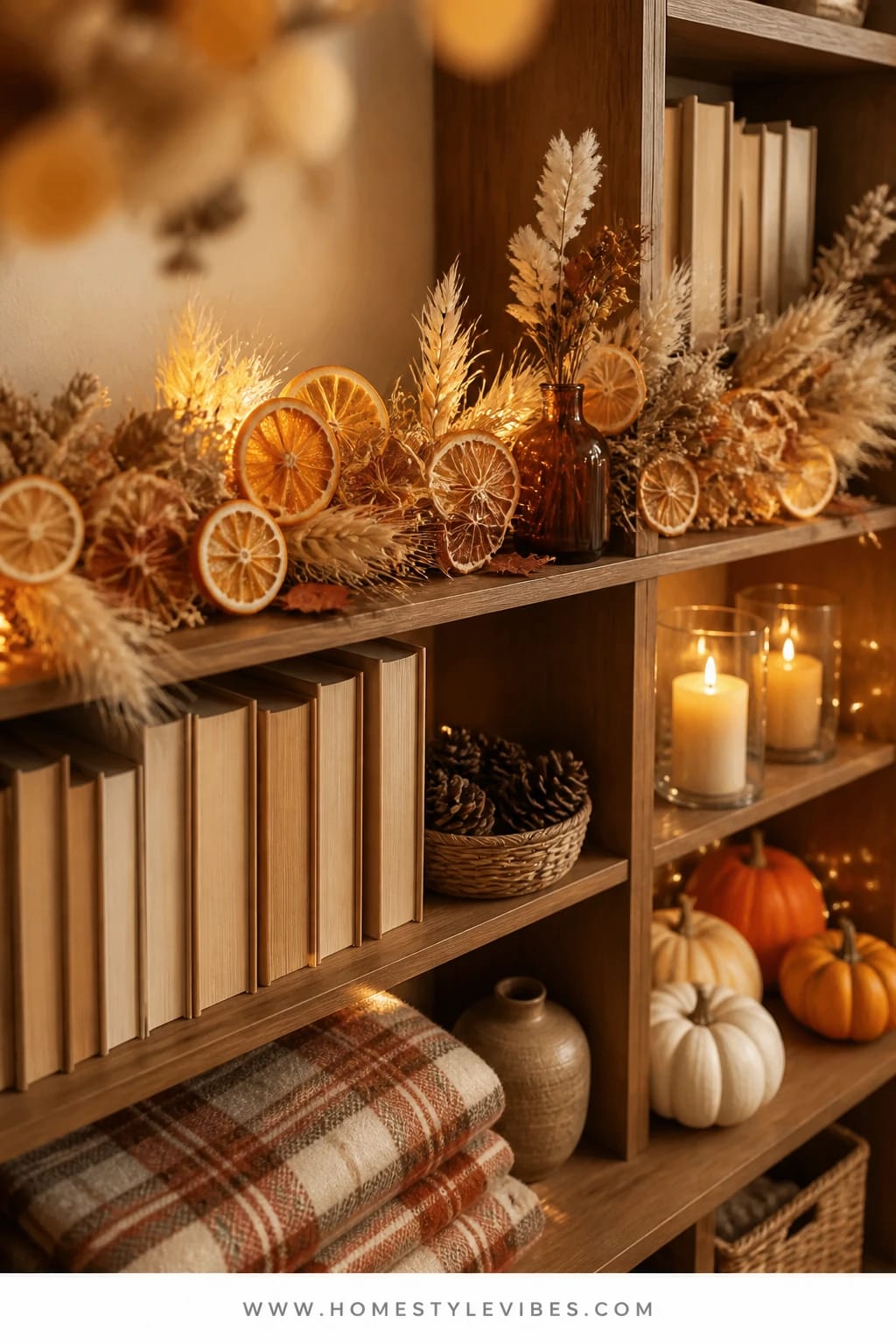
Open shelves get tricky in fall. You add a pumpkin or two and suddenly everything looks like a craft store exploded. The fix is linear: a dried citrus-and-wheat garland woven along a single shelf, accented with small copper pieces and a handful of dried florals in bud vases. It draws the eye side to side, simplifies your styling decisions, and brings that amber, cozy bright autumn vibe in a sophisticated, tailored way.
This works because bookshelves love line and rhythm. The garland acts like a runway for your eye, and the dried oranges echo candlelight even when unlit. Wheat bristles add texture without bulk, and a couple of petite vases with strawflower or marigold punctuate the run like commas. Under a picture light or a nearby floor lamp, the copper and dried citrus catch glints, which photograph beautifully—warm speckles in a sea of matte paper and wood.
Variations: Keep it monochrome with dried lemon slices and bleached wheat for a softer scheme. Or, push the harvest vibe by tucking in cinnamon sticks and tiny pinecones at intervals. If your shelves are dark, choose lighter citrus and a pale garland twine to stand out.
Budget Breakdown:
- Pre-made dried citrus garland or DIY kit: $18–$35
- Wheat stems (cut into short bundles): $8–$15
- Mini copper vessels or votive cups (2–3): $15–$30
- Small bud vases (clear or amber): $12–$25
- Strawflower or marigold bundle: $10–$20
Total Estimated Cost: $63 – $125
Best For: Living rooms or studies with styled shelving; ideal if you like a collected, layered look that still feels tidy.
Key Design Elements:
- Main seasonal props: Dried citrus garland, wheat cuts, strawflower buds
- Color palette: Amber, copper, soft wheat, rust
- Lighting strategy: Picture light over shelves or a nearby lamp to create highlights
- Textile layers: A folded plaid throw on the bottom shelf for a soft echo
- Natural elements: Cinnamon sticks, tiny pinecones (optional)
- Accent details: Copper votives, small framed art leaning behind
How To Recreate This Look:
- Start by clearing one shelf to be the “feature” line.
- Add the garland, letting it dip once or twice for graceful curves.
- Cut wheat into 5–6 inch minis and tuck them behind citrus slices at intervals.
- Place two bud vases along the run with 1–2 stems each for punctuation.
- Finish with small copper pieces staggered between books and the garland.
Why This Looks Expensive: Purposeful repetition and a single horizontal gesture tame the visual noise. The copper reads like a subtle metallic thread woven through the story.
Watch Out: Don’t scatter mini pumpkins randomly on multiple shelves; confine them to one shelf or one side so the eye gets rest.
Pro Styling Tip: Pull a few books forward by a half inch near the garland to add micro-shadow and depth in photos—it’s a tiny trick with big impact.
Little reminder: if a shelf or mantel overwhelms you, think in “lines”—a single runner of texture, a trio of verticals, or a cluster of threes. Structure calms the styling brain and makes quick decisions easier.
6) Harvest Bowl With Wheat, Dried Pomegranates, And Velvet Pumpkins On The Coffee Table
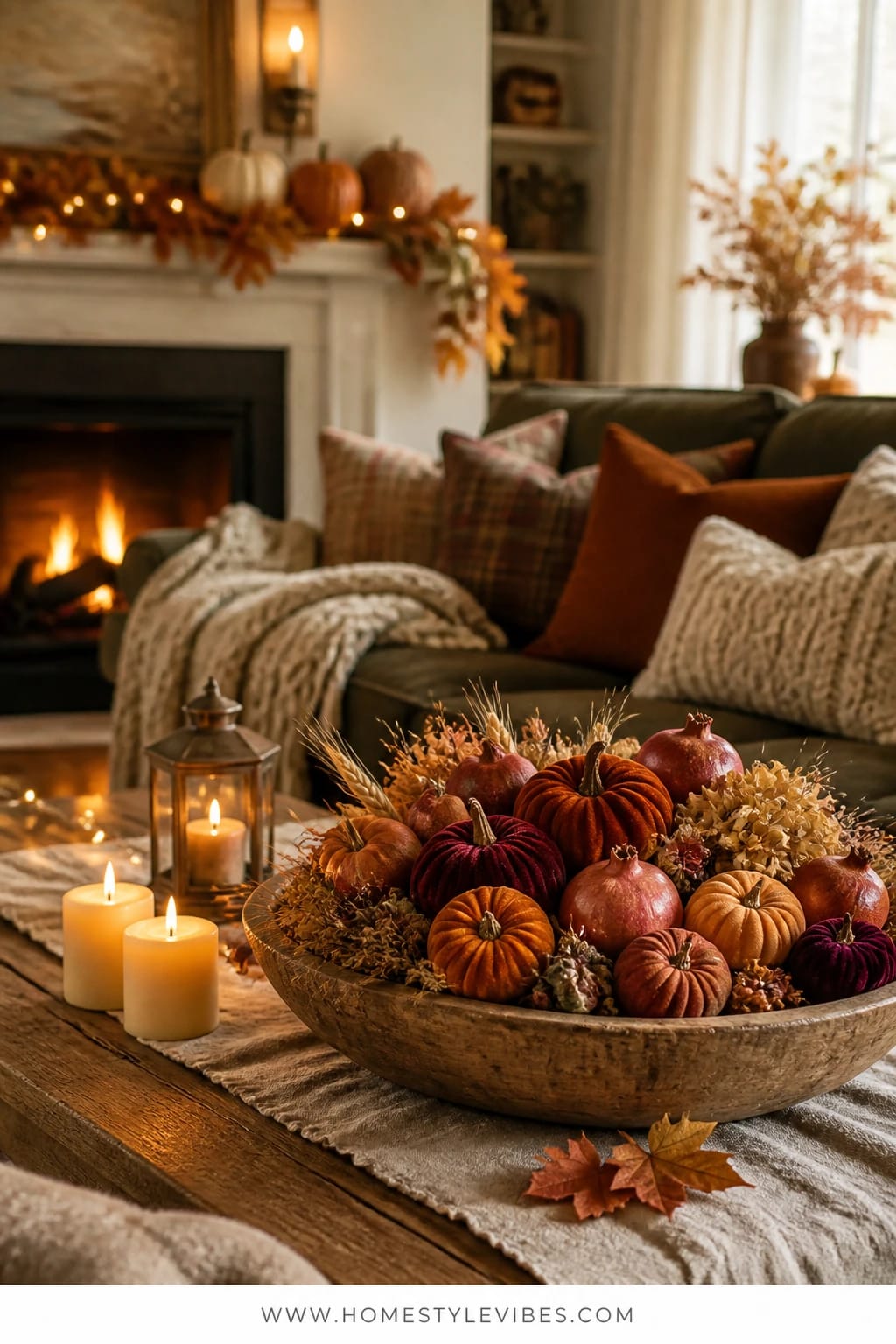
Popular living room problem: the coffee table becomes a remote graveyard. You add a tray and a candle, and it still looks like a waiting room. A low, wide harvest bowl piled with wheat stubs, dried pomegranates, velvet pumpkins, and a few dried florals solves it with lush, cozy bright autumn abundance—rich color, soft texture, and a centerpiece that invites hands to reach for cocoa and conversation.
Here’s why it works: coffee tables need breadth more than height. The bowl spreads color and texture across the center while keeping sightlines open to the TV or fireplace. Lighting loves this: lamps on side tables skim across velvet pumpkins, and a single candle in a hurricane placed nearby adds that flickering warmth. Photographs adore the layered feel—plush velvet next to the papery rustle of wheat and the leathery sheen of dried pomegranates.
I tried a version of this last October on my own table after an embarrassing run of “random candles and coasters,” and I couldn’t believe how finished the room felt. Even better, my kid started using the tray under the bowl for crayons instead of the entire couch. Wins all around.
Variations: If you prefer a neutral look, choose ivory velvet pumpkins and bleached wheat with dried white florals. For small tables, use a shallower bowl and keep the palette to two notes—say, rust pumpkins and wheat only—to avoid crowding.
Budget Breakdown:
- Low wide bowl or dough bowl: $28–$85
- Velvet pumpkins (3–5 assorted sizes): $24–$60
- Dried pomegranates or faux realistic versions (3–5): $15–$40
- Wheat stubs (leftovers cut short): $0–$8
- Dried florals (strawflower, craspedia, or marigold clusters): $10–$20
- Hurricane candle (optional): $18–$35
Total Estimated Cost: $77 – $240
Best For: Family rooms where the coffee table needs presence without height; excellent from early October through Thanksgiving weekend snacks-and-movies season.
Key Design Elements:
- Main seasonal props: Velvet pumpkins, dried pomegranates, wheat stubs, small florals
- Color palette: Rust, burgundy, wheat, warm wood
- Lighting strategy: Side-table lamps, one hurricane candle for safe glow
- Textile layers: Chunky knit throw on the sofa, plaid pillow with rust stripe
- Natural elements: Real dried fruit for authentic color variation
- Accent details: A leather or wood tray under the bowl to contain remotes
How To Recreate This Look:
- Start with a tray to define a neat zone on the coffee table.
- Place the low bowl slightly off-center so some tray space remains usable.
- Add velvet pumpkins first—largest slightly off-center, then medium, then small.
- Tuck in dried pomegranates at the base points where pumpkins meet for structure.
- Fill gaps with short wheat stubs and 3–5 floral clusters, keeping colors balanced.
Why This Looks Expensive: A single, generous vessel with curated textures (velvet, dried fruit, grain) signals “collected” rather than “last-minute.” The varied finishes catch lamp light like jewelry.
One Thing To Avoid: Don’t overshoot the bowl’s rim by more than 2 inches. Tall elements feel pokey at sofa height and risk getting bumped during snack time.
Pro Styling Tip: For photos, rotate the bowl until the smallest pumpkin sits front-left; it creates a visual on-ramp that guides the eye into the arrangement.
Honest moment: arranging dried stems can feel fiddly. Some pieces shed, a few are bent, and not every color combo sings in every room. The secret isn’t perfection—it’s intention. Choose one palette, repeat it, and let the light do the heavy lifting.
Quick Checklist
- Dried wheat bundles (regular and bleached)
- Dried hydrangea in rust or burgundy
- Dried roses or strawflower for saturated color
- Pampas stems in a single tone
- Amber glass vessels (bottles, carafes, vases)
- Stoneware pitcher with a handle
- Brass or antique-finish urn
- Velvet pumpkins in mixed sizes
- Dried pomegranates or realistic faux
- Dried citrus garland or slices
- Bud vases for punctuation stems
- Tea lights and unscented tapers
- Linen runner for table or console
- Wood or leather tray to corral items
- Ribbon (velvet or twill) for tying sheaves
- Sharp garden snips for clean cuts
- Hairspray to tame pampas shedding
- Copper accents: votives or mini cups
- Picture light or lamp on a dimmer
- Apples, pears, acorns for natural fillers
Frequently Asked Questions
How do I keep the cost reasonable if I want multiple dried flower and wheat stem arrangements?
Pick one anchor vessel per room and repeat stems across spaces. Buy wheat and strawflower in bulk, then split them among your dining table, mantel, and a bud vase or two. Thrift brass or stoneware, and use fruit (apples, pears, pomegranates) to fill volume affordably. Aim for one splurge (like a brass urn) and keep other pieces simple.
Are real dried florals better than faux for these fall looks?
IMO, real dried florals win for texture and color nuance—especially wheat, hydrangea, and roses. That said, a few high-quality faux pieces (like velvet pumpkins or faux pomegranates) mix in seamlessly. If you go faux for stems, choose matte finishes and avoid overly glossy leaves.
I live in a small home—will these arrangements overwhelm my space?
Scale is your friend. Choose shorter wheat cuts, mini sheaves, and smaller vessels. Anchor with a tray so the composition reads as one object, not clutter. Focus on two colors max and keep arrangements low on coffee tables and a single tall moment on the entry console or mantel.
What about storage after the season—how do I keep dried florals from getting crushed?
Use tall, narrow boxes (wine shippers are great) for stems and a shallow bin for pumpkins and citrus garlands. Wrap hydrangea heads loosely in tissue and label by color. Keep the box upright and store in a dry closet away from heat vents to avoid brittle breakage.
Are candles safe around dried florals, kids, and pets?
Use unscented tea lights in glass holders and keep open flames at least 6 inches from stems. For extra safety, use LED tapers or place real candles under hurricanes. With pets or toddlers, position candles on higher shelves or mantels only and skip anything within tail range.
When should I start decorating with dried flower and wheat stem arrangements?
Start in early September with wheat and neutral elements. Layer in color—burgundy, rust, citrus—by late September. Add pumpkins by early October. This pacing keeps things feeling fresh and seasonal through Thanksgiving without constant redoing.
My mantel gets direct sun—will the dried flowers fade?
Yes, strong sunlight lightens color. Rotate your arrangement weekly and angle it slightly away from the brightest spot. Choose deeper tones (burgundy, rust) there since they fade more gracefully, and reserve neutrals for shaded corners.
Wrap-Up: Set The Tone With Warmth, Light, And Abundance
Start with one moment. Maybe it’s the wheat sheaf trio on your dining table or the amber carafe on your kitchen island. Build a simple palette—wheat, rust, burgundy—and repeat it with confidence. Let warm light do its quiet magic, catching brass edges and the soft nap of velvet pumpkins.
Cozy bright autumn thrives on layers, glow, and the honest textures of harvest—grain heads that whisper when you pass, dried petals that look richer at dusk, a bowl of fruit that shifts with the week’s groceries. These six dried flower and wheat stem arrangement ideas aren’t just decor moves; they solve the everyday frustrations of flat surfaces and empty corners and make rooms actually feel finished from September to Thanksgiving.
Ready? Pick your favorite idea, pour a mug of something cinnamon-y, and give yourself 30 minutes. Trust me—you’ve got this, and your home is about to look like the warm hug you’ve been craving all season.

About the Author

Krisztina P.Rendes, Founder of Home Style Vibes
Founder of Home Style Vibes
Krisztina Puskásné Rendes created Home Style Vibes as a cozy-modern lifestyle space where homemaking meets inspiration. Her goal is to help women create beautiful, organized, and peaceful homes they truly love — without overwhelm. You’ll find here heart-driven content on home decor, cleaning tips, easy family recipes, organization and decluttering, DIY home projects, plants, and seasonal ideas — all designed to bring more calm, comfort, and style into everyday life.