6 Best Laundry Room Ideas for Small Spaces That Maximize Every Inch Now Tricks
You want a laundry room that calms your nervous system: soft light, a clean counter to fold on, baskets that actually hide the chaos. But you hate the tangle of cords, the sad builder shelf, and how your detergent bottle photobombs every photo. You crave a refined, quietly beautiful nook that works hard in a tiny footprint—and yes, looks Pinterest-famous. These 6 laundry room ideas for small spaces will fix the mess and finesse your style with smart layout, tactile finishes, and lighting that flatters.
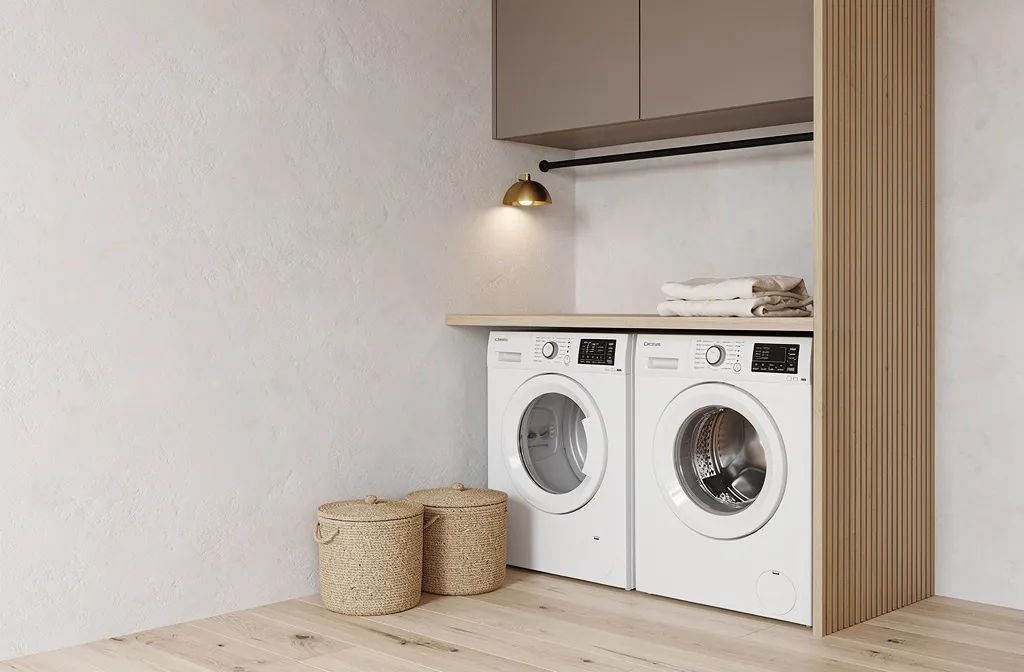
We’ll keep each design doable with materials you can source this weekend and a budget cap that won’t make you mutter. Think layered textures, smart storage, and details that look bespoke even on a $500–$2,500 budget. In two weeks or less, you can turn a fussy corner into an efficient, serene zone that photographs like a boutique hotel back-of-house—only softer, friendlier, more you. If you love clean lines with soul and a space that works as hard as you do, read on.
1. Slimline Scandinavian Nook With Hidden Rails + Pocket Ledges
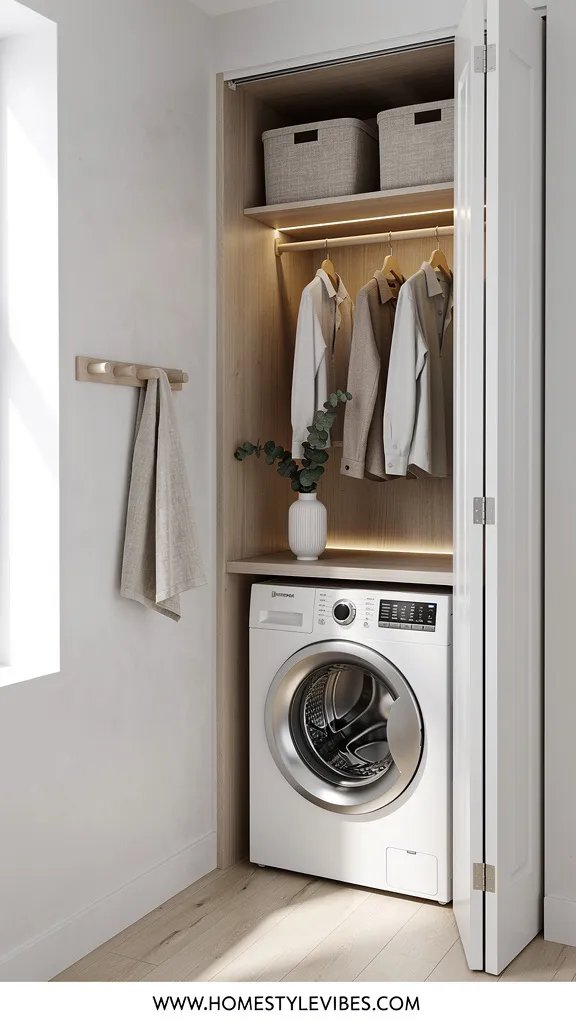
We’ve all been there: the narrow laundry closet behind bifold doors that never slide right, plus nowhere to hang shirts besides the shower rod. You’ve tried bins, but it still looks cluttered and feels like a utility cave. This setup creates a calm, airy Scandinavian mood using warm wood, hidden rails, and a shallow counter that gives you just enough workspace without swallowing floor area.
The vibe is soft Nordic: matte white, pale ash wood, and linen-textured baskets. It works in real homes because everything is shallow—think 10-inch pocket shelves, a 14-inch-deep counter, and a hidden hanging rail under the shelf. That slim profile keeps the room breathable while giving you zones: fold, hang, corral. LED tape tucked beneath the shelf casts a gentle wash over the machines—no harsh shadows, just a flattering glow. The surface mix—satin cabinet fronts, brushed stainless hardware, cotton rope baskets—photographs beautifully because you’ve got contrast (white vs. warm wood), texture (linen, cane, brushed metal), and that luminous shelf light.
Variations? Go budget-friendly with a pine shelf you stain honey and an extendable tension rod for the rail. For renters, use stick-on wall hooks with wooden dowels to mimic a rail. Prefer a darker version? Swap the white for mushroom gray fronts and walnut shelves; add a warm 2700K LED to keep it cozy, not cave-like.
Budget Breakdown:
- Prefinished wood shelf + 10-inch brackets: $80–$160
- Matte cabinet fronts on stock boxes (or shelf doors): $200–$450
- Hidden hanging rail (closet rod + flanges): $30–$70
- LED tape + driver + diffuser: $60–$120
- Linen or rope baskets (set of 4): $40–$120
- Countertop (laminate or birch slab, 14-inch depth): $90–$220
- Brushed metal hardware: $25–$60
Total Estimated Cost: $525 – $1,200
Best For: Narrow laundry closets or alcoves, 36–60 inches wide. Ideal for minimalists, renters (with small swaps), and anyone who folds on top of the washer.
Key Design Elements:
- Main materials: Ash or birch wood, matte laminate, brushed stainless
- Color palette: Soft white, warm wood, oatmeal, pale gray
- Lighting strategy: Under-shelf LED tape with diffuser; warm temperature (2700–3000K)
- Furniture silhouettes: Slim shelves, slab cabinet doors, low-profile rail
- Texture layers: Linen baskets, ribbed ceramic jar for pods, cotton runner
- Accent details (hardware, decor pieces, plants): Slim pulls, a trailing pothos, one framed line drawing
How To Recreate This Look:
- Start with paint: a soft white with low sheen to bounce light (FYI, satin reads calmer than semi-gloss under LEDs).
- Add a 14-inch-deep counter over front loaders or a freestanding slim slab over top-loaders (hinge for access if needed).
- Layer a 10-inch wood shelf above with LED tape hidden behind a diffuser channel on the underside.
- Install a closet rod under the shelf to create a hanging rail for drip-dry or quick steams.
- Style with 2–3 lidded linen baskets, a neutral runner, and one simple art piece to soften the lines.
Why This Looks Expensive: The linear light wash and unified matte fronts read custom, while the hidden rail and tight color palette eliminate visual noise. It’s restraint that whispers “built-in.”
Watch Out: Don’t mount the shelf too high. Keep 12–14 inches above your tallest detergent container so you actually use it. And choose an LED with a CRI of 90+ so whites don’t look dingy.
Pro Styling Tip: Angle the baskets slightly and stagger heights (plant, art, canister) to create depth that photographs with soft shadow play across the wood grain.
2. Vertical Pantry-Laundry Hybrid With Fluted Doors + Rolling Cart
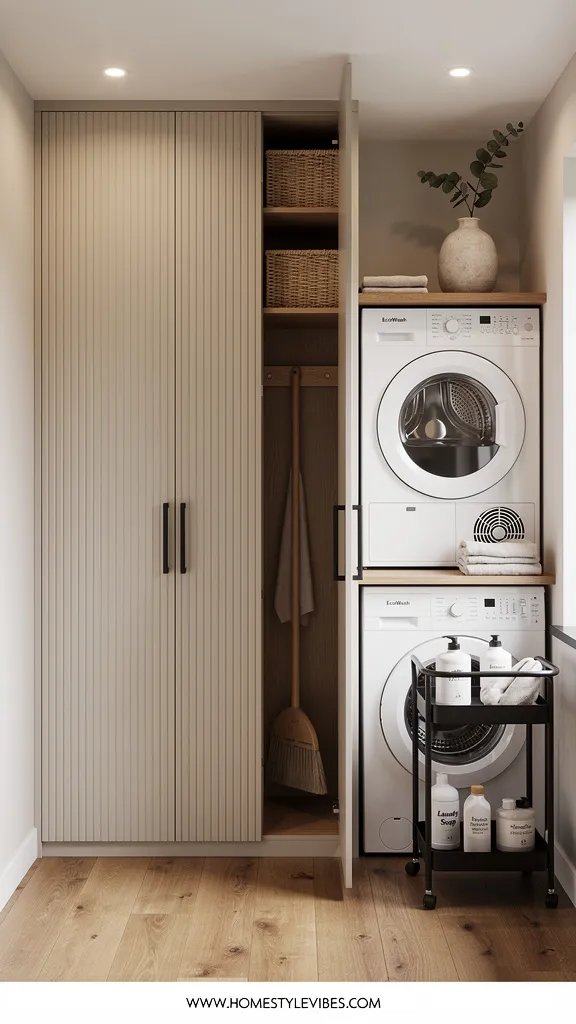
It’s that one corner that always feels off: the broom, the bulk paper towels, the dog treats crammed behind the bleach. You’ve tried a wire rack. It snagged the microfiber cloths and looked… office supply closet. This design borrows from kitchen pantries to give you a floor-to-ceiling storage wall with fluted doors, plus a slim rolling cart that lives between machines and wall for grab-and-go ease.
The mood skews modern European pantry: vertical rhythm from fluted panels, creamy taupe paint, and unlacquered brass pulls that will patina nicely. It works because fluting hides micro-mess visually, and the rolling cart solves the “no-man’s-land” gap. Lighting matters here: add a flushmount with an opal shade to diffuse light downward, making the vertical grooves glow subtly in photos. A honed quartz remnant for a tiny fold perch adds a refined matte surface that loves diffused light—no glare, no harsh reflections.
Two variations keep this adaptable. Budget-friendly: use MDF strips to DIY the fluting on basic doors and paint them in one go. Renter version: use peel-and-stick fluted panels or ribbed contact film on existing doors; swap in a battery puck inside for soft shelf light. For small spaces, go half-height fluted doors over open shelves to keep top space airy.
Key Design Elements:
- Main materials: Fluted MDF or PVC panels, painted cabinets, quartz remnant
- Color palette: Creamy taupe, soft sand, brass, white
- Lighting strategy: Opal flushmount overhead; interior motion-activated shelf lights
- Furniture silhouettes: Tall pantry cabinets, narrow rolling cart, low-profile shelf
- Texture layers: Ribbed doors, woven cane bins, stone remnant
- Accent details: Brass latch catches, leather pulls on the cart, a single dried grass stem
Budget Breakdown:
- Fluted panels or DIY MDF strips for two doors: $120–$280
- Stock pantry cabinet boxes (two narrow towers): $300–$700
- Rolling cart (6–8 inches wide): $40–$120
- Opal flushmount light: $60–$180
- Quartz or stone remnant cut: $80–$200
- Brass hardware: $60–$140
- Bins + labels: $30–$90
Total Estimated Cost: $690 – $1,710
Best For: Small laundry rooms that double as storage; families who need zones for cleaning, pet gear, paper goods, and linens.
How To Recreate This Look:
- Measure ceiling height and choose tall cabinets that stop 2–3 inches shy (shim if needed for a snug look).
- Add fluted fronts: attach ribbed panels or strips; sand edges; paint with enamel for durability.
- Install an opal flushmount centered between the towers to bounce even light.
- Slide a narrow rolling cart into the gap—stock it with stain remover, dryer balls, and cloths.
- Zone the towers: upper for bulk items, middle for detergents, lower for brooms behind a clip rail.
Why This Feels Designer: The vertical ribbing creates elegant shadows and scale, making a petite wall feel architectural. Subtle, repeating lines read intentional and calm on camera.
One Thing To Avoid: Don’t pick glossy paint on fluted doors; it emphasizes imperfections and throws harsh highlights. A satin or matte enamel keeps the look soft and refined.
Pro Styling Tip: Leave one cabinet door slightly ajar in photos to show the curated interior—labels facing forward, one stack of towels with the folded edge out.
Craving something softer? Keep scrolling. The next one wraps your laundry in texture you can actually feel.
Remember, this isn’t about recreating a showroom. It’s about building a space that fits your laundry rhythm, your lighting, your clutter habits. If one idea resonates more than the others, that’s your starting point.
3. Coastal Utility Bench Wall With Beadboard, Hooks + Fold-Down Ironing
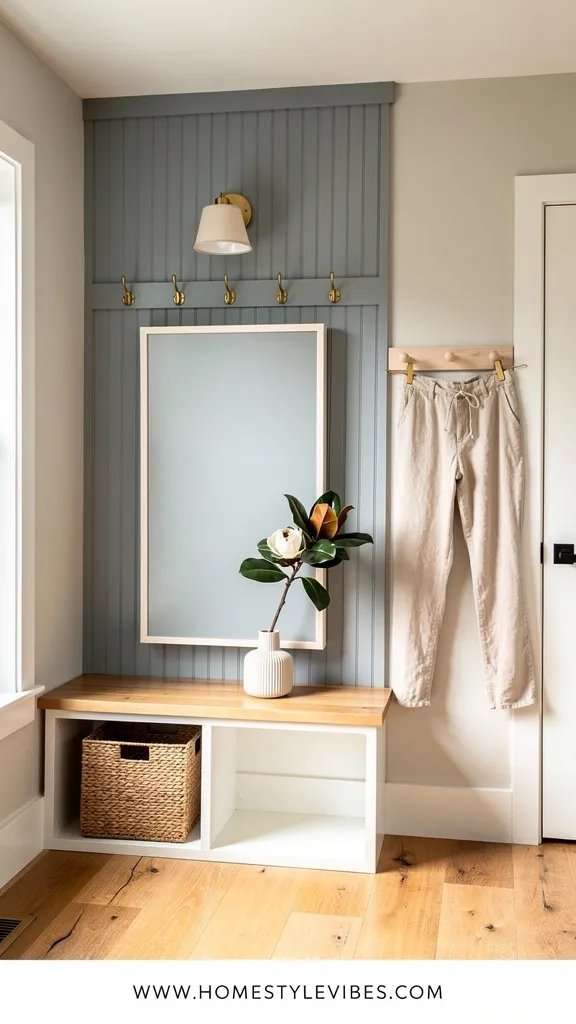
You want a spot to drop the basket, hang damp linen pants, and iron a shirt without dragging gear out of a closet. But your wall is barely five feet and there’s a door swing to dodge. This coastal utility wall creates a bench with storage, beadboard warmth, and a fold-down ironing board that disguises itself as art when closed.
It channels breezy New England mudroom energy: soft blue-gray beadboard, white oak bench, unlacquered hooks that age gracefully. Why it works in small spaces: everything hugs the wall. A 12-inch-deep bench still gives you a perch and a landing zone for detergents. The fold-down ironing board doubles as a mini folding station—two jobs, one slim profile. Lighting-wise, sconces above the hooks push light down the beadboard and create flattering ribbed shadows that photograph like a designer bathroom. Add a seagrass runner underfoot for grit and texture.
For a budget version, use MDF beadboard sheets and a pine bench with a wipeable varnish. Renter-friendly swap: freestanding bench, peel-and-stick beadboard wallpaper, over-door hooks, and a foldable tabletop ironing board stored in a cane basket. Prefer drama? Go navy beadboard with polished nickel hooks and a crisp white board front for bold contrast.
Budget Breakdown:
- Beadboard (MDF sheets) + trim: $120–$240
- Bench lumber (oak or pine) + finish: $150–$380
- Solid hooks (set of 6–8): $45–$140
- Fold-down ironing cabinet or DIY: $120–$320
- Pair of sconces: $140–$380
- Seagrass or jute runner: $50–$150
Total Estimated Cost: $625 – $1,610
Best For: Narrow walls in pass-through laundry rooms; households that want a mini-mudroom feel without giving up laundry function.
Key Design Elements:
- Main materials: Beadboard, white oak, solid brass or nickel hooks
- Color palette: Blue-gray, warm oak, crisp white, soft brass
- Lighting strategy: Two sconces above hooks; warm bulbs for cozy tone
- Furniture silhouettes: Slim bench, shallow fold-down board, simple rail of hooks
- Texture layers: Beadboard ribs, woven runner, linen cover on board
- Accent details: Stripe towel, small coastal print, a ceramic bowl for lost buttons
How To Recreate This Look:
- Run beadboard 2/3 up the wall and cap with a simple shelf ledge for frames and a plant.
- Build or buy a 12-inch-deep bench and add a cushion in a performance fabric.
- Mount a row of hooks at shoulder height; add a second staggered row lower for kids’ stuff.
- Install a fold-down ironing board cabinet centered under one sconce—align edges for symmetry.
- Style with two framed prints, a bowl for pocket change, and a rolled towel stack on the bench.
Why This Reads High-End: Repeating verticals (beadboard, hooks, sconce stems) create quiet order. The fold-down feature feels custom and the layered light brings out the wood grain in photos.
The Most Common Mistake: Mounting the sconces too high. Keep the bottom of the shade around 60–64 inches from the floor so light hits the beadboard, not just the ceiling.
Pro Styling Tip: Leave one hook empty between items to let negative space breathe; your photo will feel polished, not packed.
4. Micro-Utility Galley With Slide-Out Sorting + Waterfall Counter
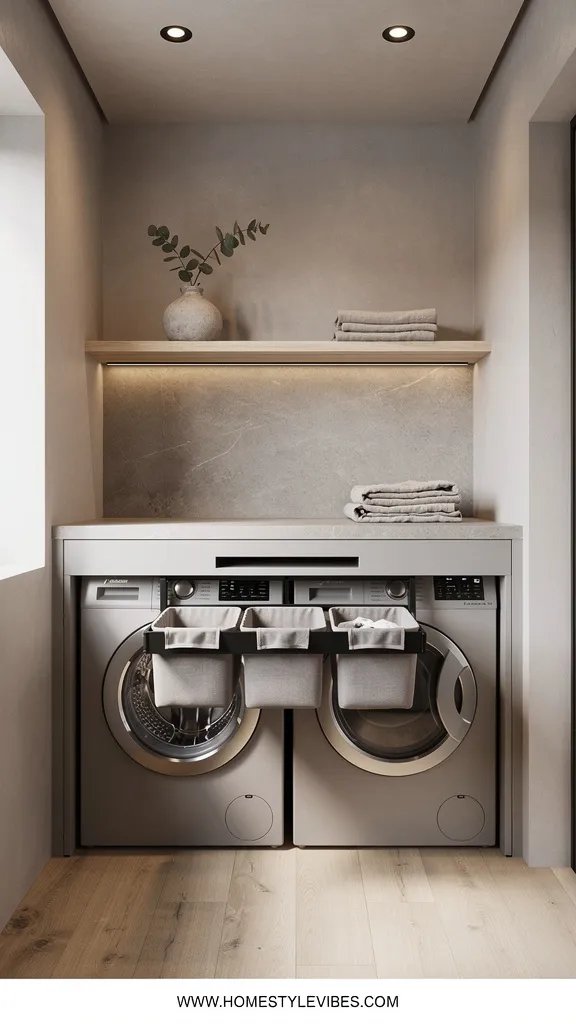
Short on floor space but big on socks? You’ve stacked machines to save room, but sorting laundry turned into a pile on the floor. You tried hampers, yet they eat up every inch. This micro-utility galley uses a slide-out triple sorter and a slim waterfall counter to give you a place to sort, fold, and stash—all within a footprint barely wider than the appliances.
The mood leans modern minimal: stone-look laminate waterfall counter, matte black rails, and a quiet greige cabinet box surrounding the stack. Why it works: vertical zoning. Stack the units, then add a 14–16-inch side panel with a pull-out sorter (darks, lights, delicates). The waterfall counter turns the side panel into a sturdy fold perch that looks bespoke. Lighting gets surgical here: a single track with two aimable heads—one to the counter, one to the sorter—keeps every task bright and photogenic. The matte surfaces avoid glare; the sharp line of the waterfall adds a clean magazine-style edge.
Small-space version? Use a 12-inch-wide IKEA frame with a garbage-pull kit repurposed for laundry bags. Budget-friendly: laminate counter off-cuts and a DIY plywood panel with iron-on edge banding. Prefer warmth? Swap greige for light oak melamine and brushed nickel rails.
Budget Breakdown:
- Laminate countertop with waterfall side: $180–$420
- Cabinet frame for pull-out: $120–$300
- Triple pull-out hardware + bags: $90–$220
- Track light with two heads: $70–$180
- Melamine or painted surround panels: $120–$260
- Matte black hardware: $25–$60
Total Estimated Cost: $605 – $1,440
Best For: Super compact rooms or hallway laundries; anyone who prefers everything closed and labeled, and who sorts as they go.
Key Design Elements:
- Main materials: Laminate or compact stone, melamine panels, metal pull-outs
- Color palette: Greige, black, soft white
- Lighting strategy: Two-head track, 3000K, high CRI for true fabric color
- Furniture silhouettes: Stacked appliances, slim cabinet column, waterfall edge
- Texture layers: Matte laminate, powder-coated rails, cotton sorter bags
- Accent details: Minimal labels, one sculptural vase, microfiber cloth stack
Why This Looks Intentional: The waterfall edge frames the stack like architecture, and the centered track lights carve crisp highlights. Sorting disappears from sight while staying within arm’s reach.
How To Recreate This Look:
- Measure your stack’s height and plan a side cabinet that aligns with the drum center for ergonomic reach.
- Build a 12–16-inch-wide pull-out cabinet; fit triple sorter hardware and line with washable bags.
- Install a laminate top that waterfalls down the side of the pull-out; align edges for a seamless look.
- Wrap the stack with side panels to create a tidy niche; leave 1–2 inches for vibration clearance.
- Add a two-head track light; aim one at the counter and the other into the pull-out cavity.
Don’t Do This: Don’t forget ventilation gaps. Stacked machines generate heat and moisture; leave space at back and sides and use a louvered panel if you must close the front.
Pro Styling Tip: For photos, pull the sorter out 10 inches with one bag slightly fuller than the others—texture and shadow make the scene feel lived-in but tidy.
Pause for breath. If spreadsheets are your love language, the next design’s zoning will make your left brain purr.
If you feel overwhelmed, pick one upgrade—a hidden rail, a new light, or a better counter. Tiny, specific changes beat big vague plans every time.
5. Moody Linen-Laundry Library With Rail Ladder + Stone Shelf
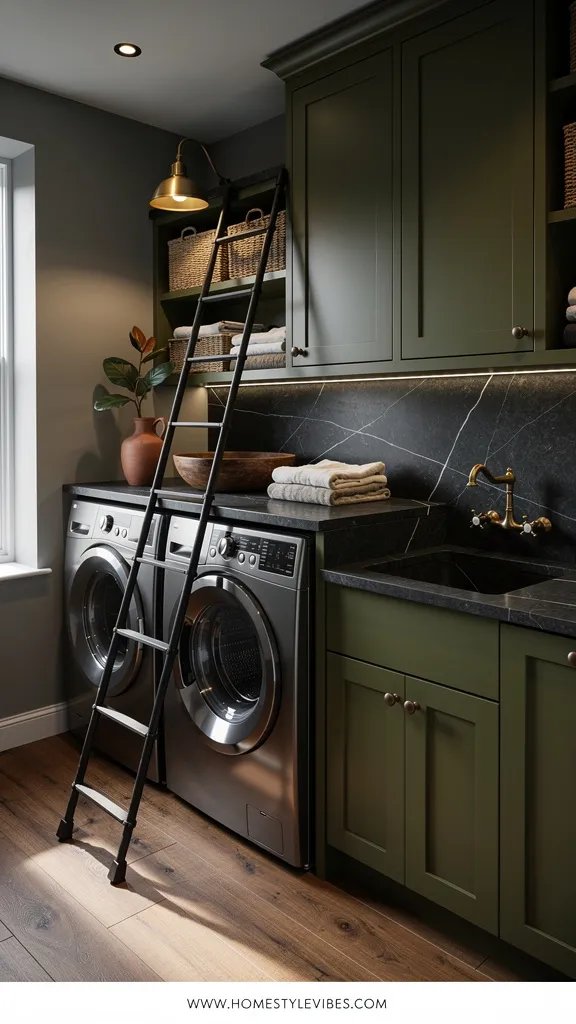
You love a cozy, bookish vibe and dream about a laundry that feels like a little library. But your space is small, and you worry dark colors will make it feel cramped. Here’s the twist: a moody palette with a micro-ladder and a slim stone shelf actually adds depth, not heaviness, when layered right.
This design blends English utility with modern craft. Think deep olive cabinetry, a honed soapstone shelf that runs wall to wall, and a slim rail ladder that slides to reach upper baskets. It works because dark, low-sheen finishes recede, letting the soapstone and brass accents catch the light. Under-shelf miniature spots create punctuation shadows along the wall and make the stone glow. On camera, the interplay of deep green, gray stone, and warm brass hits like a still-life painting—you get contrast, line, and texture without clutter.
Two variations keep it flexible. Budget-friendly: paint stock cabinets a deep olive and use a porcelain-look stone remnant for the shelf. Renter-friendly: a leaning ladder shelf for baskets and a painted peg rail below for hang-dry items—no drilling into high cabinets. Prefer cooler tones? Swap olive for deep charcoal and use polished nickel details.
Budget Breakdown:
- Upper cabinets (stock) + paint: $300–$700
- Soapstone or honed quartz remnant shelf: $150–$420
- Mini LED spots under shelf (set of 3–4): $80–$160
- Sliding rail + slim ladder: $220–$520
- Brass knobs/latches: $60–$150
- Canvas or rattan baskets: $40–$120
Total Estimated Cost: $850 – $2,070
Best For: 5–8 foot wall laundries; design lovers who want character and aren’t afraid of darker paint in small spaces.
Key Design Elements:
- Main materials: Painted wood, honed stone, brass, canvas
- Color palette: Deep olive/charcoal, graphite, brass, creamy white accents
- Lighting strategy: Discreet under-shelf spots plus a dimmable ceiling fixture
- Furniture silhouettes: Shaker or slab uppers, thin stone shelf, rail ladder
- Texture layers: Honed stone, brass patina, canvas weave
- Accent details: Vintage-style labels, framed botanical print, wool dryer balls in a glass jar
How To Recreate This Look:
- Paint uppers in a deep, low-sheen tone; color match to a favorite swatch you’ll love in low light.
- Install a honed stone shelf directly under uppers with hidden brackets for a floating effect.
- Add mini LED spots beneath the shelf, spaced 10–12 inches apart, aimed toward the backsplash.
- Mount a slim rail and ladder; position baskets on the highest shelf for seasonal storage.
- Style with a single print, a brass bowl for clothespins, and neutral canvas bins with neat labels.
Why This Looks Expensive: The honed stone reads tactile, not shiny; the rail ladder hints at bespoke millwork. Dark paint hides small-scale imperfections and turns the shelf lighting into a feature.
Watch Out: Too many small decor pieces on the stone make it fussy. Keep it to three: one functional, one sculptural, one soft (like a folded towel).
Pro Styling Tip: Photograph at a slight angle so the shelf edge catches light—this creates a crisp line that highlights the stone’s matte finish.
6. Japandi Pocket Studio With Slatted Screen + Foldaway Table
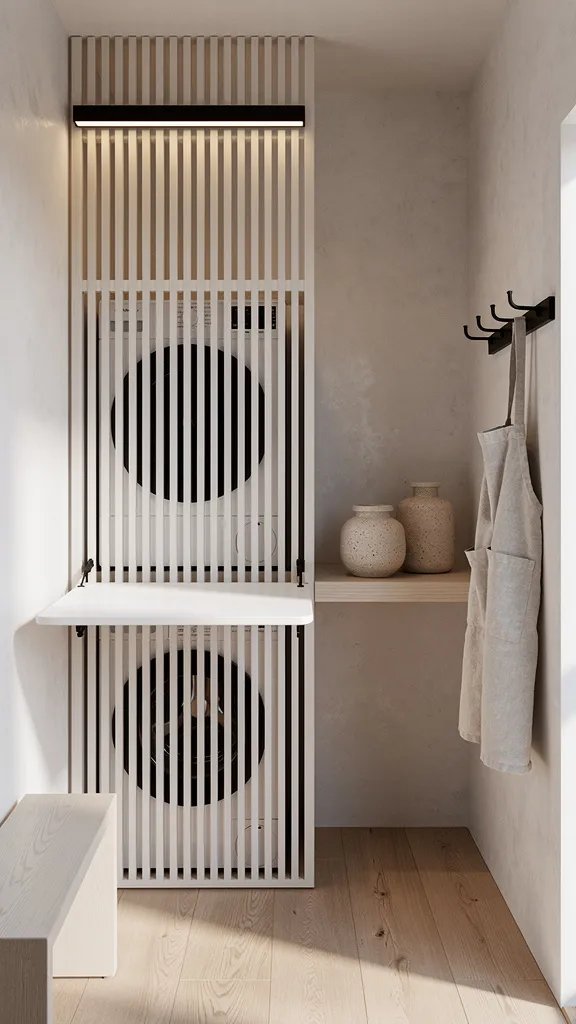
You crave serenity: warm woods, stoneware jars, soft shadows. But your laundry shares space with a back entry, and it constantly feels like a crossroads. You’ve tried hiding things in baskets, yet it still reads “utility” from the hallway. This Japandi pocket studio uses a slatted wood screen to veil machines and a foldaway table that flips down for folding, crafting, or plant repotting. When you walk by, it feels like a mini studio, not a chore zone.
The mood is calming and textural: white oak slats, mushroom-colored walls, creamy terrazzo-look floor tile. It works because the slatted screen breaks sightlines without blocking airflow; your eye reads rhythm and light rather than appliance fronts. A foldaway table mounted to the wall disappears when not in use; when down, it creates a generous plane for tasks, lit by a paper lantern pendant that spreads diffused light. Photographically, the slats create gorgeous repeating shadows, the terrazzo adds playful specks, and the paper shade glows like a soft moon. It’s all very “I respect laundry, but I also have taste.”
Small-space version: half-height slatted screen on wheels that tucks beside the machines. Budget-friendly: pine slats with a water-based stain and a birch ply fold table sealed in matte poly. Renter-friendly: free-standing bamboo screen and a wall-mounted drop-leaf shelf using removable anchors rated for heavy loads (check weight!). Darker take: smoked oak slats, clay-colored walls, and a black linen cord pendant.
Budget Breakdown:
- Wood slats + mounting track: $180–$420
- Foldaway wall table hardware + birch top: $140–$320
- Paper lantern pendant + canopy kit: $50–$120
- Terrazzo-look vinyl tile or porcelain: $120–$380
- Stoneware canisters + tray: $40–$120
- Soft-close wall hooks for hang-dry: $30–$80
Total Estimated Cost: $560 – $1,440
Best For: Pass-through laundry entries; people who love natural textures, like to fold in peace, and want visual quiet without losing air movement.
Key Design Elements:
- Main materials: White oak or pine slats, birch ply, terrazzo-look tile, stoneware
- Color palette: Mushroom, natural oak, cream, soft black accents
- Lighting strategy: Diffused pendant plus a directional spotlight near the fold table
- Furniture silhouettes: Slatted screen, ultra-slim drop-leaf, low-profile hooks
- Texture layers: Wood grain, terrazzo flecks, linen towel, matte ceramics
- Accent details: Black metal rail, eucalyptus sprig, low wide tray for essentials
Why This Feels Designer: The screen turns appliances into soft geometry and the lightweight paper lantern keeps the mood cloud-like. Fewer materials, better quality—your eye rests instead of scanning clutter.
How To Recreate This Look:
- Paint walls a mushroom beige with warm undertones to flatter wood tones.
- Mount a slatted screen on a ceiling or wall track; leave at least 2 inches for ventilation.
- Install a foldaway table at hip height; test clearance with the screen open and closed.
- Lay terrazzo-look tiles or click-in vinyl for instant texture and easy cleanup.
- Style with stoneware jars on a shallow rail shelf; add a linen towel for softness.
One Thing To Avoid: Don’t space slats too tight; you’ll choke airflow and create a sauna for your machines. Aim for 5/8 to 3/4-inch gaps for balance.
Pro Styling Tip: When photographing, time it for late afternoon—angled light through slats paints stripes across the floor for a subtle, editorial effect.
Honest moment: I once obsessed over finding the perfect “greige” for a client’s laundry. We repainted twice. The real problem? Overhead lighting with a low CRI that made every paint read sickly. We changed the bulbs, not the paint, and everything snapped into place. The truth is—texture and lighting are non-negotiable in tiny rooms. Get them right, and even a $30 basket looks tailored.
Quick Checklist
- Use warm, high-CRI bulbs (90+) to keep fabrics true and flattering
- Hide a hanging rail under a shallow shelf for instant function
- Add one continuous counter (14–16 inches deep) for folding
- Choose one hero texture: fluted door, beadboard, or stone shelf
- Install under-shelf lighting with a diffuser to avoid hot spots
- Cap gaps above cabinets with a filler strip for a custom look
- Use slide-out sorters to keep floors clear in micro rooms
- Keep a tight color palette: 1 wood tone, 1 neutral, 1 metal
- Label bins on the short side so they read neatly in photos
- Leave one empty hook or shelf zone—negative space = calm
Frequently Asked Questions
How do I keep costs under $500 for a laundry room refresh?
Prioritize paint, one new light, and a shelf with a hidden rail. Use pine for shelves, a tension rod for hanging, and swap in high-CRI LED bulbs. Corral supplies in matching baskets. These three moves change the look and function fast.
I rent—what can I actually install without losing my deposit?
Use peel-and-stick beadboard or fluted film, freestanding shelves, tension rods, and removable hooks. Battery-powered puck lights under shelves add glow without hardwiring. Keep all original parts to reinstall when you leave.
My laundry shares space with a hallway. How do I hide it without blocking airflow?
Use a slatted screen or lightweight curtain mounted high with at least 2-inch air gaps. Choose breathable fabrics or wood slats with 5/8-inch spacing. Never seal machines tightly; heat and moisture need to escape.
Dark paint scares me in a tiny room. Will it make it feel smaller?
Not if you balance it with matte textures and targeted lighting. Dark, low-sheen walls recede visually, especially when a lighter shelf or counter catches light. Add under-shelf LEDs and keep decor simple for depth, not gloom.
What’s the most common design mistake in small laundry rooms?
Ignoring lighting. Overhead glare makes every bottle and cord shout. Add a second light source—under-shelf LEDs, sconces, or a diffused pendant—to soften shadows and make surfaces read intentional and calm.
Closing Thoughts
If you’re itching to start, choose one idea and move. Install the rail. Swap the bulb. Add the slim counter. Small rooms reward action over perfection—you’ll feel the difference the first time you fold on a surface that doesn’t wobble.
Luxury in a laundry room comes from texture, lighting, and restraint. Not from price tags. Pick one hero texture, keep the palette tight, and give your light a job to do. The secret isn’t buying more bins—it’s giving everything a home, then letting a little negative space breathe.
You’ve got this. One weekend, one wall, one good light—your laundry can stop being a chore corner and start feeling like a tiny studio. And when you catch yourself lingering for an extra second because the shelf glow hits just right? That’s when you’ll know you nailed it.

About the Author

Krisztina P.Rendes, Founder of Home Style Vibes
Founder of Home Style Vibes
Krisztina Puskásné Rendes created Home Style Vibes as a cozy-modern lifestyle space where homemaking meets inspiration. Her goal is to help women create beautiful, organized, and peaceful homes they truly love — without overwhelm. You’ll find here heart-driven content on home decor, cleaning tips, easy family recipes, organization and decluttering, DIY home projects, plants, and seasonal ideas — all designed to bring more calm, comfort, and style into everyday life.