7 Succulent Garden Bed Ideas That Make Your Yard Look Like A Desert Paradise
You want a yard that glows at sunset, all soft shadows across sculptural succulents and stone. You don’t want to babysit fussy plants or fight a constant weed war. You dream in sandy neutrals, terracotta grit, and silvery-blue rosettes—yet every attempt ends up flat, messy, or, let’s be honest, a little “strip-mall median.” These 7 succulent garden bed ideas fix that. Each one gives you a clear plan—materials, layout, lighting, and styling—so you can pull off a high-end desert paradise that costs less than a new patio set and comes together over a few weekends.
We’re talking color stories that photograph beautifully, textures that make your yard look intentional, and lighting that creates drama after dark. No vague advice here. Expect precise materials, small-space and renter-friendly variations, and trouble-shooting notes. If you love clean lines, baked earth hues, and plants that practically take care of themselves, this is your moment. These are Pinterest-worthy looks designed for real-life maintenance. Quiet luxury meets low-water ease—perfect for sunny courtyards, side yards that never felt finished, or that front bed crying out for personality.
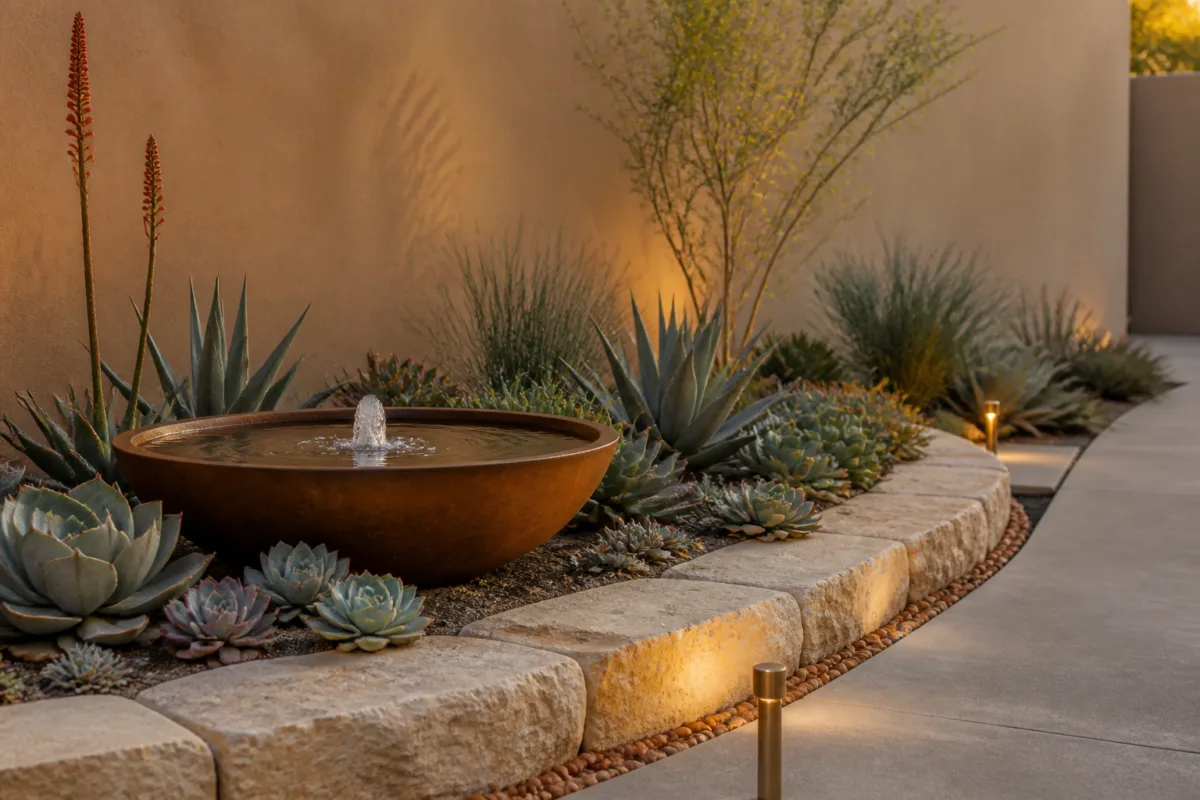
1. Salt-Cured Limestone Border, Golden Hour Uplighting, and a Corten Steel Bowl Fountain
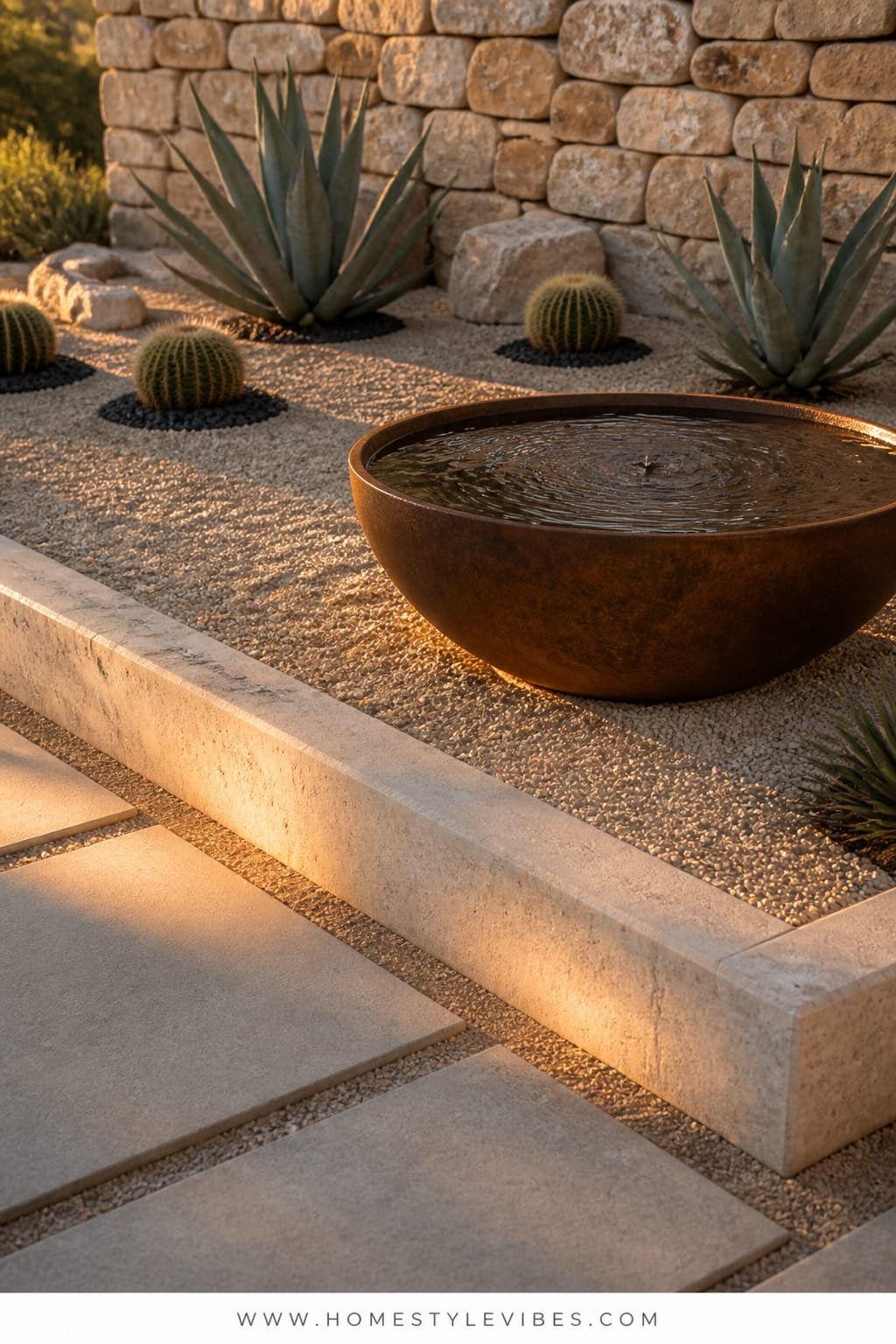
We’ve all been there: you want sculptural drama out front, but the bed reads bland by day and disappears at night. You’ve planted a few agaves, laid some gravel, and still… crickets. This design fixes the “flat plateau” effect with crisp stone edges, a burnished steel focal point, and light that glows like desert sunset. The mood is modern Mediterranean with a whisper of Joshua Tree—calm, sculptural, and just a little wild.
Why it works in real homes: the raised limestone border corrals gravel for easy cleanup and tidy edges, while the Corten bowl fakes that luxe water feature vibe with minimal footprint. Low-voltage uplights create long shadows that make even a small bed feel architectural. Dominant materials include salt-cured limestone, rust-toned Corten, and warm buff gravel—each chosen for contrast and patina. Photographing this bed is a dream because the materials create layers: matte limestone, glowing steel, and glossy water surfaces after dusk.
Variations that keep it flexible:
– Budget-friendly: swap real limestone for concrete pavers with a roughened edge and faux patina.
– Small-space: downsize the steel bowl to a 24–30 inch diameter and plant a single statement agave inside.
– Renter-friendly: assemble a loose rectangle of stacked pavers (no mortar), lay landscape fabric and pea gravel, and use a plug-in fountain pump you can take when you move.
Budget Breakdown:
- Salt-cured limestone blocks or concrete pavers: $250–$800
- Corten steel bowl fountain (30–36 inches): $280–$850
- Low-voltage brass uplights (2–4 fixtures): $120–$400
- Transformer and wire: $100–$250
- Buff or desert gold gravel (1–2 yards): $80–$180
- Statement agave or aloe: $35–$150
Total Estimated Cost: $865 – $2,630
Best For: Front-entry beds or courtyards that need a focal moment. Works beautifully in hot, dry climates or coastal zones with good drainage.
Key Design Elements:
- Main materials: limestone edging, Corten steel, buff gravel
- Color palette: warm sand, rust, blue-green foliage
- Lighting strategy: 2–3 uplights aimed across the gravel to create raking shadows
- Furniture silhouettes: none needed; let the bowl be the “furniture” moment
- Texture layers: rough stone, smooth water, spiky agave
- Accent details: slim black rock mulch under the bowl, a few basalt stones for depth
How To Recreate This Look:
- Start with a clean outline: stake and excavate a rectangular or U-shaped bed and level the soil.
- Add limestone edging in a single or double course for height and crisp containment.
- Lay landscape fabric and fill with buff gravel at 2–3 inches depth.
- Place the Corten bowl slightly off-center; if it’s a fountain, run power safely.
- Install two uplights low to the ground at diagonal angles to the bowl and the hero plant.
- Style with a ring of black rock mulch beneath the bowl for contrast, then plant one agave and 3–5 low succulents.
Why This Looks Expensive: The controlled palette and high-contrast materials read custom. Corten and limestone age gracefully, which telegraphs quality long after install day.
Watch Out: Don’t overplant. Too many small succulents crowd the silhouette and kill the sculpture. Keep at least 18–24 inches of negative space around your statement plants.
Pro Styling Tip: Shoot at blue hour—your uplights will rim the agave edges while the sky cools to slate, creating editorial-level contrast.
Keep scrolling. The next idea is for anyone with an awkward corner that never feels intentional.
2. Whitewashed Stucco Mounds, Soft Dawn Light, and a Terracotta Amphora Cluster
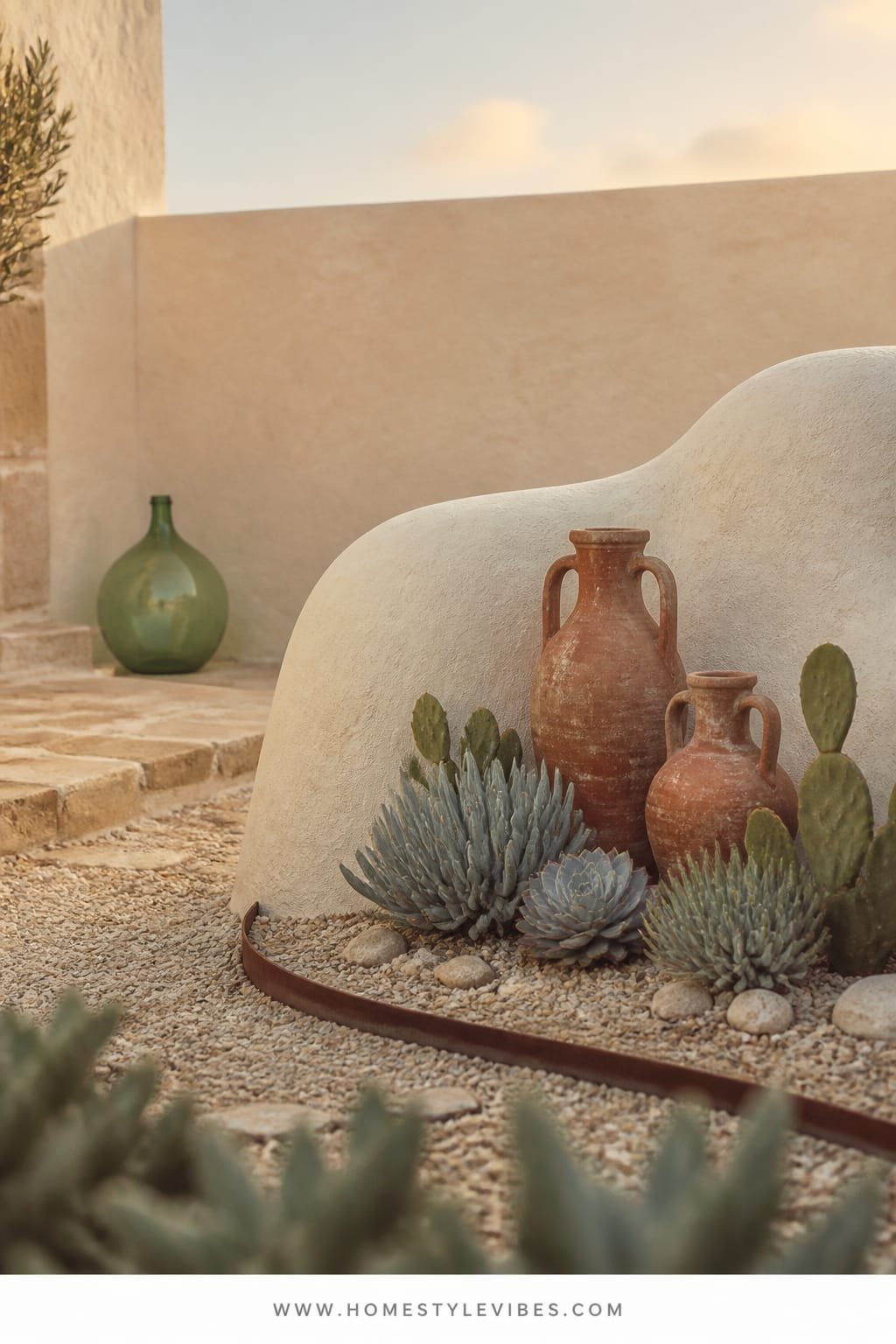
It’s that one corner that always feels off—too shallow for a tree, too big for a pot. You’ve tried random groundcovers, but it still looks like “filler.” This garden bed gives that no-man’s-land purpose with sculpted stucco mounds that look like mini dunes, settled terracotta amphorae, and soft-toned succulents that thrive in reflected light. The vibe is warm Mediterranean meets art installation—gentle, organic, and photogenic from every angle.
Here’s why this works: the mounds add height variation without heavy hardscape. Whitewashed stucco reflects morning light onto blue-gray rosettes, so they glow without trying. Terracotta amphorae at staggered heights become a sculptural “still life” that anchors the bed. The materials—limewash stucco, terracotta, silvery echeveria—create a soulful palette that resells well and needs little maintenance.
Variations worth trying:
– Budget-friendly: form mounds with compacted decomposed granite (DG) and paint with masonry paint instead of true stucco.
– Small-space: one mound, two amphorae, three hero plants. Done.
– Darker version: swap whitewash for clay-tinted stucco and use black lava rock mulch for moody contrast.
Budget Breakdown:
- Stucco or masonry paint over formed mounds: $150–$500
- Terracotta amphorae (2–3 sizes): $120–$450
- Echeveria and kalanchoe mix: $60–$180
- DG base and landscape fabric: $80–$200
- Low-profile path lights (optional): $60–$200
Total Estimated Cost: $470 – $1,530
Best For: Nooks near walls, courtyards with reflected light, or anywhere with morning sun and afternoon shade.
Key Design Elements:
- Main materials: limewash stucco, terracotta, decomposed granite
- Color palette: chalk white, clay rust, soft blue-gray
- Lighting strategy: ambient dawn light; optional low path lights for a gentle glow
- Furniture silhouettes: amphorae as sculptural forms
- Texture layers: smooth mounds, ribbed terracotta, velvety succulent leaves
- Accent details: scattered white pebble halos around amphora bases
How To Recreate This Look:
- Build two gentle mounds from compacted soil topped with DG; seal shape with mesh if needed.
- Apply a thin stucco coat or masonry paint; let it cure fully.
- Nestle amphorae at slight angles—one lying, one upright—to feel collected, not staged.
- Add fabric, then a thin DG layer around mounds; leave clean reveal at the base for shadow lines.
- Plant echeveria near mound bases where light bounces; tuck trailing sedum around amphora edges.
Why This Feels Designer: Negative space, fewer species, and varied height look curated. The amphorae act as “art” that anchors the eye and elevates inexpensive plants.
One Thing To Avoid: Don’t center the amphorae in a perfect triangle. Asymmetry makes it look collected over time.
Pro Styling Tip: Dust a little soil on the amphora shoulders so they read “settled” in photos—brand-new terracotta can look too shiny on camera.
Remember, this isn’t about recreating a showroom. It’s about building a yard that actually reflects your pace, your light, your mornings. If one idea sings, start there and ignore the rest for now.
3. Weathered Cedar Grid Edging, Silvery Moonlight Wash, and a Sculptural Agave ‘Blue Glow’ Pedestal
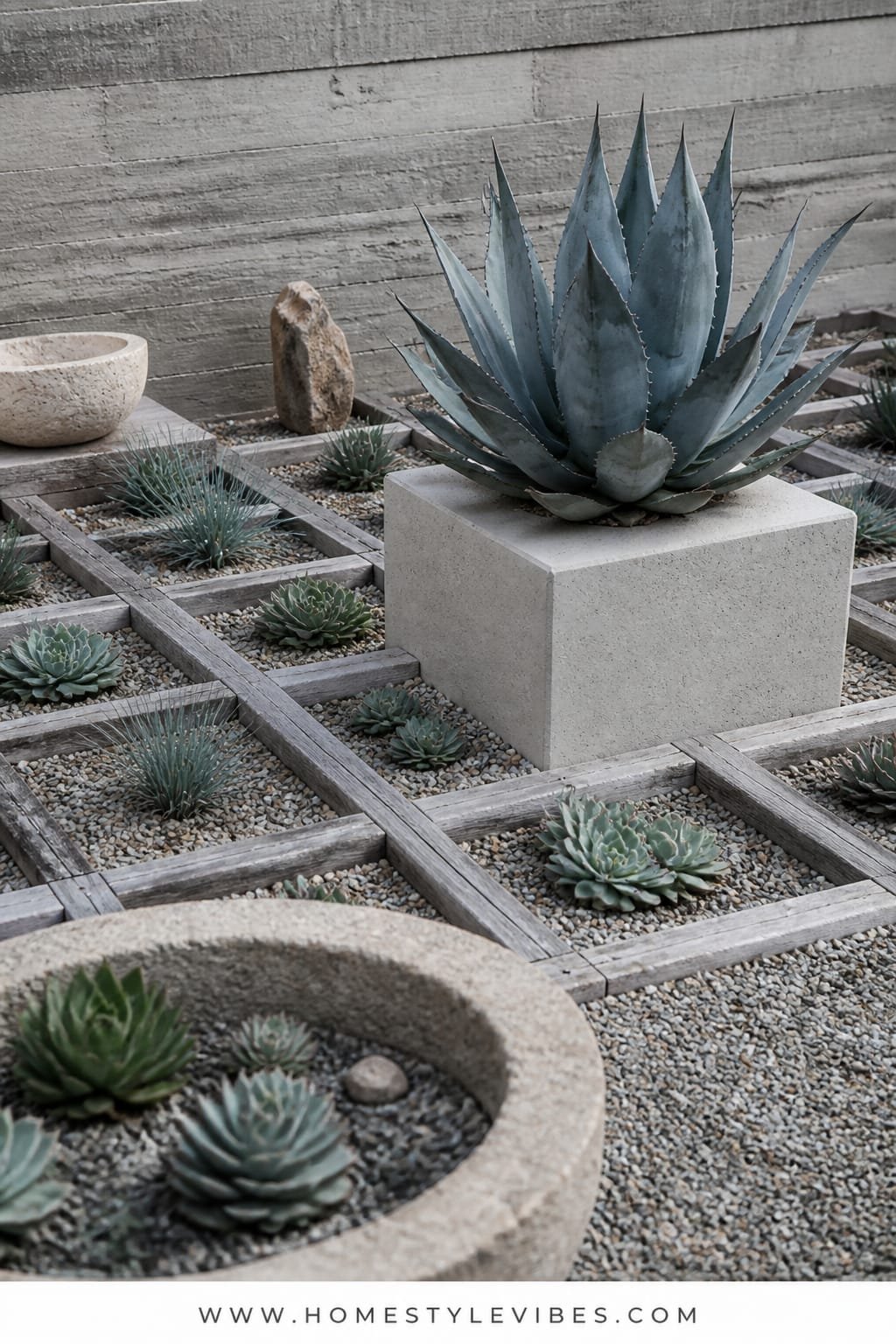
You love a neat garden, but your beds slouch after a season—gravel spills, plants migrate, edges blur. You crave order without sterility. This design lays down a subtle wooden grid, backstops it with moody moonlight wash, and spotlights a single Agave ‘Blue Glow’ on a pedestal. The mood lands somewhere between Japandi and desert modernism—calm, minimal, and precise.
Why it’s so livable: cedar edging creates shallow cells that keep gravel and small succulents contained. It’s basically drawer dividers for your yard. A small pedestal (concrete, stone, or dark wood) lifts the agave, letting its halo margins catch the light at night. The materials—weathered wood, basalt or gray gravel, blue-green leaves—photograph crisply because you get layered lines and defined negative space.
Try these variations:
– Budget-friendly: swap cedar for pressure-treated garden stakes; stain with a weathered gray tone.
– Renter-friendly: assemble a freestanding frame with corner brackets on top of landscape fabric.
– Small space: 4–6 grid cells with one pedestal and 3 species repeated in a rhythm.
Budget Breakdown:
- Cedar boards or stakes for grid: $120–$300
- Concrete or stone pedestal: $80–$250
- Agave ‘Blue Glow’ (medium size): $60–$150
- Gray or basalt gravel: $100–$250
- Low-voltage washers (2 fixtures): $120–$240
Total Estimated Cost: $480 – $1,190
Best For: Side yards and entry runs where clean lines matter. Great if you like to weed once a month and call it done.
Key Design Elements:
- Main materials: weathered cedar, gray gravel, concrete pedestal
- Color palette: charcoal, fog gray, blue-green
- Lighting strategy: soft wash across the grid, tight spotlight on the pedestal
- Furniture silhouettes: none; the pedestal acts as the hero “object”
- Texture layers: linear wood grain, fine gravel, waxy leaves
- Accent details: a few rounded river stones placed in odd-number groupings
How To Recreate This Look:
- Map a rectangle and pre-assemble cedar strips into a grid with outdoor screws.
- Lay weed fabric, set the grid on top, and stake corners tight.
- Fill cells with gravel, then plant in designated cells only—repeat species for rhythm.
- Place the pedestal off-center with the agave; keep a 24-inch clear gravel “moat.”
- Install two moonlight washers to graze across the grid, one tight spotlight for the agave.
Why This Reads High-End: Repetition and restraint. Professional gardens repeat shapes and species, which signals control and quality without shouting.
The Most Common Mistake: Mixing too many stone colors. Pick one gravel tone and stick to it to avoid “patchwork patio” vibes.
Pro Styling Tip: Wet the gravel lightly before photographing; it deepens the gray and sharpens leaf reflections.
I tried a version of this in my side yard last fall. The second I switched to a single gravel color and added that pedestal, my neighbor asked if we’d hired a landscape architect. We hadn’t. It was a Saturday and two coffees.
4. Reclaimed Brick Ribbon Paths, Sunset Backlighting, and a Low Fire Bowl Nook
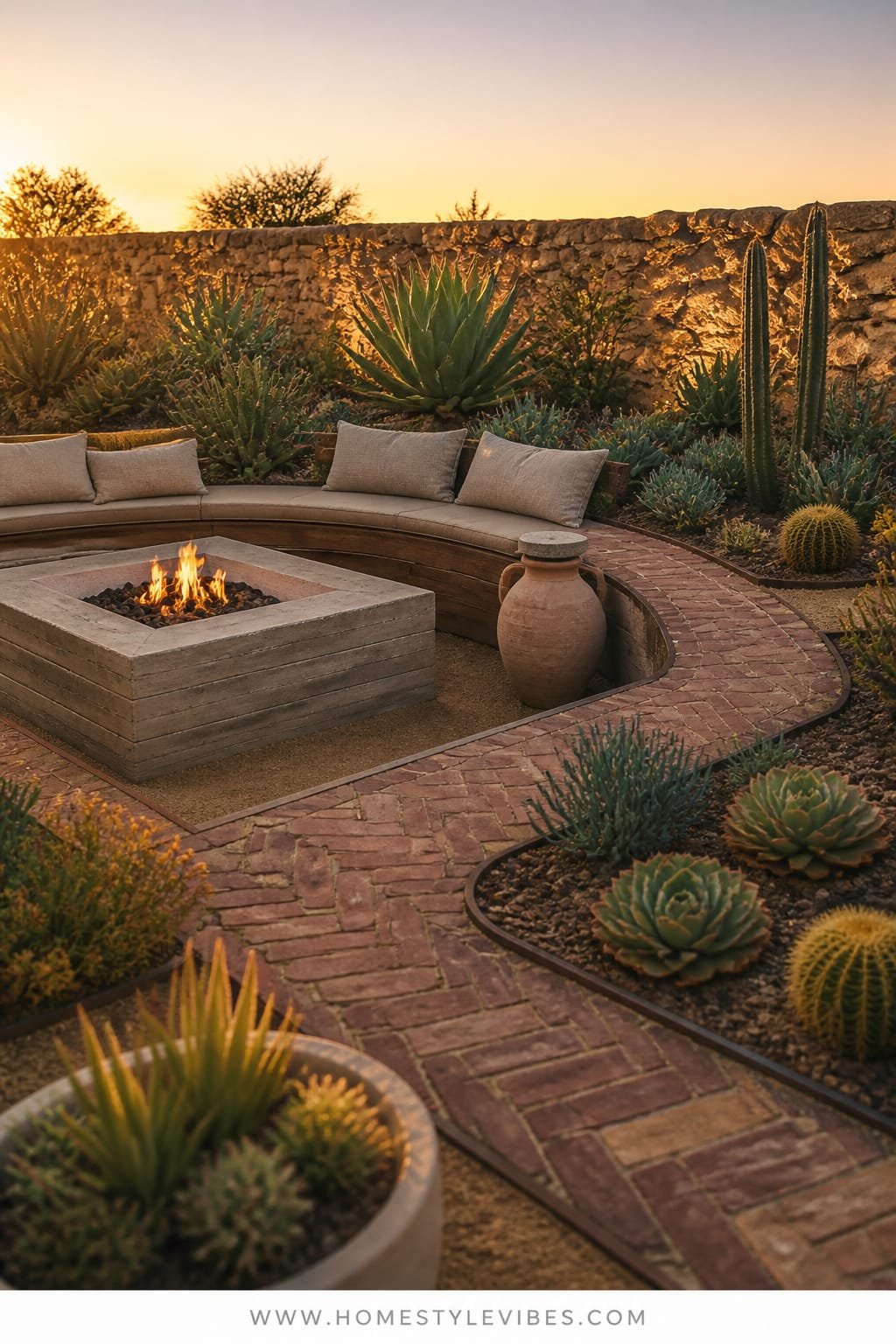
You’ve got a big bed that feels empty by day and useless at night. Paths? Fire? Seating? It’s a lot. This concept uses narrow reclaimed-brick ribbons to guide you through pockets of succulents and lands you at a low fire bowl nook. The feeling? Soft, romantic, and a little nostalgic—like a desert courtyard that remembers stories.
Why it’s practical: skinny brick paths break up planting zones and reduce erosion. They also give you maintenance access without trampling. Backlighting at sunset (small bollards or strip lighting along path edges) makes the textures sing and helps guests actually navigate. The materials—reclaimed brick, golden gravel, dusky-toned succulents—photograph like a magazine spread because the serpentine paths create depth and leading lines.
Flexible by design:
– Budget-friendly: use common bricks with limewash rub for patina.
– Small space: one looping ribbon with a micro seating pad and tabletop fire bowl.
– Darker version: charcoal pavers, black pebbles, deep green aloe varieties for moodier contrast.
Budget Breakdown:
- Reclaimed brick (narrow ribbons, 60–120 linear feet): $200–$700
- Portable low fire bowl: $120–$600
- Path edge lights or LED strip kits: $80–$280
- Desert gold gravel and soil amendments: $120–$260
- Mixed succulents (aloe, dyckia, mangave, sedum): $120–$400
Total Estimated Cost: $640 – $2,240
Best For: Larger beds, sloped sites, or family yards that want cozy evening moments with s’mores and low maintenance.
Key Design Elements:
- Main materials: reclaimed brick, golden gravel, steel fire bowl
- Color palette: clay red, desert gold, sage and plum foliage
- Lighting strategy: backlight paths with small bollards; keep fire bowl zone low and warm
- Furniture silhouettes: low sling chairs or built-in bench curve
- Texture layers: rough brick, crunchy gravel, smooth fire bowl
- Accent details: pocket boulders to frame seating pad and create planted “islands”
How To Recreate This Look:
- Sketch meandering ribbons; keep them 12–16 inches wide and spaced by planting islands.
- Set bricks on compacted sand with tight joints; no mortar needed if edged well.
- Create a small circular or oval pad for the fire bowl; ensure safety clearances.
- Plant taller succulents at outer curves and groundcovers on inner curves.
- Install low lights to wash path edges; avoid eye-level glare.
Why This Looks Intentional: The paths choreograph your view. Eye-level control—curves, pauses, focal points—feels designed, not accidental.
Don’t Do This: Avoid straight lines that dead-end at the fire bowl. Add a slight arc so the destination reveals itself gradually.
Pro Styling Tip: Shoot from a low angle along a brick ribbon; the curve pulls the viewer’s eye through the frame like a story arc.
Take a breath. These ideas stack, but they don’t have to. One small change—like an edge detail or a single statement plant—often flips the entire read of a space.
5. Honed Concrete Planter Bands, Crisp Noon Shadow Lines, and a Ribbed Terracotta Bench
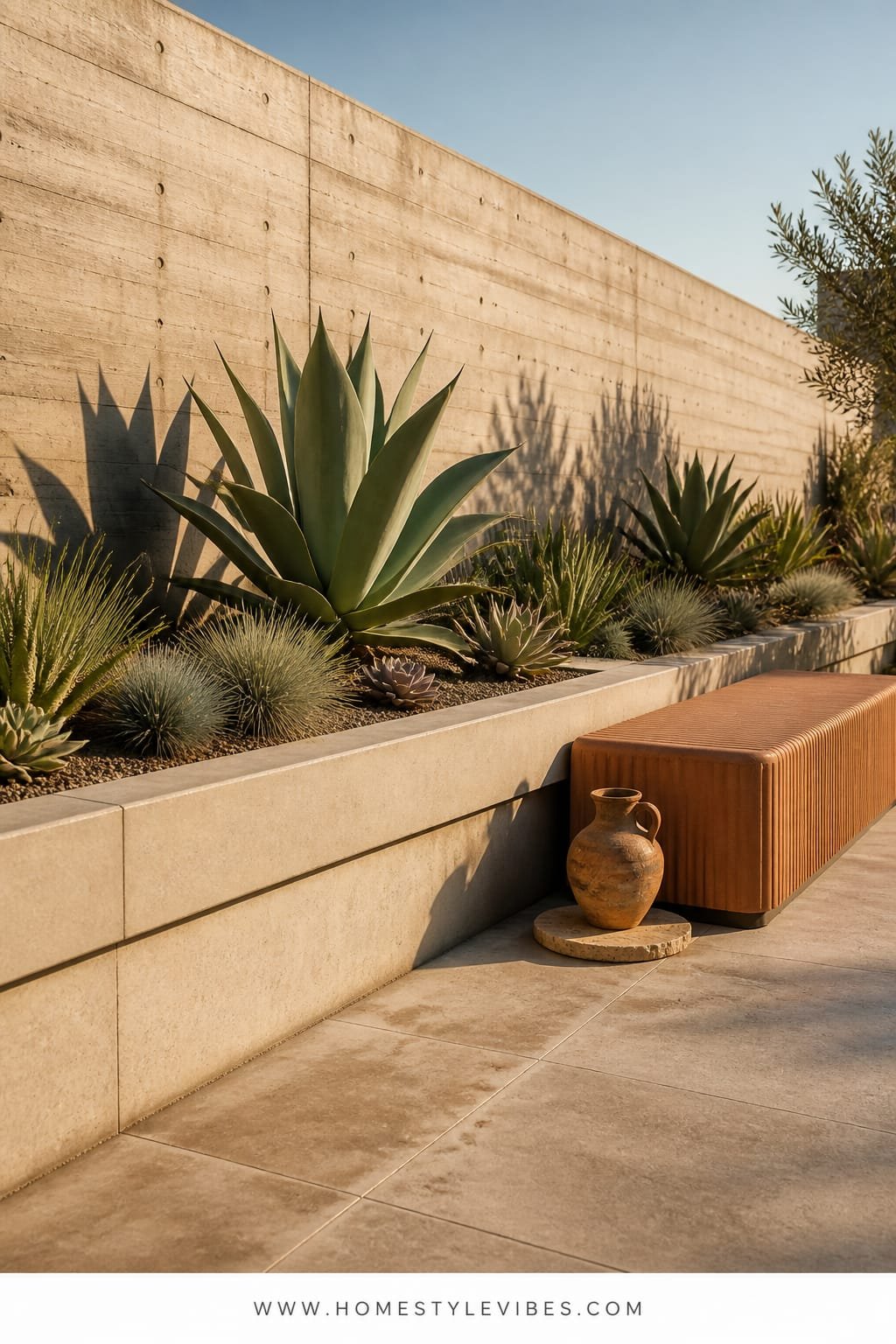
You want structure in a long, boring strip bed—the kind developers leave by the driveway that never feels finished. You’ve tried random pots, but it reads as clutter. This concept installs long, low bands of honed concrete planters, engineered to throw razor-sharp shadow lines at midday, with a ribbed terracotta bench breaking the rhythm. The mood is gallery-modern meets desert courtyard—graphic, clean, and quietly luxurious.
Real-life strengths: the planter bands act as raised beds with excellent drainage, perfect for echeveria, haworthia, and mangave. They also keep gravel contained near driveways. Noon light, usually a design enemy, becomes an asset—those planter edges cast confident lines that give your succulents theatrical definition. In photos, it’s all tone-on-tone, cool gray against blue-green leaves, with the terracotta bench warming the scene.
Try these versions:
– Budget-friendly: use fiberstone or composite trough planters in a tight row.
– Renter-friendly: freestanding planters with hidden casters behind a slim gravel strip.
– Small space: two bands and a stool-size terracotta side table instead of a full bench.
Budget Breakdown:
- Honed concrete or composite trough planters (2–4): $300–$1,400
- Ribbed terracotta bench or two stools: $200–$800
- Succulents in repetitive species: $120–$350
- Gravel and weed fabric: $80–$200
- Drip line kit (optional): $60–$180
Total Estimated Cost: $760 – $2,930
Best For: Driveway beds, apartment entryways, or long narrow yards that need crisp geometry and minimal mess.
Key Design Elements:
- Main materials: honed concrete, ribbed terracotta, fine gravel
- Color palette: cool gray, clay, blue-green foliage
- Lighting strategy: embrace high noon shadows; add subtle step lights for evening
- Furniture silhouettes: long bench or two ribbed cubes
- Texture layers: smooth concrete, ridged terracotta, waxy leaves
- Accent details: repeat one species per planter for graphic punch
Why This Looks Expensive: Repetition, negative space, and a controlled palette. The bench breaks the severity just enough to feel curated, not corporate.
How To Recreate This Look:
- Measure the bed length and choose planters that fill 80–90% of it, leaving slim gravel borders.
- Set planters perfectly level; micro-adjust until shadow lines read straight at noon.
- Backfill with gritty succulent mix; plant in straight rows or odd-number clusters per planter.
- Place the terracotta bench centered between planters or slightly off for a designer “miss.”
- Run drip irrigation or water deeply and infrequently; keep the gravel clean with a quick weekly rake.
One Thing To Avoid: Mixing more than three plant species across the bands. You want rhythm, not noise.
Pro Styling Tip: Photograph on a cloudless day at noon; lean into the stark shadows—they’re your design allies here.
Confession time: aligning planters perfectly can be maddening. I’ve stood there with a level and a stubborn planter foot that refused to cooperate. Shims under the back edge saved my sanity. You’ll thank yourself when those shadows run like drawn lines.
6. Desert Quartzite Flagstone, Amber Path Glow, and a Black Basalt Boulder Trio
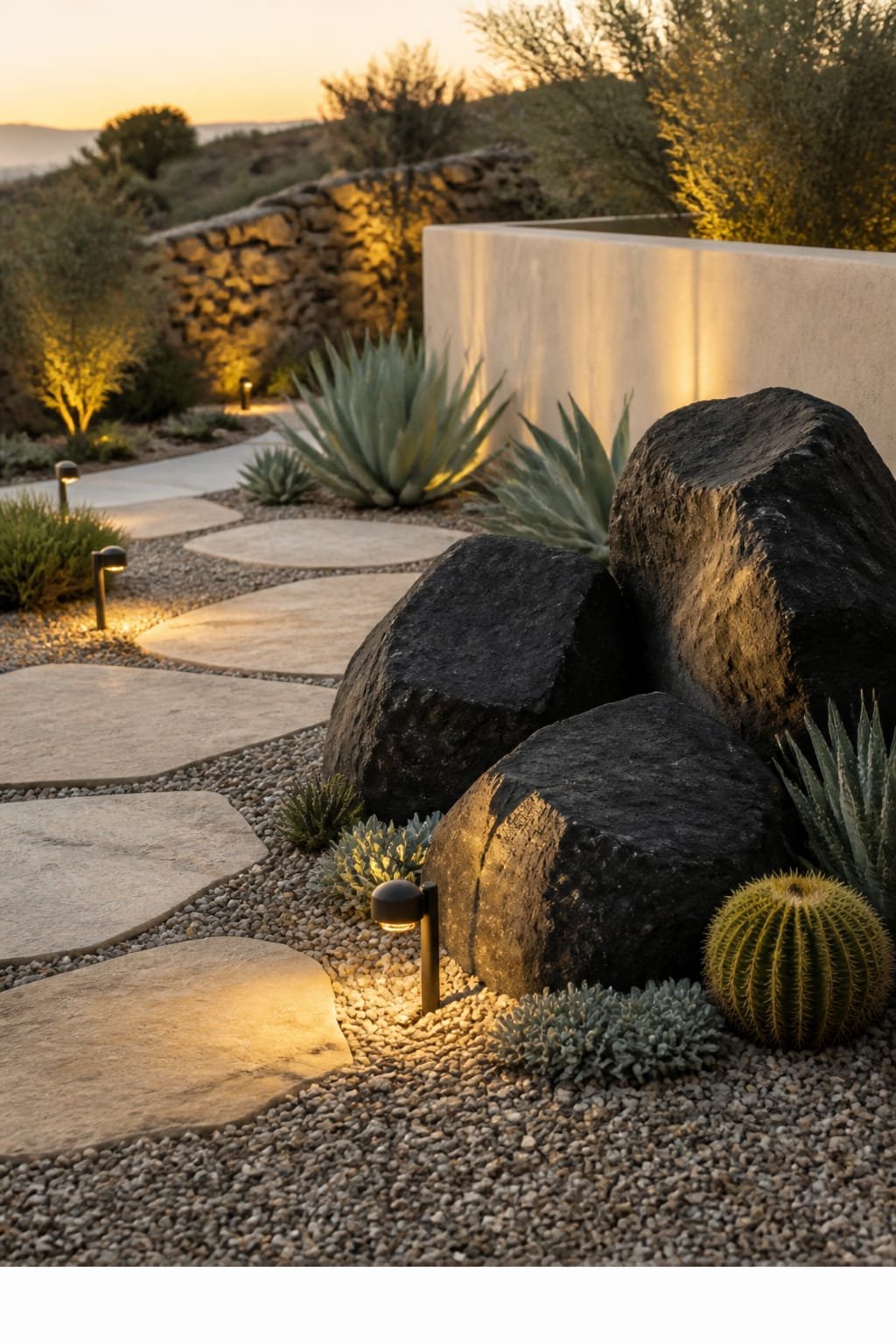
You’ve got plenty of plants but zero presence. It reads busy and forgettable. This bed pairs silky quartzite flagstone with warm amber path lights and a trio of black basalt boulders that hold the scene like punctuation marks. The overall feel is modern Southwest with a hint of spa—grounded, warm, and quietly strong.
Function meets form: flagstone creates stepping pockets that invite you in for care and close-ups, while boulder trios add scale without constant grooming. Amber lighting softens the stone at night and bounces warmth onto cooler-toned succulents for crazy-good contrast. The materials—quartzite, basalt, and bronze-toned fixtures—photograph well because you get light/dark dynamics and human-scale steps that lead the eye.
Play with these variations:
– Budget-friendly: use concrete steppers dusted with polymeric sand for a sleek faux look.
– Small-space: a single S-curve of stone with one hero basalt boulder and two smaller “cousins.”
– Renter-friendly: surface-lay steppers on compacted DG; you can lift them later.
Budget Breakdown:
- Desert quartzite flagstone (80–120 sq ft): $350–$1,000
- Black basalt boulders (S, M, L): $180–$600
- Amber path lights (4–6 fixtures): $160–$420
- Gravel and DG base: $120–$260
- Succulent infill (mixed heights): $120–$320
Total Estimated Cost: $930 – $2,600
Best For: Mid-sized yards that need hierarchy and nighttime usability. Perfect near patios or spa areas.
Key Design Elements:
- Main materials: quartzite, black basalt, bronze fixtures
- Color palette: sandy cream, inky black, soft greens
- Lighting strategy: amber path glow on stone edges; no direct glare
- Furniture silhouettes: none; the boulders do the visual heavy lifting
- Texture layers: honed-looking stone faces, rough basalt, plump leaves
- Accent details: a few tufts of drought grasses for movement
Why This Feels Designer: Boulder groupings in threes, staggered sizes, and a consistent stone tone look intentional. The eye understands the rhythm, so the scene reads calm.
How To Recreate This Look:
- Lay out boulders first; anchor the largest slightly off-center, then add medium and small nearby.
- Map stepping lines with cardboard templates; cut flagstone to hug the curves.
- Set on compacted DG with tight, irregular joints; brush in fine gravel.
- Plant succulents in crescents around boulders; keep a 6-inch breathing zone from stone edges.
- Install amber path lights low, aiming across stone, not at eyes.
The Most Common Mistake: Random boulder scattering. Always group and partially bury boulders by 20–30% so they look like they’ve been there forever.
Pro Styling Tip: At dusk, bounce a small handheld light onto the boulder faces for photos; it pulls texture without blowing out your highlights.
If one of these feels extra bold, good. Desert gardens reward clarity. Pick a lane—sculptural, minimal, moody—and commit with 2–3 materials max.
7. Warm Terracotta Gravel Field, Dappled String Light Glow, and an Oversized Glazed Urn Plinth
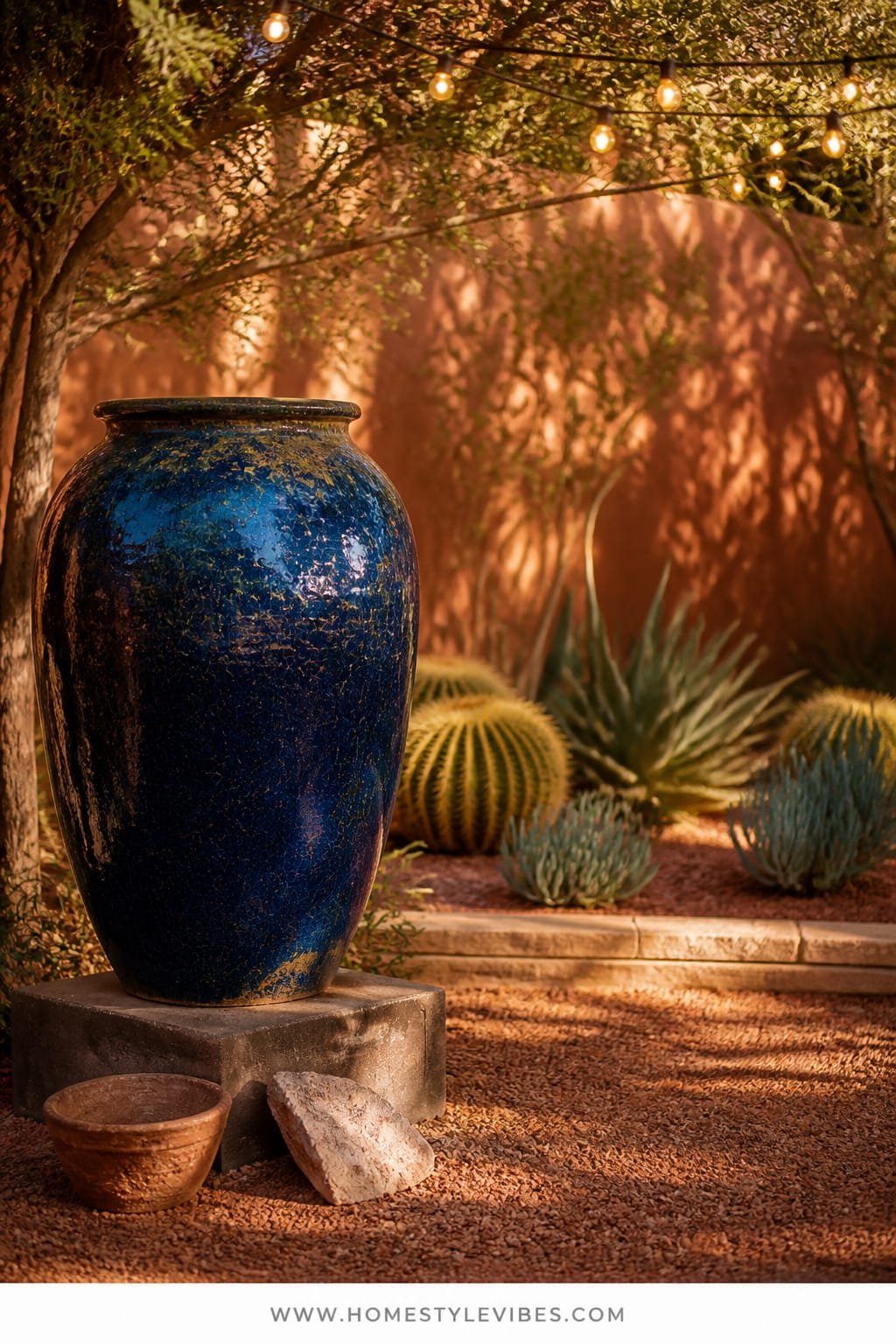
You want that courtyard moment—something your friends actually gather around. But your current bed lacks a “why.” This look leans into a warm terracotta gravel field, strung with dappled lights overhead, anchored by an oversized glazed urn on a simple plinth. The mood is festive desert boho meets boutique hotel—warm, textured, and social.
Real talk: terracotta-toned gravel instantly warms a space and makes green and blue succulents pop. A single oversized urn on a low square plinth acts like a sculpture. Add string lights, and suddenly your yard feels like an outdoor room. The materials—clay gravel, glossy ceramic, matte succulents—create a tactile contrast that photographs beautifully, especially with gentle overhead sparkle that mimics starlight on the glaze.
Variations to make it yours:
– Budget-friendly: use a large fiberglass urn with a high-gloss glaze finish; looks luxe, lighter weight.
– Small space: one urn, 6–9 plants, and a single bistro chair nearby for scale.
– Darker version: deep oxblood urn, charcoal gravel border, cooler-toned plants for drama.
Budget Breakdown:
- Warm terracotta gravel (1–2 yards): $120–$260
- Oversized glazed urn (30–40 inches): $250–$900
- Simple concrete or stone plinth: $80–$250
- Outdoor string lights and posts: $80–$220
- Succulents (aloe, echeveria, crassula mix): $120–$320
- Optional drip irrigation: $60–$180
Total Estimated Cost: $610 – $2,130
Best For: Courtyards, patio edges, or any gathering spot that needs a focal piece and flirty evening light.
Key Design Elements:
- Main materials: terracotta gravel, glazed ceramic urn, concrete plinth
- Color palette: warm clay, glossy oxblood or olive glaze, jade greens
- Lighting strategy: overhead string lights for dapple and sparkle; optional low uplight on urn
- Furniture silhouettes: add a slim bistro set or woven lounge chair
- Texture layers: gritty gravel, glassy glaze, matte foliage
- Accent details: a thin charcoal gravel border to frame the field like a rug
How To Recreate This Look:
- Square off the bed and add a 4–6 inch charcoal gravel border for a “frame.”
- Set the plinth dead-center or 1/3 in from a corner; check level twice.
- Place the urn; if it’s a fountain, route power neatly and hide cords behind the plinth.
- Spread terracotta gravel evenly; rake in long pulls for subtle striping.
- String lights overhead in a wide V for even sparkle; plant low succulents in arcs around the urn.
Why This Looks Expensive: One commanding object on a plinth screams gallery, not garden store. The framed gravel field reads like a thoughtfully composed outdoor “floor.”
Watch Out: Don’t overdo the string lights. One to two lines feel chic; five lines scream backyard carnival.
Pro Styling Tip: Turn off all other lights and shoot the urn scene at night with just the string lights; the glaze reflections will look like liquid.
One more mindset shift: plants are supporting actors here. The star is composition—edges, light, shadow, and one unforgettable object. When I finally stopped chasing rare plants and focused on lines and light, my yard started to look like those photos I saved for years.
Quick Checklist
- Decide on a single color story: warm sand or cool gray
- Pick one hero object: bowl, urn, bench, or boulder trio
- Limit plant palette to 3–5 species max
- Choose one gravel type and stick to it
- Edge your beds with stone, wood, or a visible shadow line
- Plan lighting first: uplight, wash, or path glow
- Use negative space around focal plants
- Repeat shapes: rows, grids, or arcs
- Test layouts with black-and-white phone photos
- Rake gravel before guests or photos
Frequently Asked Questions
How much should I budget for a small succulent garden bed that still looks high-end?
For a 6×8 foot bed, plan on $600–$1,500, depending on materials. Splurge on one hero element (Corten bowl, glazed urn, or stone border) and keep plants and gravel consistent. That single statement piece creates the “designer” read.
What if my space is tiny or I only have a narrow side yard?
Pick the cedar grid bed or the concrete planter bands. Both thrive in narrow strips and look tidy from every angle. Repeat 2–3 plant species and leave clean negative space between focal points for a purposeful look.
Are succulent garden beds hard to maintain long-term?
No. Once established, maintenance drops to monthly: a light rake, a quick weed pull, and the occasional trim. The trick is drainage—use gritty soil mixes and avoid overwatering. Good edging and landscape fabric under gravel also save hours.
I rent. What can I do without committing to permanent changes?
Focus on freestanding elements: composite trough planters, a portable Corten or fiberglass bowl, and surface-laid steppers on compacted DG. Use plug-in lights and string lights instead of hardwired fixtures. You can lift everything when you move.
What’s the most common mistake people make with succulent garden beds?
Too many materials. Mixing 4–5 gravels, random pavers, and ten plant species reads chaotic. Choose one stone, one hero object, and 3–5 plants. Give each statement plant breathing room so it can cast a shadow and actually be seen.
Wrap-Up: Your Desert Paradise, On Purpose
Pick one idea and claim a corner this weekend. Lay that crisp edge, set the hero object, and light it like you mean it. You’ll be shocked how quickly a simple material palette and a sculptural plant read like a full redesign.
The truth is, luxury outdoors comes from texture, lighting, and restraint. Not price tags. When gravel stays consistent, borders feel deliberate, and light paints those slow evening shadows, your yard looks finished—like a place, not an afterthought.
You’ve got this. Start with one bed, keep your palette tight, and let the succulents do what they do best: thrive with barely any fuss. Then make yourself a drink, step outside at golden hour, and enjoy that quiet, glowing desert paradise you built—one beautiful choice at a time.
About the Author

Krisztina P.Rendes, Founder of Home Style Vibes
Founder of Home Style Vibes
Krisztina Puskásné Rendes created Home Style Vibes as a cozy-modern lifestyle space where homemaking meets inspiration. Her goal is to help women create beautiful, organized, and peaceful homes they truly love — without overwhelm. You’ll find here heart-driven content on home decor, cleaning tips, easy family recipes, organization and decluttering, DIY home projects, plants, and seasonal ideas — all designed to bring more calm, comfort, and style into everyday life.