6 Cozy Vintage Cottage Laundry Room Ideas That Feel Warm And Charming
You want a laundry room that smells like fresh cotton and looks like a page torn from a vintage cottage magazine. You hate the harsh lighting, the plastic hampers, and the jumble of mismatched detergents staring at you while socks mysteriously vanish. Picture soft morning light on worn wood, a whisper of linen at the window, and the kind of charm that makes laundry feel less like a chore and more like a ritual. These six cozy vintage cottage laundry room ideas will fix the clutter, tame the chaos, and give you a warm, charming space you’ll actually want to be in—on a weekend afternoon—with a budget ceiling of $2,500 for most versions and weekend-ready timelines.
Think muted colors, honest materials, old-world details. Each section is a complete design plan with styling notes and pricing so you can stop guessing. They’re photogenic, deeply practical, and yes—Pinterest-loved. If your home leans cottage, English country, Cape Cod, or farmhouse-adjacent, these are your people.
1. Milk-Painted Pine With Sunlit Sconces And A Deep Apron-Front Sink
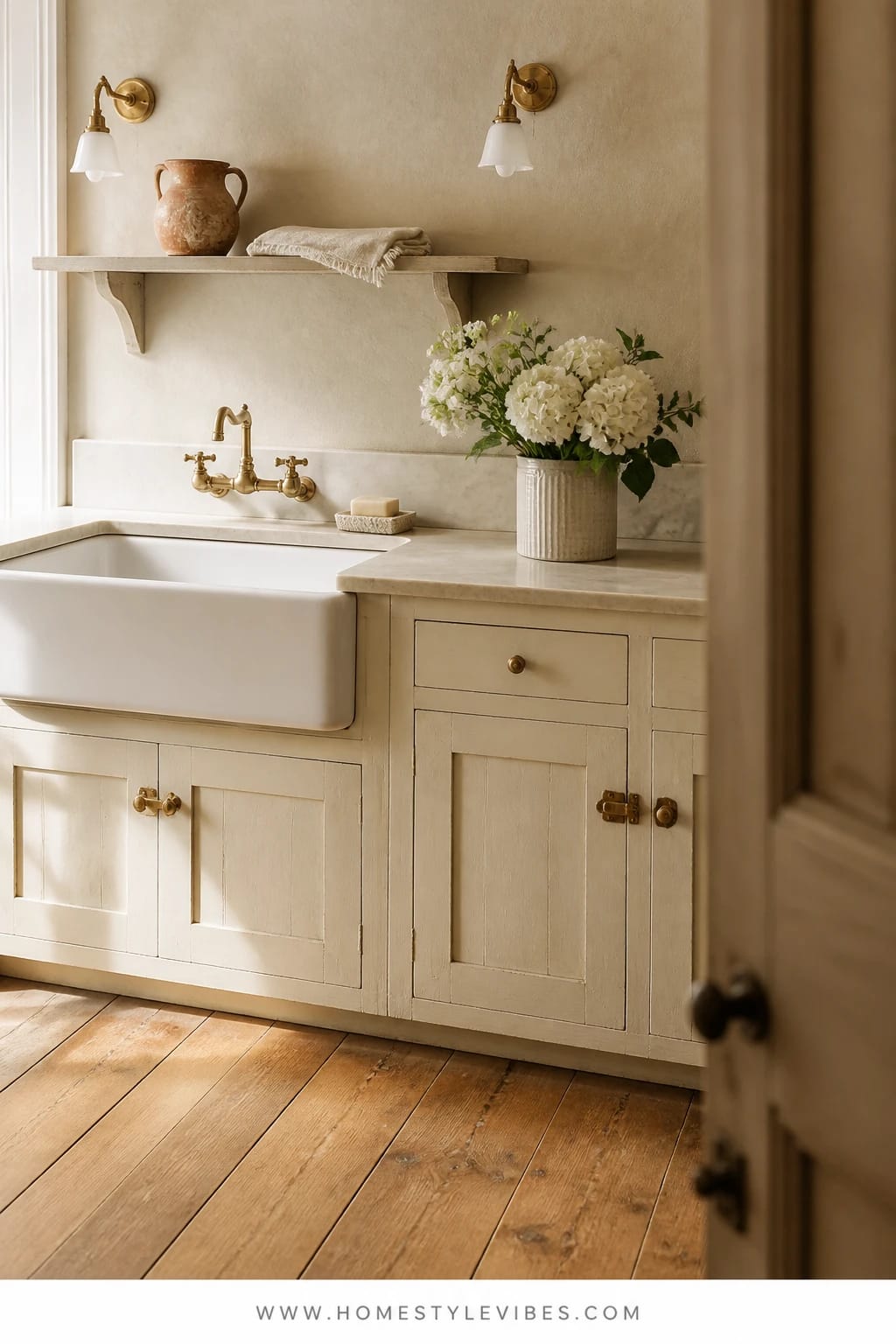
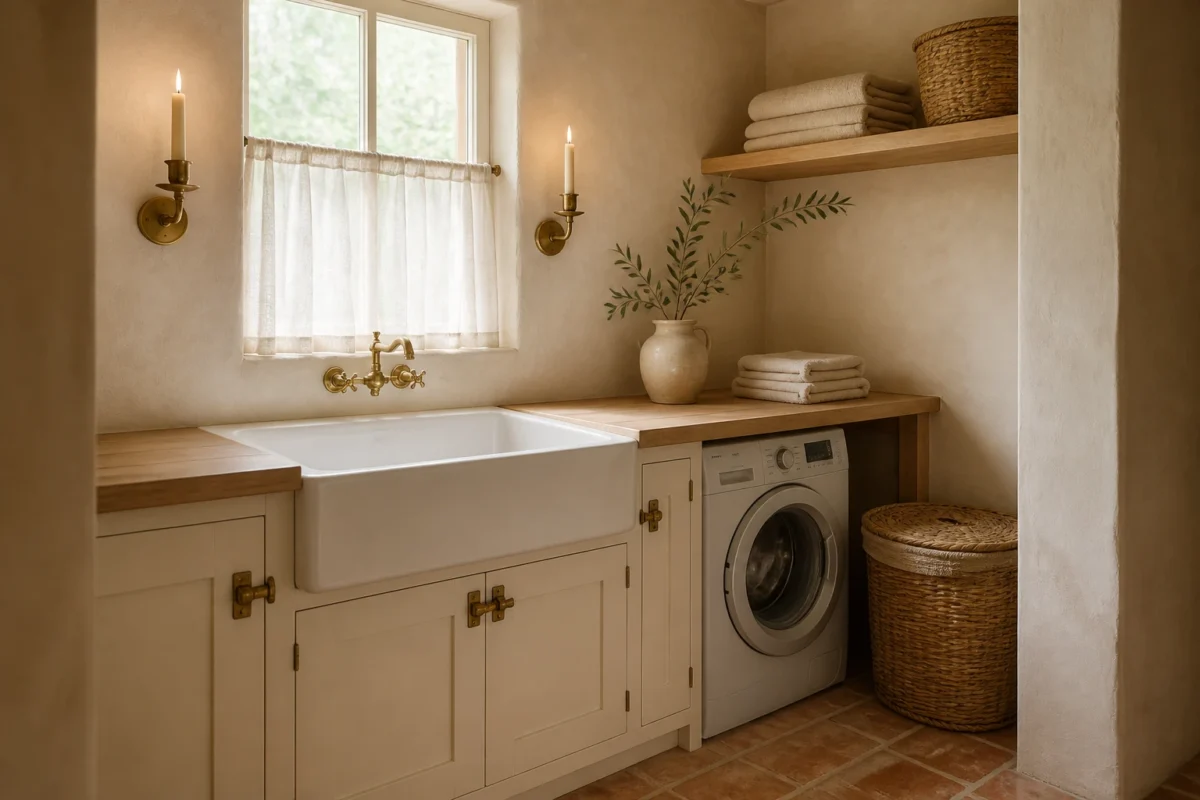
We’ve all been there: a laundry corner that always feels utilitarian and cold, no matter how many baskets you buy. You’ve tried brightening the walls, but it still reads like a basement closet. This design leans into soft nostalgia: milk-painted pine cabinetry, hand-rubbed brass latches, and a deep apron-front sink that makes even handwashing delicates feel old-world luxurious. The mood is slow-living cottage—clean, tactile, and sunlit.
Why it works in the real world: milk paint forgives dings and scrapes, pine warms up even a windowless nook, and the apron-front sink is a workhorse for muddy boots and oversized sweaters. Lighting shifts the whole vibe—swap the harsh flush mount for a pair of warm-lensed sconces flanking a small mirror or open shelf. Photos love this setup because the matte milk paint drinks light, the brass adds tiny gleams, and the sink provides sculptural weight. Texture and gentle contrast do the heavy lifting.
Variations you’ll love: a budget-friendly version with IKEA pine boxes and peel-and-stick beadboard; a renter-friendly swap with a freestanding sink cabinet and plug-in sconces; and a smaller-space layout that uses a 24-inch sink and a narrow counter above the machines. Prefer a darker cottage mood? Try a mossy milk paint with unlacquered brass and cream linen cafe curtains.
Budget Breakdown:
- Apron-front sink: $350–$800
- Milk paint + primer: $60–$120
- Pine cabinet fronts or boxes: $250–$700
- Brass hardware and latches: $75–$200
- Pair of sconces (hardwired or plug-in): $120–$300
- Beadboard or V-groove paneling: $100–$250
- Linen cafe curtain + rod: $50–$150
Total Estimated Cost: $1,005 – $2,520
Best For: Classic cottages, small to medium laundry rooms, anyone who wants a calming, soft-lit workspace with durable surfaces and charming details.
Key Design Elements:
- Main materials: milk-painted pine, brass, ceramic sink
- Color palette: cream, gentle sage or French gray, warm brass, soft white
- Lighting strategy: warm 2700K sconces, dimmer switch, bounce light off a light wall
- Furniture silhouettes: Shaker cabinet faces, deep apron-front sink, simple wall shelf
- Texture layers: beadboard, linen, hand-brushed paint finish
- Accent details: ceramic soap dish, wooden scrub brush, petite oil painting
How To Recreate This Look:
- Start with beadboard half walls painted cream; cap with a simple pine rail.
- Add an apron-front sink and a basic faucet with cross handles.
- Layer milk-painted pine cabinets or fronts; distress edges lightly with fine sandpaper.
- Install warm sconces on either side of a small mirror or shelf to expand light.
- Style with a linen cafe curtain, a vintage-style brush, and a small framed botanical.
Why This Looks Expensive: The sink reads custom, the brass ages gracefully, and the milk-painted finish adds depth you can’t fake with flat latex. It’s quietly layered, not loud.
Watch Out: Don’t choose a too-bright white; stark white plus brass can feel clinical. Pick a softer cream so the metals glow instead of glare.
Pro Styling Tip: Angle a small mirror to catch window light and create a rim of brightness along the sink front—great for photos and makes mornings feel gentler.
Curious how to make tiny rooms pull their weight? Keep scrolling—Section 2 is your storage hero.
2. Beadboard Birch With Overcast Lantern Light And An Antique Drying Rack
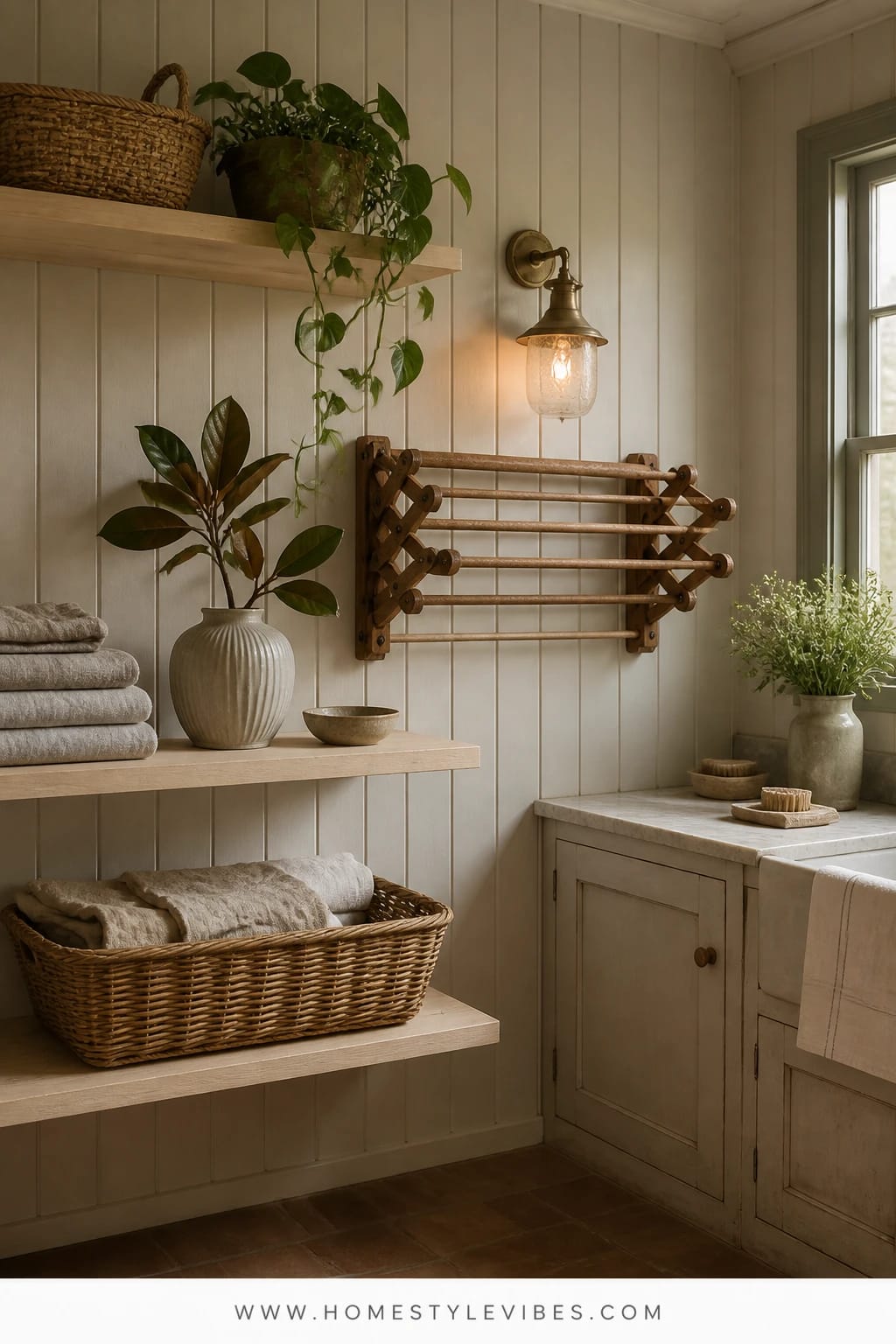
It’s that one wall of open shelving that always feels cluttered, no matter how many baskets you buy. Labels help, but the space still looks busy. The fix: a beadboard wrap, birch shelves with a gentle rounded edge, and an antique wall-mounted drying rack as your statement piece. The mood is English laundry attic on a gray day—soft, humble, and organized without shouting about it.
Here’s why this works in real homes: beadboard has built-in rhythm that calms visual noise, and birch stays light without feeling cheap. A fabric-lined storage system hides the mess. Swap the overhead spotlight for a cottage-style lantern with milk glass that diffuses light like a softly overcast sky. This combo photographs beautifully because the vertical lines of beadboard, the curves of the lantern, and the accordion shadows from the drying rack create depth.
Variations include a small-space option using a narrower, folding drying rack; a renter version with removable beadboard wallpaper; and a darker palette with inky blue beadboard and oiled walnut shelves for drama. If you’re on a tight budget, thrift a folding rack and refresh with tung oil—instant heirloom energy.
Budget Breakdown:
- Beadboard panels or beadboard wallpaper: $80–$220
- Birch shelves + brackets: $120–$300
- Antique or reproduction drying rack: $60–$180
- Milk-glass lantern or pendant: $100–$250
- Fabric-lined baskets: $60–$140
- Low-profile wall hooks: $30–$90
Total Estimated Cost: $450 – $1,180
Best For: Narrow laundry nooks, households with line-dry delicates, anyone craving visual order with a cottage soul.
How To Recreate This Look:
- Start by wrapping your main wall in beadboard or beadboard wallpaper and paint a muted gray-green.
- Add two birch shelves with rounded fronts and sturdy brackets, spaced to fit baskets.
- Layer in an antique-style folding drying rack centered above the machines.
- Install a milk-glass lantern pendant on a dimmer; keep the bulb frosted.
- Style with fabric-lined baskets, a ceramic jar for pegs, and a small ivy in a clay pot.
Key Design Elements:
- Main materials: beadboard, birch, milk glass
- Color palette: gray-green, birch blonde, cream, clay
- Lighting strategy: diffused pendant + task light if needed
- Furniture silhouettes: rounded shelf edges, folding rack geometry
- Texture layers: woven fabric, clay, matte paint
- Accent details: peg jar, linen-wrapped bin, tiny framed landscape
Why This Feels Designer: The drying rack reads like sculpture, the lantern glow is atmospheric, and the beadboard lines tie everything together with deliberate rhythm.
One Thing To Avoid: Don’t cram the shelves end-to-end with baskets. Negative space is your friend, especially above eye level.
Pro Styling Tip: Leave one shelf partially empty with a single vintage bottle and a trailing leaf—your eye needs a “rest stop,” and so does the camera.
If you’ve ever wished your laundry room smelled like a summer porch, the next look leans into that breeze-kissed energy.
3. Honed Soapstone With Morning Window Glow And A Vintage Wall-Mounted Faucet
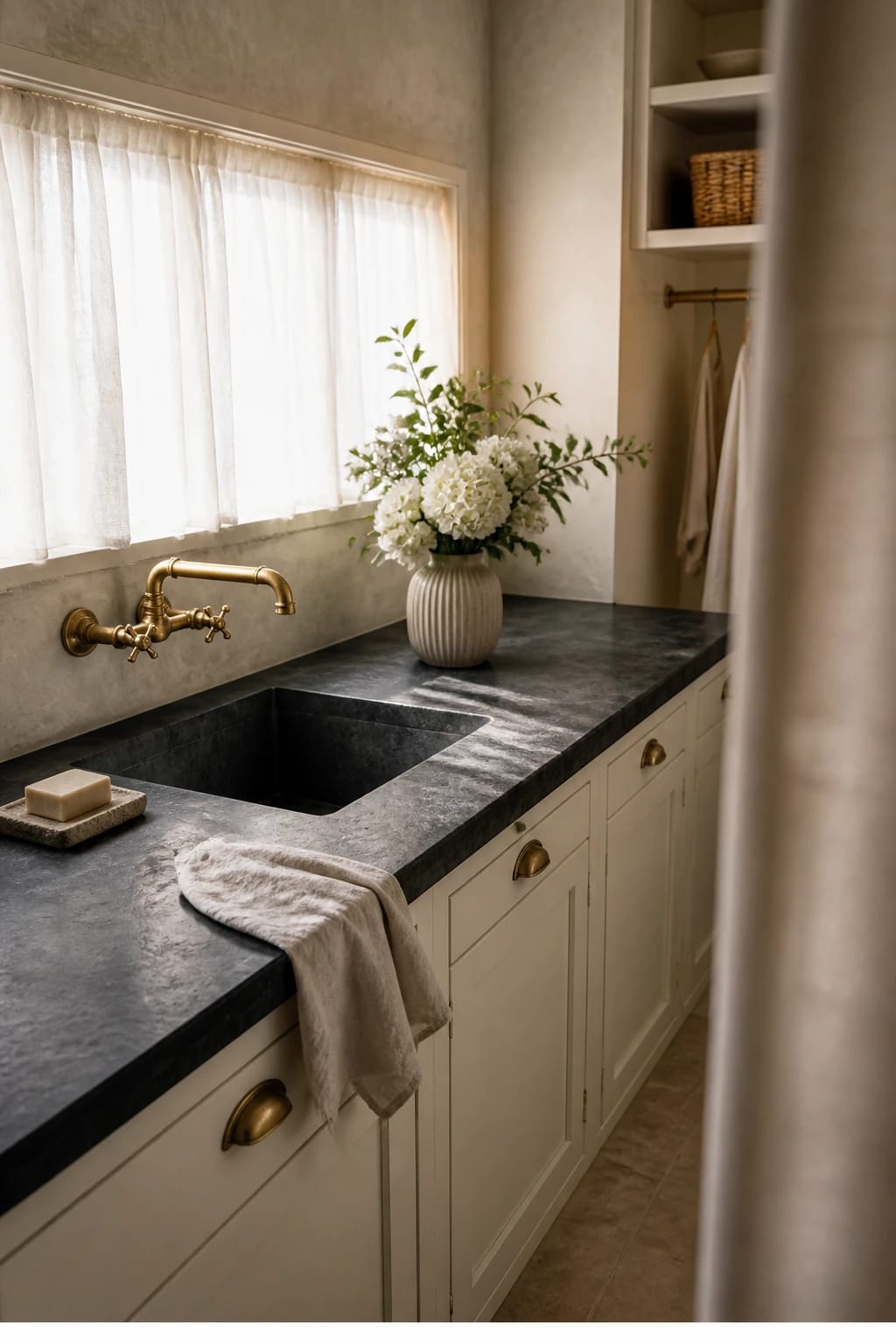
You want utility without the “utility room” vibe. Stainless counters felt too industrial, and butcher block worried you with water stains. Honed soapstone is the quiet hero that solves it. It’s deep, velvety, and ages beautifully—like a leather jacket for your countertops. Add a vintage wall-mounted faucet and a low, wide window with sheers. The mood: coastal cottage meets working pantry, easy and grounded.
Real-world win: soapstone shrugs off splashes and hot pots. The window glow softens its depth so the counter never feels heavy. This photographs like a magazine spread—the dark counter frames the whites, the faucet line adds charm, and the morning light creates a delicious shadow on the backsplash.
Options for different budgets: choose a soapstone remnant for small runs, or faux it with a deep charcoal laminate and a soft-matte finish. If you’re renting, use a freestanding vintage washstand with a stone remnant on top and a wall-mount faucet mimic (yes, there are bridge faucets with deck mounts that give a similar vibe). For a darker look, pair the stone with olive cabinets and antique brass knobs; for a breezier feel, keep cabinets warm white and add a pale blue curtain.
Key Design Elements:
- Main materials: honed soapstone, matte tile, linen sheer
- Color palette: charcoal, warm white, soft blue-gray, antique brass
- Lighting strategy: maximize window glow, add an under-shelf LED strip at 2700K
- Furniture silhouettes: simple shaker doors, vintage bridge faucet
- Texture layers: velvety stone, slubby linen, matte ceramic
- Accent details: enamel basin, wooden scoop, glass jar of clothespins
Budget Breakdown:
- Soapstone (remnant or small slab): $450–$1,200
- Vintage-style wall faucet: $160–$450
- Linen window sheers + rod: $70–$180
- Matte tile backsplash: $120–$320
- Under-shelf LED strip + dimmer: $60–$150
Total Estimated Cost: $860 – $2,300
Best For: Rooms with at least one window, households that want hardwearing counters and timeless utility with a cottage accent.
How To Recreate This Look:
- Start by planning a single run of counter; choose soapstone or deep charcoal laminate in matte.
- Add a simple matte tile backsplash to the window line.
- Layer a wall-mounted or bridge faucet above a shallow but wide sink.
- Install a thin under-shelf LED strip to graze the tile at night.
- Style with a linen sheer, enamel basin, and a wooden-handled scrub brush.
Why This Reads High-End: Matte stone plus vintage plumbing equals “quiet money.” The finishes are tactile and honest, not shiny for the sake of it.
The Most Common Mistake: Pairing soapstone with overly cool white paint. Choose a creamy white so the counter looks rich, not harsh.
Pro Styling Tip: Leave a 2-inch gap between the sheer and the wall so light can wrap the tile edge. That tiny halo looks luxe in photos.
Small pep talk time: Remember, this isn’t about recreating a showroom. It’s about building a space that feels like yours, not an algorithm’s. If only one element from a section lands—use it and ignore the rest.
4. Limewashed Brick With Candlelit Warmth And A Skirted Utility Table
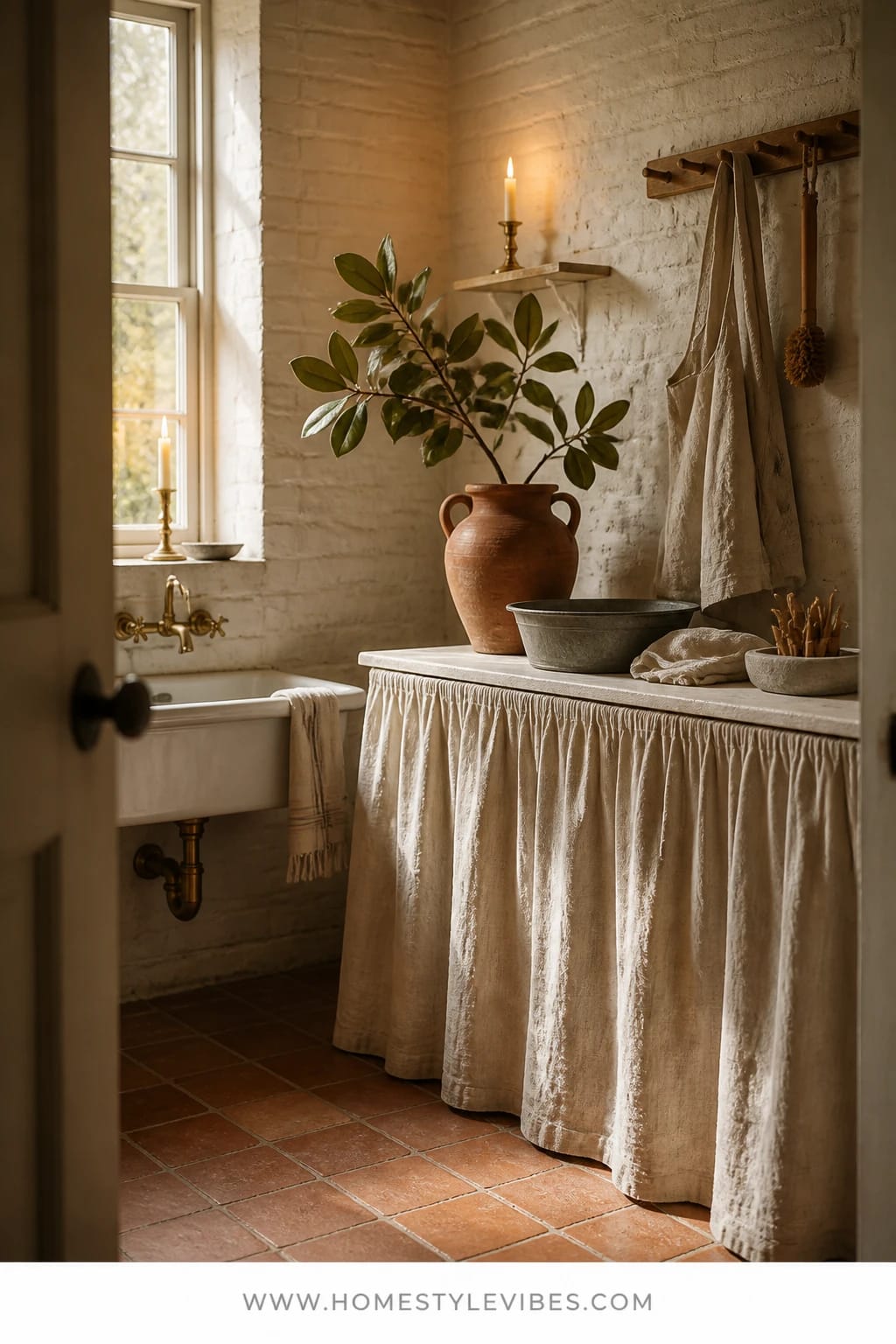
Let’s be honest: not every laundry room has pretty bones. Maybe your floor is patchy, the walls are uneven, and the plumbing shows like bad jewelry. Limewashed brick and a skirted utility table are the clever cover-ups that still feel authentic. The mood is rustic cottage hearth meets laundry—soft shadows, earthy tone, and that rumpled linen skirt that hides everything with a wink.
It works because limewash gives depth to imperfect surfaces (it loves flaws), and a skirted table lets you stash hampers, rolling bins, even a vacuum, without the visual clutter. Candle-style bulbs in a wrought-iron sconce add warmth that fluorescent lights steal. This setup photographs beautifully—the brick’s tonal variation creates moody depth, the skirt moves gently, and the iron adds a crisp line.
Variations: use brick veneer panels if you don’t have masonry, or try limewashed plaster with broad, visible brush strokes for a Mediterranean-cottage vibe. On a budget, a simple plywood top on sawhorse legs with a linen-cotton skirt still looks elevated. Renter-friendly? Use peel-and-stick brick with a chalky topcoat and a Velcro-attached skirt on a freestanding console.
Budget Breakdown:
- Brick veneer or peel-and-stick brick: $150–$500
- Limewash paint + brush: $80–$180
- Utility table or console base: $120–$400
- Linen or linen-blend skirt fabric + curtain tape: $60–$160
- Wrought-iron sconce(s) with candle bulbs: $100–$280
- Simple jute rug runner: $40–$120
Total Estimated Cost: $550 – $1,640
Best For: Cramped or awkward rooms, homes with rustic leanings, anyone who needs to hide functional chaos gracefully.
Key Design Elements:
- Main materials: limewashed brick, linen skirt, iron
- Color palette: dusty white, clay red peeking through, oatmeal linen, blackened iron
- Lighting strategy: warm candle bulbs, second lamp for task clarity
- Furniture silhouettes: rectangular table, loose skirt with soft pleats
- Texture layers: chalky lime, rough jute, airy linen
- Accent details: wooden pegs, beeswax candle, wire basket
How To Recreate This Look:
- Start by installing brick veneer or applying limewash to existing brick or textured wall.
- Add a utility table cut to fit your space; finish in a matte clear coat.
- Layer a linen skirt using tension rods or Velcro under the tabletop edge.
- Install candle-style iron sconces on a dimmer; supplement with a small shaded lamp on the table.
- Style with a jute runner, beeswax candle, and a wire basket for clothespins.
Why This Looks Intentional: The mix of rough (brick) and refined (linen) feels art-directed, not accidental. Imperfections become texture, not problems.
Don’t Do This: Don’t over-pleat the skirt. Too many tight gathers look fussy and hotel-y. Aim for relaxed, wide pleats that skim the floor.
Pro Styling Tip: Let the skirt barely graze the floor with a tiny 0.25-inch break. In photos it reads “tailored but soft.”
Up next: a design that loves tiny footprints and busy families—zero pretense, all charm.
5. Whitewashed Oak With Golden Afternoon Light And A Rolling Butcher-Block Island
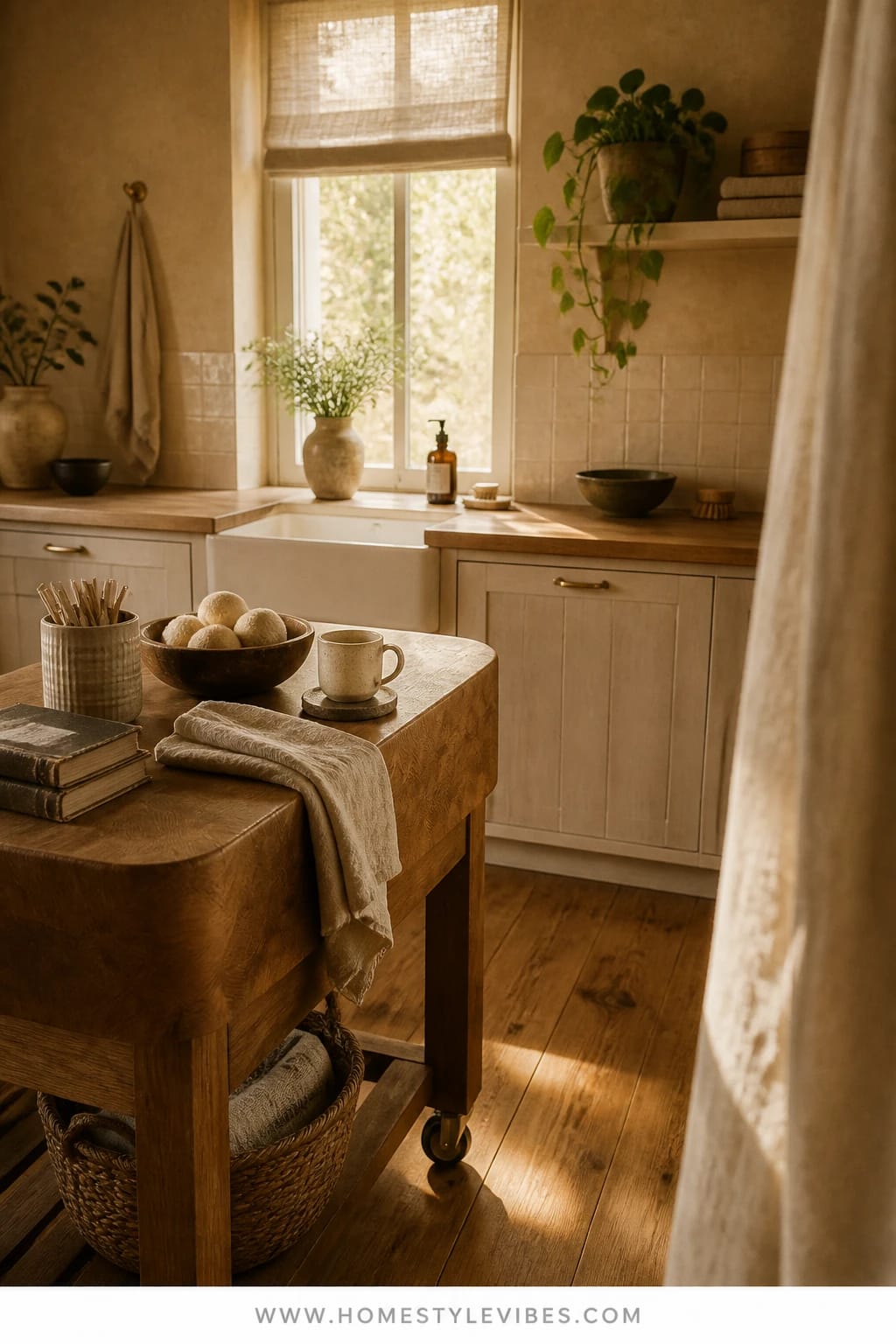
You’ve tried organizing detergents and baskets, but folding still ends up happening on the bed. Or worse—on the sofa while Netflix judges you. This cottage plan builds a proper folding zone: whitewashed oak cabinets, honeyed afternoon light, and a rolling butcher-block island that parks where you need it. The mood is Scandinavian-cottage—breezy, golden, and practical.
Why it works day-to-day: whitewashed oak reads bright without going stark, and it hides fingerprints like a champ. The mobile island adds counter space in seconds, then tucks away. If you choose an island with a lower slat shelf, you gain a spot for baskets or a steamer. Photography loves the interplay of pale oak grain, the warm block top, and that late-day glow that paints soft shadows on cabinet doors.
Scale it up for larger rooms with a wider island and pendant lighting, or keep it petite with a narrow trolley and folding leaves. On a tight budget, snag a secondhand bar cart and top with a butcher-block cutting board. If you rent, add plug-in picture lights over cabinets and go wild with peel-and-stick floor tile in a check pattern.
Budget Breakdown:
- Whitewashed oak (doors or veneer): $300–$900
- Rolling butcher-block island/trolley: $120–$450
- Plug-in picture lights or mini pendants: $90–$260
- Peel-and-stick checkered flooring: $120–$280
- Woven baskets for island shelf: $40–$120
- Ceramic hooks for bags: $30–$80
Total Estimated Cost: $700 – $2,090
Best For: Busy households, small to medium rooms, people who want flexible work zones and light, Scandi-cottage vibes.
How To Recreate This Look:
- Start by refacing or painting existing cabinets in a whitewashed oak finish (stain + whitewash combo).
- Add peel-and-stick check flooring for vintage cottage pattern underfoot.
- Layer a rolling butcher-block island sized to clear door swings.
- Install plug-in picture lights above cabinetry for that golden wash.
- Style with lidded baskets on the island shelf, a striped linen runner, and a ceramic pitcher for lost socks.
Key Design Elements:
- Main materials: whitewashed oak, butcher block, ceramic
- Color palette: pale oak, creamy white, soft caramel, inky black accents
- Lighting strategy: golden-hour bulbs, picture lights, ambient bounce
- Furniture silhouettes: slim island, flat-panel or simple Shaker fronts
- Texture layers: woven baskets, linen runner, subtle wood grain
- Accent details: ceramic knobs, enamel caddy, striped towel
Why This Feels Designer: The island introduces movement and a professional workflow. Light skims the oak grain, adding depth that looks custom.
Watch Out: Don’t choose a yellowy stain. Aim for pale oak with a whisper of white; yellow reads dated under warm bulbs.
Pro Styling Tip: For photos, park the island at a 15-degree angle and drape a single striped towel casually—effortlessly “lived in.”
Little mindset reset: If one idea resonates more than the others, that’s your starting point. You don’t need all of them. A single great counter, or just better lighting, can make laundry feel kinder.
6. Fluted Maple With Dappled Pendant Light And A Built-In Ironing Niche
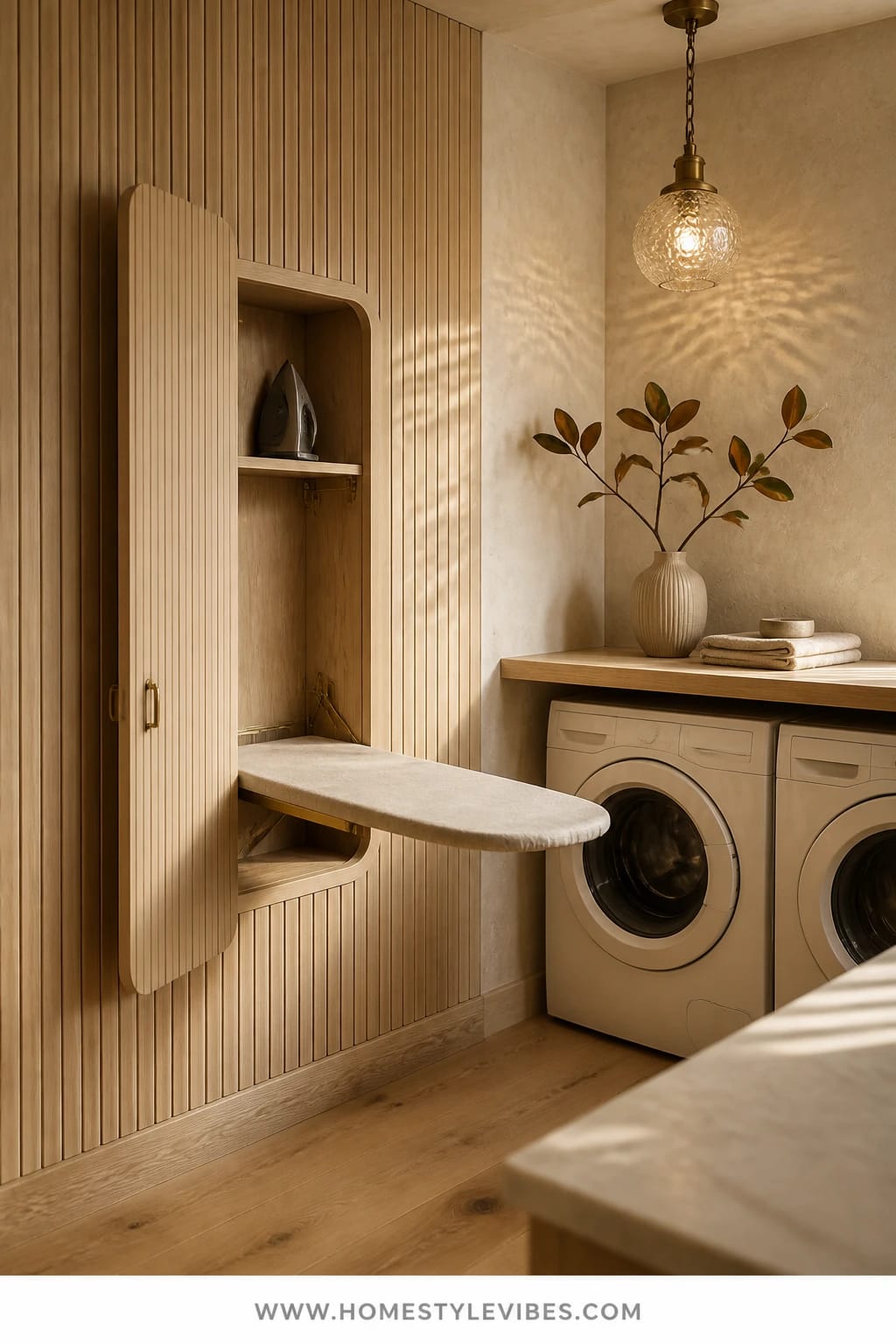
You’ve got the machines and a shelf, but there’s nowhere to iron without dragging a board from the guest closet. And when you do? It hogs the hallway. Enter: fluted maple paneling for architectural interest, a dappled-glass pendant that throws beautiful shadows, and a built-in ironing niche that tucks away when not in use. The mood is modern cottage with vintage manners—tidy, textural, and softly lit.
This works because fluting brings vertical texture without bulk, making small rooms feel taller. The ironing niche eliminates setup friction, which means shirts actually get ironed before school picture day. Dappled glass on the pendant scatters light elegantly, giving that “sun through leaves” effect that flat fixtures can’t. On camera, the flutes catch light and shadow, the pendant creates jewelry-like interest, and the niche looks like a bespoke detail, not a compromise.
Budget-friendly take: use fluted MDF strips painted soft putty instead of maple, and opt for a wall-mounted fold-down ironing board. Renter version: a slim ironing cabinet you can take with you and peel-and-stick fluted panels. For deeper mood, paint the fluting a muddy mushroom tone and pair with polished nickel hardware.
Budget Breakdown:
- Fluted maple or MDF panels: $180–$600
- Dappled-glass pendant: $120–$300
- Built-in ironing cabinet/board: $150–$450
- Soft-putty paint + primer: $70–$140
- Nickel or brass pulls: $60–$140
- Wool ironing pad + spray bottle: $30–$70
Total Estimated Cost: $610 – $1,700
Best For: Tall but narrow laundry rooms, organized homes that crave one smart feature to reduce stress.
Key Design Elements:
- Main materials: fluted maple/MDF, dappled glass, painted cabinetry
- Color palette: putty, mushroom, warm white, soft nickel
- Lighting strategy: pendant for atmosphere, under-cab strip for ironing task light
- Furniture silhouettes: slim fluted wall, integrated niche door
- Texture layers: ribbed panel, matte paint, woven hamper
- Accent details: nickel knobs, wool pad, glass spray mister
Why This Looks Expensive: Fluting adds architectural detail that feels custom, and the niche reads like millwork. The pendant’s patterned glow feels artisanal.
How To Recreate This Look:
- Start by paneling one focal wall with fluted maple or painted MDF strips.
- Add a fold-down ironing niche between studs or mount a slim cabinet on the wall.
- Layer in a dappled-glass pendant centered to the panel wall.
- Install task lighting near the niche: a low-profile LED strip does the job without glare.
- Style with a compact woven hamper and a glass mister on a small open shelf.
The Most Common Mistake: Mounting the niche too low. Top should align roughly with your elbow height when standing, so you’re not hunched over—measure twice.
Pro Styling Tip: Turn off the task strip and leave only the pendant on for photos; let the glass throw gentle patterns across the flutes for a romantic, cottagey mood.
A quick personal note: A friend of mine spent weeks agonizing over paint colors before realizing the real problem was her lighting. We lowered her pendant, swapped the bulb temp, and suddenly her “wrong” paint looked perfect. Moral: light first, then color.
One more mindset nudge: Perfection isn’t the goal. If your tile has a chip or your skirt seams aren’t couture, that’s fine. Cottage charm is about patina and honesty. Seriously, the most loved rooms usually have a scuff or three.
Quick Checklist
- Choose one dominant natural material (pine, oak, soapstone, brick, maple)
- Pick a warm light source at 2700K with dimmers
- Add a single statement feature (apron sink, drying rack, vintage faucet, skirted table, rolling island, ironing niche)
- Use matte or limewashed finishes for depth
- Layer soft textiles (linen cafe curtains, striped towels)
- Hide clutter with baskets or skirts
- Introduce a vintage accent (oil painting, enamel basin, wire basket)
- Balance light and dark surfaces for contrast in photos
- Keep at least one shelf partially empty for breathing room
- Install task lighting exactly where your hands work
Frequently Asked Questions
What if my laundry room has no windows—can I still get that cozy vintage cottage feel?
Yes. Use warm 2700K bulbs, frosted shades, and layered lighting: a ceiling lantern for ambient glow plus sconces or under-shelf strips. Choose creamy wall colors and matte finishes to mimic soft daylight. Add a small mirror to bounce light.
I’m on a tight budget. Which upgrade makes the biggest visual difference first?
Swap the lighting and add one statement feature. A pair of warm sconces or a milk-glass pendant plus a vintage drying rack or skirted table will change the mood fast for under $300–$500.
My space is tiny—how do I avoid cluttered visuals?
Commit to one focal material (beadboard or fluted panel), hide supplies in fabric-lined baskets, and leave 20–30 percent of open shelf space empty. Keep finishes matte and colors quiet so shadows read as texture, not mess.
I rent. What can I do without drilling or rewiring?
Use peel-and-stick beadboard or brick, plug-in sconces or picture lights, Velcro-attached skirts, rolling islands, and adhesive hooks. You’ll get the vintage cottage laundry room vibe with zero landlord drama.
How do I keep everything looking good with kids and pets?
Choose forgiving finishes: milk paint hides dings, whitewashed oak disguises fingerprints, and baskets with lids corral chaos. Add a washable runner and set a rule: socks go in the enamel basin, not the floor—make it a game.
Closing Thoughts
Pick one idea and start. Maybe it’s the apron-front sink that makes scrubbing boots feel like a ritual, or the rolling island that finally gives you a place to fold. You don’t need all six. One solid move—plus warm light—can make the room feel finished and kinder to live in.
The truth is, luxury in a laundry room isn’t price tags. It’s texture, light, and restraint. Honest materials, dimmable warmth, and a single statement piece will carry the whole space. If you can hear your own exhale when you step in, you did it right.
You’ve got this. Choose your favorite from these cozy vintage cottage laundry room ideas, queue a weekend playlist, and make a cup of tea. Then change the one thing that’s been bugging you most. Small shift, big mood—trust me.

About the Author

Krisztina P.Rendes, Founder of Home Style Vibes
Founder of Home Style Vibes
Krisztina Puskásné Rendes created Home Style Vibes as a cozy-modern lifestyle space where homemaking meets inspiration. Her goal is to help women create beautiful, organized, and peaceful homes they truly love — without overwhelm. You’ll find here heart-driven content on home decor, cleaning tips, easy family recipes, organization and decluttering, DIY home projects, plants, and seasonal ideas — all designed to bring more calm, comfort, and style into everyday life.