6 Crochet Flower Curtain Ideas For A Dreamy Cottagecore Window
You want that soft, sun-washed cottagecore glow: light filtering through lacey blooms, fluttery edges, and a window that makes your morning tea taste better. But tangled rods, too-short panels, and “why is this so flat?” fabric are wrecking your vibe. Let’s fix the frustration with crochet flower curtains that actually work in real life—authentic texture, better light, and finishes that photograph beautifully. In the next six ideas, you’ll find exact setups (each under a set budget range) that you can put together in a weekend and live with for years. Expect cozy light, layered texture, and a window moment that looks good from the street and even better on your feed. This is for vintage lovers, plant parents, and anyone who secretly wants their home to feel like a tender, quiet poem.
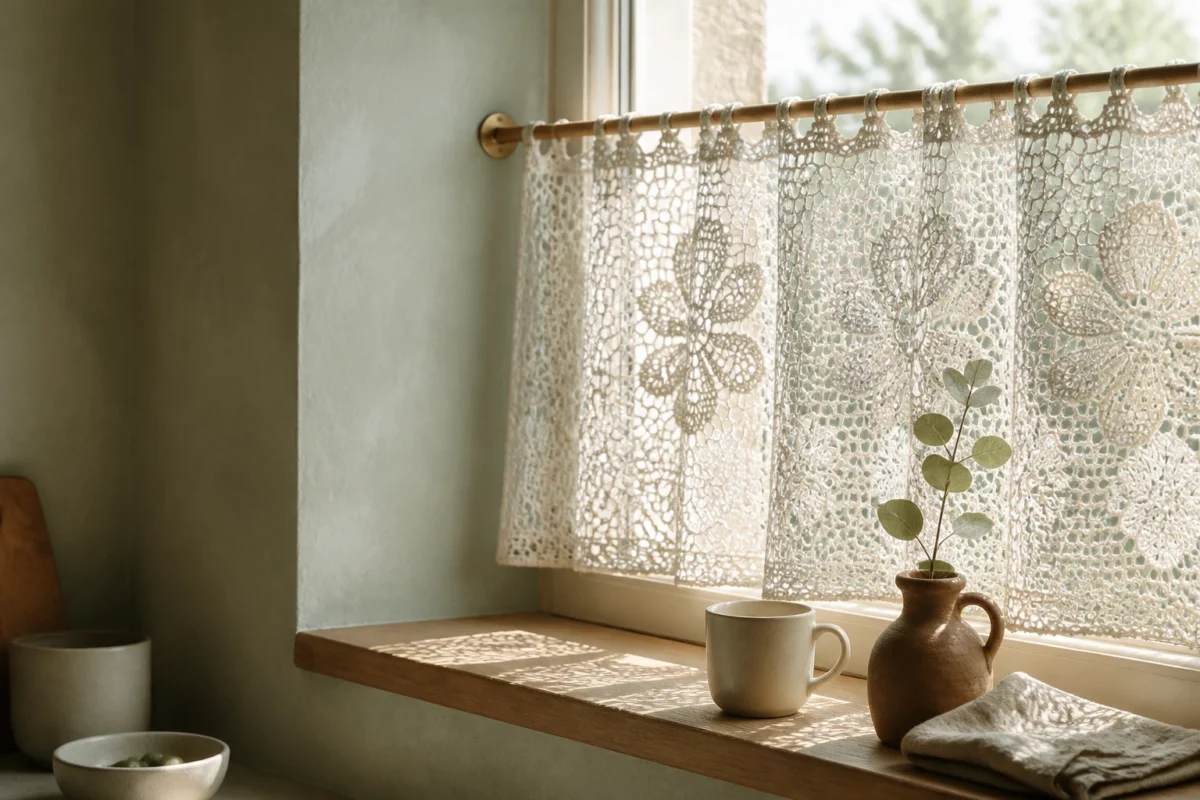
1. Open-Lace Cotton With Morning-Soft Light And A Turned-Wood Cafe Rod
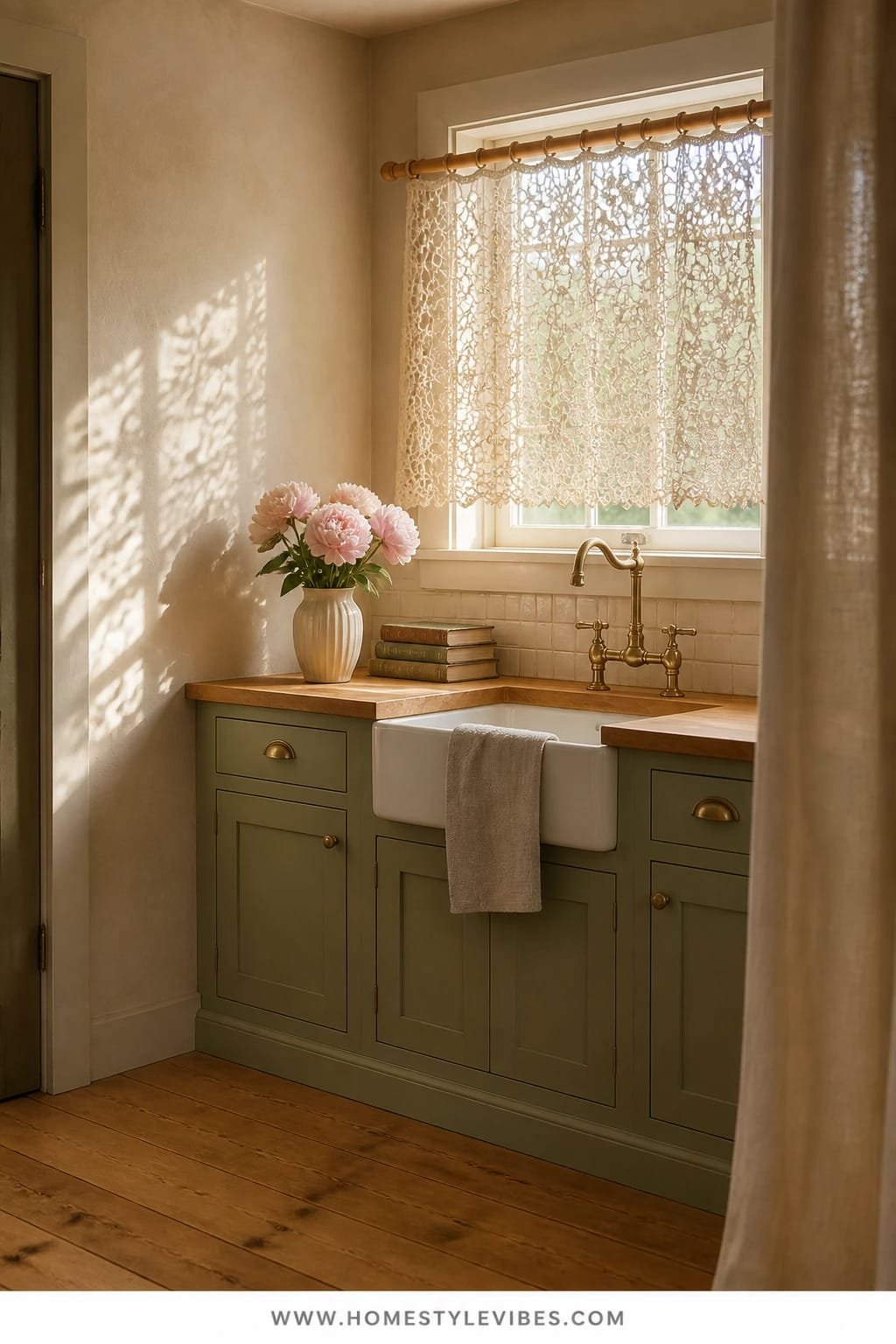
We’ve all been there—your kitchen window feels naked without curtains, but every panel you try looks heavy or blocks the good light. This design keeps the window’s brightness but brings in the nostalgia: open-lace cotton crochet flowers that scatter sunlight like confetti. It leans sweet cottagecore without tipping into fussy. Think warm scones, a tea kettle, and that soft hush of morning light on cut flowers.
It works because the cotton’s open pattern keeps visibility while the flower motifs create rhythm and softness. Small spaces love this: cafe-height panels make counters usable and show off your sink faucet or herbs. Lighting stays delicate; the perforations in the crochet act like a natural diffuser, avoiding harsh glare. In photos, you’ll love the mix of matte cotton, turned-wood texture, and a little sparkle from a ceramic mug or brass soap pump.
Variations? Budget-friendly: hang two narrow runners instead of custom panels. Renter-friendly: use no-drill cafe rod brackets. For darker rooms, choose ivory over pure white so light looks warm, not cold.
Budget Breakdown:
- Open-lace cotton crochet panels: $40–$120 per pair
- Turned-wood cafe rod and brackets: $30–$80
- Clip rings (antique brass): $12–$25
- Herb shelf under sill (optional): $25–$65
- Simple tie-backs (twisted cotton cord): $8–$20
Total Estimated Cost: $90 – $310
Best For: Small kitchens or breakfast nooks, rental apartments, and anyone who wants filtered daylight without total privacy loss.
Key Design Elements:
- Main materials: Open-lace cotton, turned wood, antique-brass accents
- Color palette: Cream, soft honey wood, brushed brass, sage green from plants
- Lighting strategy: Natural morning light diffused through open crochet, no overhead glare
- Furniture silhouettes: Rounded bistro chair, slim console shelf, small pedestal planter
- Texture layers: Matte cotton lace, smooth ceramic, aged wood grain
- Accent details: Tiny glass bud vase, herb pots, a cotton tea towel with a crocheted edge
How To Recreate This Look:
- Start with a turned-wood cafe rod and mount it halfway up the window for that Parisian-cafe line.
- Add two open-lace cotton crochet panels with small flower motifs—aim for panels that kiss the sill.
- Layer clip rings for easy drape; space them evenly for clean folds.
- Install a slim under-sill herb shelf to visually anchor the softness with a hard edge.
- Style with a ceramic mug, a bud vase, and one small brass accent to catch the light.
Why This Looks Expensive: The wood rod reads bespoke and the lace’s negative space feels custom. Matching the warm brass clips to a single countertop detail creates deliberate repetition—an editorial trick that suggests craftsmanship.
Watch Out: Don’t hang the rod too low. The gap between the rod and the top of the window frame can make everything look cheaper. Keep at least 2 inches above the midpoint line to elongate the window.
Pro Styling Tip: Snap photos at golden hour with a dark mug on the sill to boost contrast against the lacy, blown-out highlights.
2. Linen-Look Crochet With Honeyed Glow And A Vintage Bamboo Roman Shade
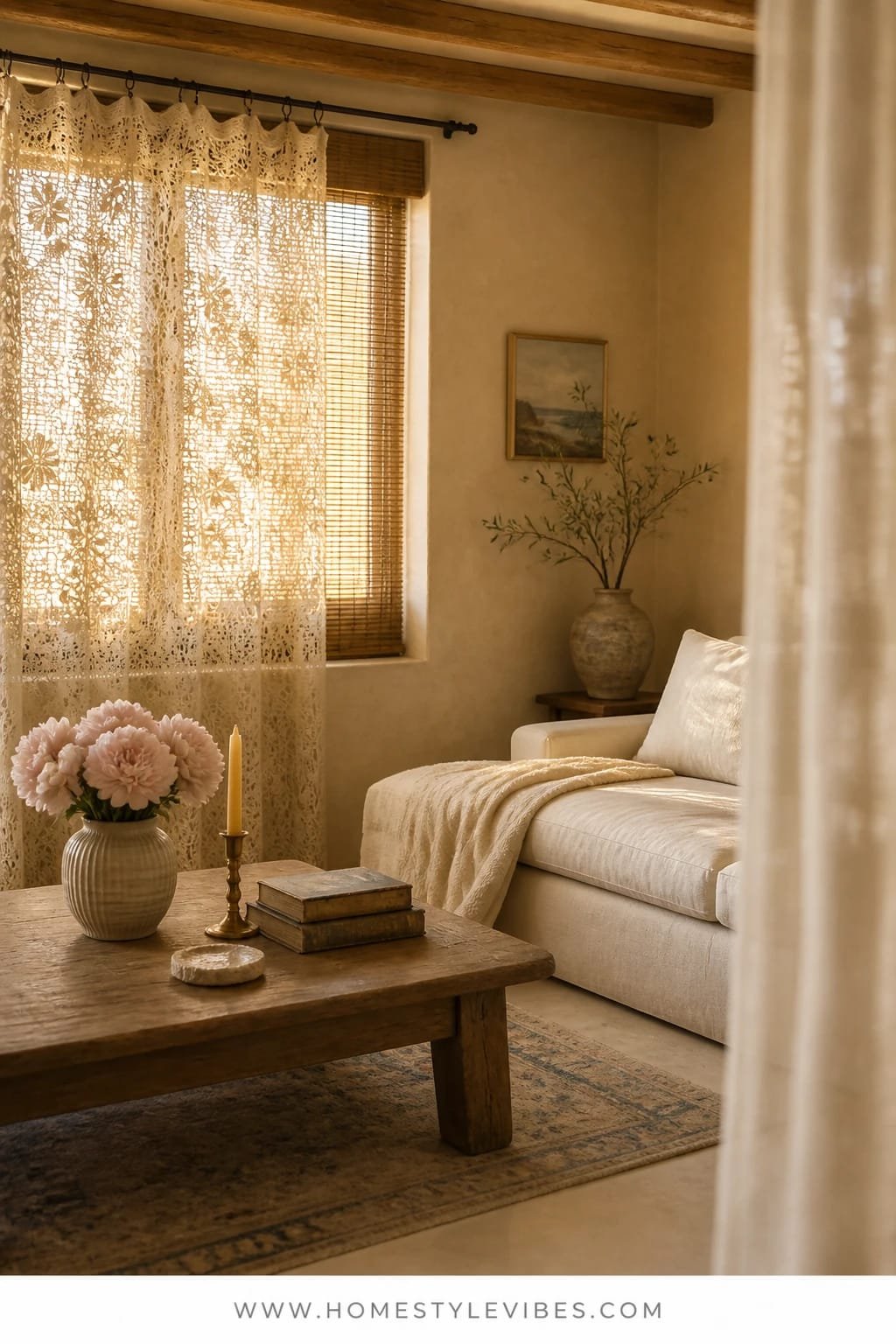
It’s that one corner that always feels off: lovely view, awkward light control. You’ve tried a single panel, but it flutters weirdly and looks unfinished. The answer here pairs a linen-look crochet flower curtain with a bamboo Roman shade. The layering brings polish and precise control. Pull down the bamboo for privacy at night; let the crochet float in front for daylight texture.
The vibe is relaxed farmhouse with a pinch of coastal. Why it works in real homes: two layers solve function first, then style. The bamboo’s honeyed tone warms cool daylight so your space never looks sterile. The crochet adds airiness. Together, they photograph like a mood board—structured vertical lines from the shade, delicate lace in the foreground.
Variations: Small-space version uses an inside-mount bamboo shade to free wall space. Budget-friendly: pick an off-the-shelf faux-linen crochet with embroidered flowers. Renter-friendly: command hooks for the sheer rod; mount the shade with pressure brackets if your landlord allows.
Key Design Elements:
- Main materials: Linen-blend crochet, natural bamboo, matte black rod
- Color palette: Oatmeal, honey, soft charcoal, olive
- Lighting strategy: Layered light—bamboo filters glare; crochet softens edges
- Furniture silhouettes: Slim console table, curved basket, spindle-back chair
- Texture layers: Slubby linen, reed grain, woven basketry, matte metal
- Accent details: Olive branches, ironstone pitcher, tassel tie-backs
Budget Breakdown:
- Linen-look crochet panels: $55–$150 per pair
- Bamboo Roman shade: $60–$180
- Matte black tension or standard rod: $20–$60
- Tassel tie-backs: $10–$25
- Olive branch faux stems: $18–$45
Total Estimated Cost: $163 – $460
Best For: Living rooms and bedrooms that need both privacy and softness; north-facing windows that crave warmth.
How To Recreate This Look:
- Start with an inside-mount bamboo Roman shade cut to your window width.
- Add an outside-mount matte black rod a few inches wider than the window for visual breadth.
- Layer the linen-look crochet panels in front, skimming the sill or pooling lightly for drama.
- Install tassel tie-backs at lower-third height to keep things relaxed, not stiff.
- Style a slim console with a basket for throws and an ironstone pitcher for a gentle farmhouse note.
Why This Feels Designer: Dual layers signal intention. The natural bamboo grain plus linen slub is texture-on-texture—expensive-looking because it avoids flat surfaces and plays beautifully with side light.
One Thing To Avoid: Don’t match wood tones exactly. Slight variation (warm bamboo with cooler oak floors) creates depth. Perfect matches feel lifeless.
Pro Styling Tip: Angle the Roman shade halfway for a stepped shadow effect that creates cinematic depth in photos.
Pause and breathe. Remember, this isn’t about recreating a showroom. It’s about building a cottagecore window that feels like yours—work with your light first, then let the flourishes follow.
3. Hand-Knotted Cotton Blooms, Candlelit Warmth, And An Ironwork Curtain Pole
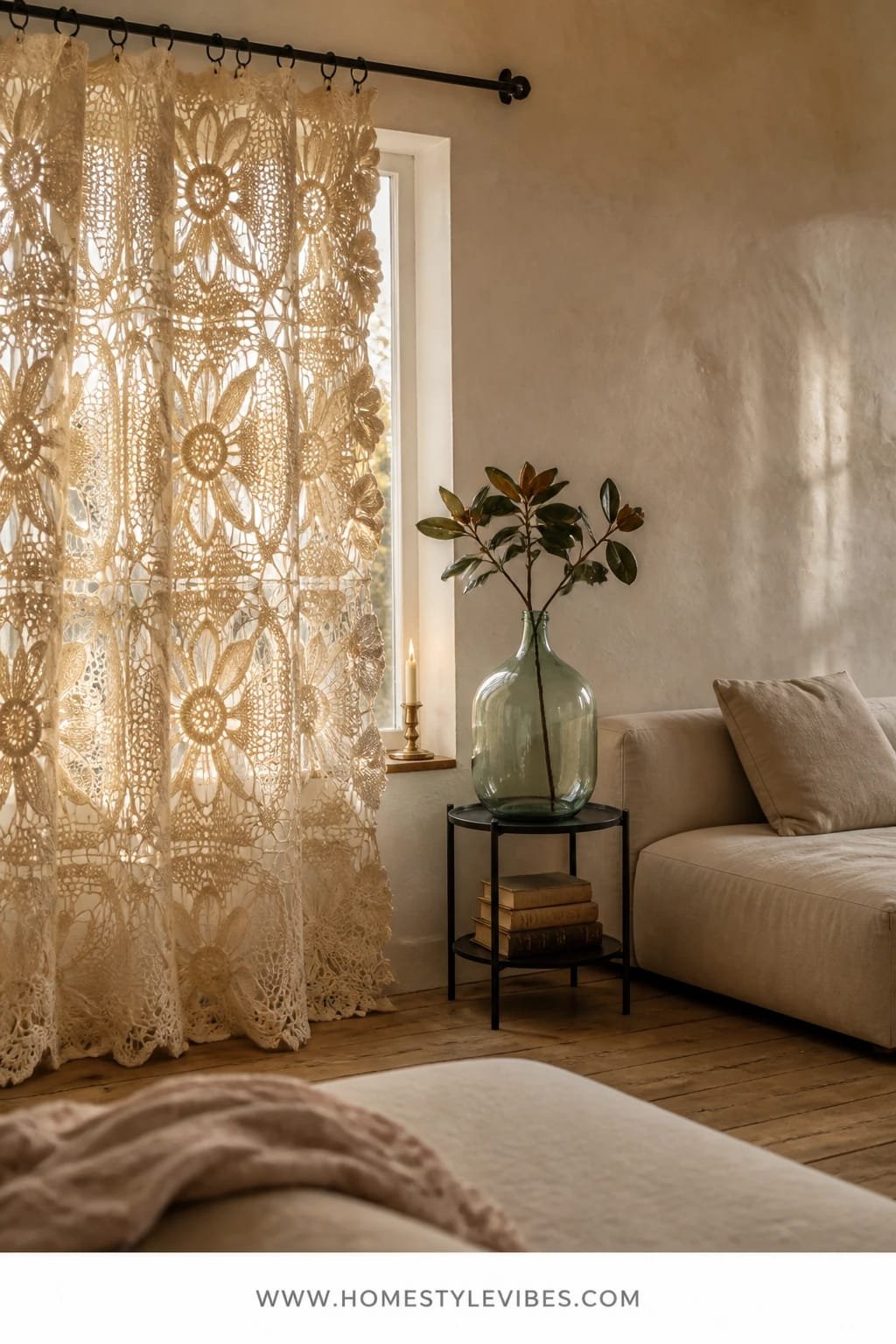
You love romance but hate clutter. Crochet flower curtains can tip twee if everything else is frilly. This concept grounds the sweetness with an ironwork pole—substantial, a little rustic, undeniably grown-up. As evening falls, candles lift soft highlights through the open knots, and the whole room hums with poetry.
Here’s why it works: contrast. Hand-knotted cotton with oversized flower medallions meets iron hardware. The dialogue keeps things from leaning too precious. Maintenance stays easy—cotton hand-wash or gentle cycle, iron pole that lasts decades. Photographs thrive on the black line of the pole against pale walls and the haloed candlelight peeking through the lace.
Customize it. Darker version: choose ecru or tea-dyed panels. Budget swap: powder-coated metal rod instead of true wrought iron. Small-space hack: mount the pole closer to the ceiling to draw the eye up and make the window feel taller.
Budget Breakdown:
- Hand-knotted cotton crochet panels: $90–$240 per pair
- Wrought-iron pole and finials: $70–$200
- Candle set and safety holders: $25–$60
- Iron tie-backs or leather straps: $20–$55
- Weighted hem tape (optional): $10–$18
Total Estimated Cost: $215 – $573
Best For: Cozy dining rooms or bedrooms that want visible structure; cottages with plaster or limewashed walls; evening entertainers.
How To Recreate This Look:
- Start with a sturdy ironwork pole hung 4–6 inches below the ceiling to emphasize height.
- Add hand-knotted cotton panels with oversized flower medallions; aim for soft puddling on the floor (1–2 inches).
- Layer a few candles on the sill and a sideboard—use varied heights for dimensional glow.
- Install subtle weights at the hem to control movement near radiators or drafts.
- Style with a linen table runner, mismatched vintage plates, and one black-framed artwork to echo the iron.
Why This Reads High-End: Weight and contrast. The visual heft of iron against airy crochet says intentional, not accidental. That tension is a classic designer move.
The Most Common Mistake: Skipping blackout where needed. If this is a bedroom and you’re light-sensitive, add a discreet roller shade behind the panels so you can keep the romance and still sleep.
Pro Styling Tip: For photos, light only half the candles and let the others remain unlit props—uneven glow creates painterly gradients instead of a flat wall of light.
4. Sheer Mercerized Thread, Cool-Daylight Brightness, And A Vintage Brass Swing-Arm Sconce
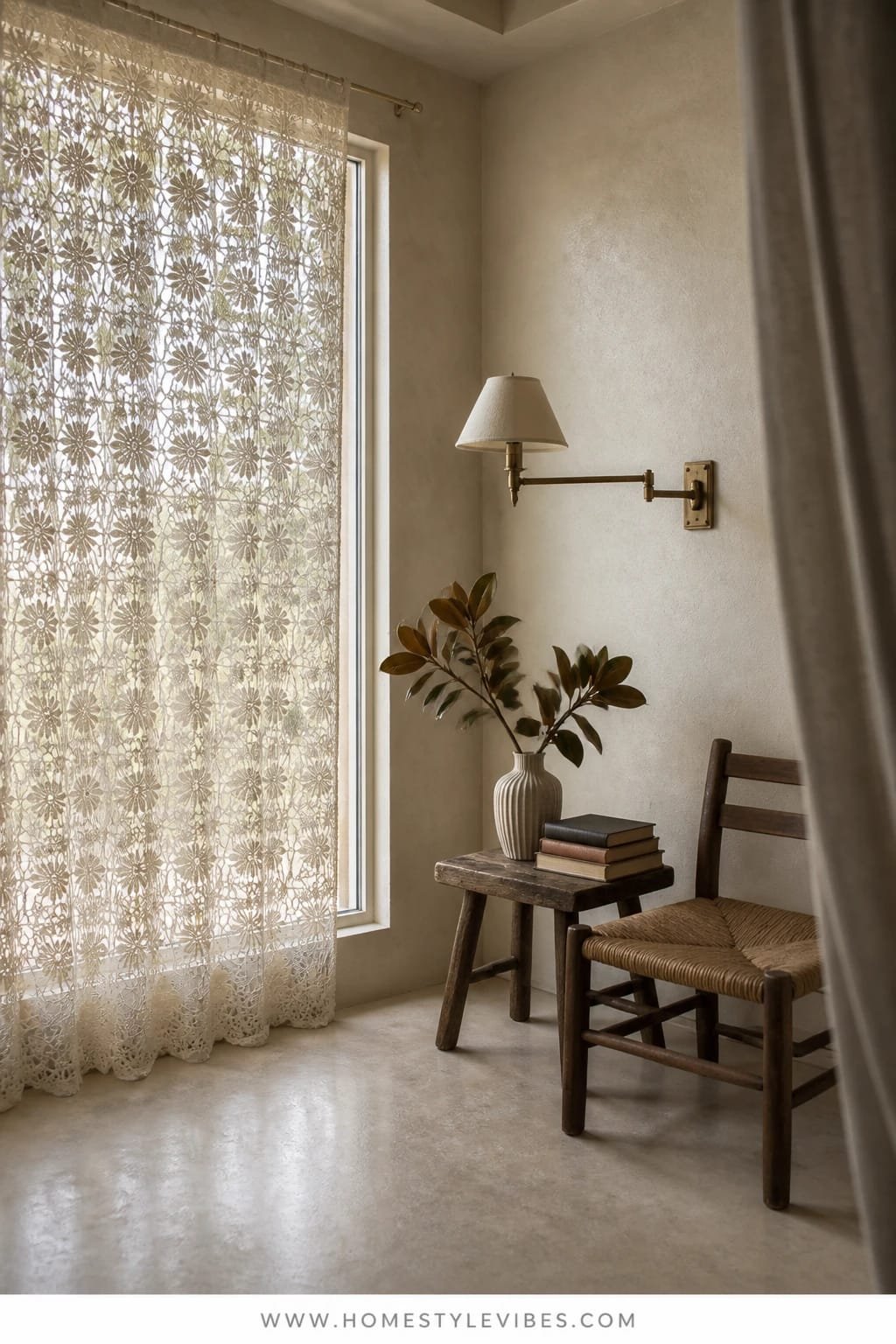
You’ve tried white sheers, but they look like office curtains. This design swaps in mercerized crochet—sheer but with a soft gloss that catches light like dew. Pair it with a vintage brass swing-arm sconce mounted off-center for a reading nook that glows at dusk and sparkles by day. The vibe lands somewhere between Paris flea market and quiet study nook.
Real homes like this because it keeps sightlines open. The cool daylight stays crisp through the mercerized thread, which subtly reflects and lifts the room’s brightness. The sconce creates targeted evening light without flooding the space. Your photos will capture crisp highlights on the thread, warm brass reflections, and a moody shadow fall on the wall behind the chair.
Options: On a budget, go for mercerized-look polyester crochet with micro-flowers. Renter-friendly: battery-operated sconce with a magnetic plate. Small space: use a narrow slipper chair instead of a full armchair to keep floor area clear.
Key Design Elements:
- Main materials: Mercerized thread crochet, vintage brass, linen upholstery
- Color palette: Bright white, pale gray, aged brass, inky book covers
- Lighting strategy: Cool daylight in, targeted warm sconce at night
- Furniture silhouettes: Slipper chair, round pedestal side table
- Texture layers: Glossy thread, nubby linen, soft leather bookmark
- Accent details: Stack of worn paperbacks, a ceramic tray, a trailing pothos
Budget Breakdown:
- Mercerized thread crochet panels: $70–$160 per pair
- Vintage brass swing-arm sconce: $90–$250 (or $50–$120 for battery version)
- Matte white rod: $20–$50
- Slipper chair (optional): $150–$450
- Round pedestal side table: $60–$180
Total Estimated Cost: $240 – $1,090
Best For: Reading corners, offices, and any window where you need clarity by day and a warm cone of light by night.
Why This Looks Intentional: Mixed color temperatures—cool daylight plus warm lamp—sound risky, but the mercerized sheen bridges them. The brass sconce repeats the warm note, so nothing clashes.
How To Recreate This Look:
- Start with a matte white rod mounted as high as possible to amplify the window height.
- Add mercerized crochet panels with small, repeating floral motifs for an even texture field.
- Layer a vintage brass swing-arm sconce to the side of the window, aimed at your seating.
- Install a round pedestal table to hold a small ceramic tray and your current read.
- Style with a linen throw and one trailing plant to soften the verticals.
Don’t Do This: Avoid busy, colorful tie-backs here. They fight the refined, glowy simplicity. If you need holdbacks, use clear acrylic or slim brass so the sheen stays the star.
Pro Styling Tip: Photograph from a low angle so the sconce arc frames the crochet—this adds swoop and makes the window feel grander.
Quick reminder: if one idea resonates more than the others, that’s your starting point. You don’t need all six. Pick the one that solves your light problem and feels like you.
5. Chunky Wool-Cotton Crochet, Afternoon Amber Light, And A Painted Farmhouse Bench
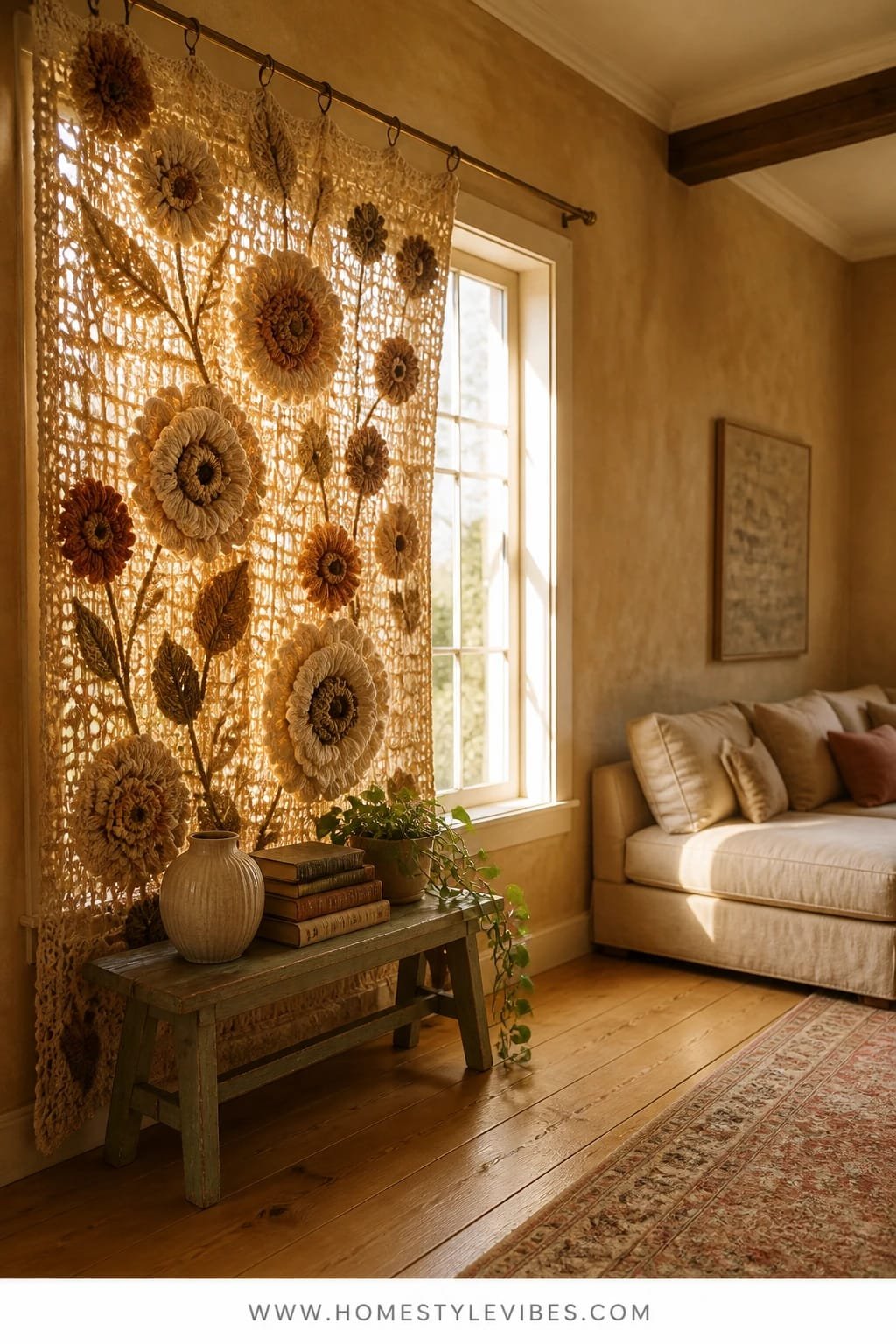
You’ve got a drafty window and a living room that never feels settled. Thin sheers won’t cut it. This setup leans into chunkier crochet—wool-cotton blend with oversized floral appliqués—so the panels look like a handmade heirloom blanket stood up. Add a painted farmhouse bench under the window for plants, baskets, or spontaneous shoe-tie moments. The palette goes sun-baked and earthy, like honey on warm bread.
Why it works at home: thicker fibers add insulation and visual weight, so the room feels grounded. The amber light that hits in late afternoon catches the yarn fluff and turns it into a soft halo. Photographs pick up the knits’ shadow lines and the matte chalk finish of the bench—layered, cozy, very “come sit for a minute.”
Variations: Budget version uses cotton-acrylic blend. Darker look: choose caramel or wheat panels. Renter swap: use a freestanding coat tree next to the bench if you can’t add hooks. Small-room trick: paint the bench the same color as the wall to make it feel built-in without bulk.
Budget Breakdown:
- Chunky wool-cotton crochet panels: $110–$280 per pair
- Painted farmhouse bench: $80–$220
- Antique brass rod with thick rings: $40–$120
- Wool pom tie-backs (optional): $15–$30
- Seagrass baskets for under-bench storage: $25–$60 each
Total Estimated Cost: $270 – $710
Best For: Drafty living rooms, sunrooms with afternoon light, family spaces that need function and softness.
How To Recreate This Look:
- Start with an antique brass rod and thicker rings—the scale supports the chunky panels.
- Add wool-cotton crochet flower panels that touch the floor cleanly (no puddle, to avoid dragging).
- Layer a painted bench under the window and tuck two baskets beneath for throws and toys.
- Install minimal wall hooks nearby for hats or a market bag—casual utility meets charm.
- Style with a clay pot, a woven throw, and a single striped cushion to break up solids.
Why This Looks Expensive: Scale and finish. Big stitches read artisanal; the bench’s chalky paint absorbs light instead of reflecting it, which looks custom, not mass-market.
Watch Out: Don’t overload the bench with plants. Three items max (tall, medium, low) so the crochet remains the star and cleaning stays sane.
Pro Styling Tip: For photos, stagger one basket half-pulled out. That little imperfection adds lived-in warmth without mess.
6. Delicate Filet Crochet, Dappled Garden Light, And A Painted Iron Canopy Bed
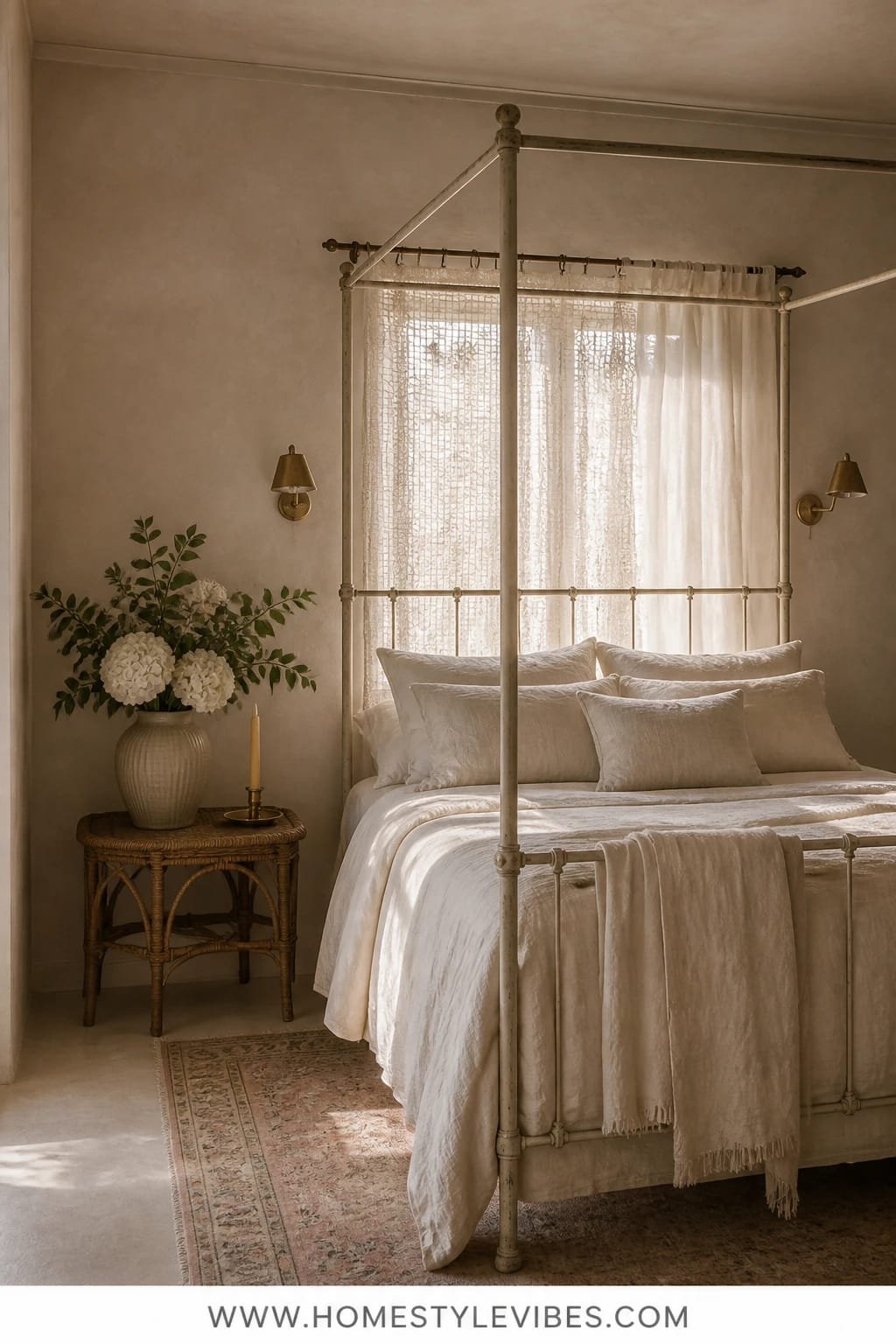
You want romance in the bedroom, not clutter. Filet crochet—with its tiny square mesh and dainty flower motifs—creates a veil that feels luxurious but not heavy. Pairing it with a painted iron canopy bed frames the window like a storybook illustration. Morning light arrives dappled; at night, everything softens into a hush.
Homes benefit here because filet crochet delivers privacy while letting the room breathe. The iron canopy adds a vertical anchor, making small bedrooms feel designed instead of improvised. In photos, the bed’s slim lines echo the crochet’s grid, and layered bedding gives depth: matte linen, a quilt with hand-ties, and a single velvet cushion for contrast.
Mix it your way. Budget option: polyester filet with embroidered flowers. Renter-friendly: tension rod inside the window frame to avoid drilling. Small room: keep the bed in soft black or cream so the palette stays calm and the crochet detail pops.
Budget Breakdown:
- Filet crochet flower panels: $65–$180 per pair
- Painted iron canopy bed: $350–$1,100
- Slim brass rod or tension rod: $20–$60
- Linen duvet and quilt layering: $120–$380
- Velvet cushion: $25–$90
Total Estimated Cost: $580 – $1,810
Best For: Primary or guest bedrooms that crave softness and a focal point; cottages and historic homes with tall ceilings.
How To Recreate This Look:
- Start with a painted iron canopy bed placed so the window becomes the headboard’s backdrop.
- Add filet crochet panels that skim the floor for a tailored look—no puddling to avoid dust near the bed.
- Layer linen bedding in two neutrals (e.g., warm white and mushroom) and top with a lightweight quilt.
- Install a slim brass rod inside the window frame if you’re renting; outside-mount for drama if you own.
- Style with one velvet cushion and a tiny bedside posy for an intimate, unfussy finish.
Why This Feels Designer: Repetition and restraint. The canopy lines mirror the crochet grid, and the palette stays edited. Fewer colors, more textures—always reads considered.
One Thing To Avoid: Don’t crowd the window with heavy drapery on top of filet. You’ll smother the detail. If you need blackout, add a minimal roller shade behind the crochet instead.
Pro Styling Tip: Shoot with the bed slightly off-center so the canopy post overlaps the window frame—this overlap adds depth and avoids the “flat postcard” look.
Real talk: I once tried a ruffled valance over filet crochet and wondered why everything felt fussy. Stripping the valance let the pattern breathe, and suddenly the room felt calm again. Sometimes less truly is kinder.
Little confession: I installed my first crochet flower curtain on a stormy October afternoon and immediately questioned it. Then the clouds parted for five minutes. The room went to honey, and I had that “okay, this was worth it” lump in my throat. Texture and light—when they click, you feel it.
Quick Checklist
- Measure rod height to minimize the gap above the window
- Choose crochet density based on privacy and light needs
- Layer with bamboo shade or roller if you need blackout
- Match hardware finish to one other accent for cohesion
- Use clip rings to create even folds
- Add hem weights for drafty windows
- Install rods wider than the frame to reveal more glass
- Pick a single warm metallic—brass or iron—not both
- Keep bench or sill styling to three items max
- Photograph at golden hour for lace shadow drama
Frequently Asked Questions
How do I pick the right crochet density for privacy without losing light?
Stand back from the fabric and look for negative space. If you can clearly see your hand through it from six feet away, you’ll get glow but limited privacy. For bedrooms, choose mid-density patterns like filet or small medallions; for kitchens, open-lace works beautifully.
I’m on a tight budget. What’s the smartest place to spend?
Invest in hardware. A solid rod with good finials instantly makes affordable panels read custom. Then choose a natural-looking crochet in cotton or a high-quality blend. Finish with clip rings for that tailored drape.
My space is tiny. Will crochet flower curtains feel busy?
Go tone-on-tone. Pick panels in the same color as your walls (warm white or soft cream). Mount the rod higher and wider than the window to frame more glass and reduce visual clutter. Keep nearby decor minimal—one plant, one small object, done.
How do I keep crochet panels clean without ruining the pattern?
Use a garment bag on gentle cycle or hand-wash in cool water, then lay flat to dry. Avoid high heat. If needed, steam lightly while hanging—never iron directly on raised motifs.
I rent and can’t drill. Any workaround for layered looks?
Use a tension rod for the crochet and a no-drill adhesive or pressure-mount shade behind it. Keep panels light so the tension rod holds. Choose smaller finials or none at all to fit inside the frame.
Closing Thoughts
Pick one crochet flower curtain idea that solves your biggest headache—glare, privacy, emptiness—and start there. You don’t need to overhaul the room. A better rod height, the right lace density, and one supportive layer can make the window feel finished by this weekend.
The truth is, luxury isn’t a price tag. It’s texture that catches light and a restrained palette that lets those textures speak. When you pair the right crochet with the right hardware and a touch of warmth—wood, brass, bamboo—you get that dreamy cottagecore window that feels calm every single day.
Ready to make tea taste better? Choose your favorite setup, measure once, hang slow, and enjoy that first moment when the sun hits and the flowers shimmer. You’ve got this—seriously.

About the Author

Krisztina P.Rendes, Founder of Home Style Vibes
Founder of Home Style Vibes
Krisztina Puskásné Rendes created Home Style Vibes as a cozy-modern lifestyle space where homemaking meets inspiration. Her goal is to help women create beautiful, organized, and peaceful homes they truly love — without overwhelm. You’ll find here heart-driven content on home decor, cleaning tips, easy family recipes, organization and decluttering, DIY home projects, plants, and seasonal ideas — all designed to bring more calm, comfort, and style into everyday life.