6 Modern Bathroom Design Ideas That Instantly Upgrade Any Home
You want a bathroom that looks like a modern boutique hotel—calm, clean, soft light on stone, warm towels, and a mirror that flatters your skin at 7 a.m. You hate cluttered counters, harsh lighting, and that weird gap under the mirror that makes everything feel unfinished. These six modern bathroom design ideas solve those exact frustrations with real-world fixes—think $300–$8,000 projects that fit weekend timelines, rental restrictions, and tight alcoves. Each one is highly photogenic and Pinterest-worthy, but more importantly, they make your morning routine easier, your evening baths slower, and your home feel more considered.
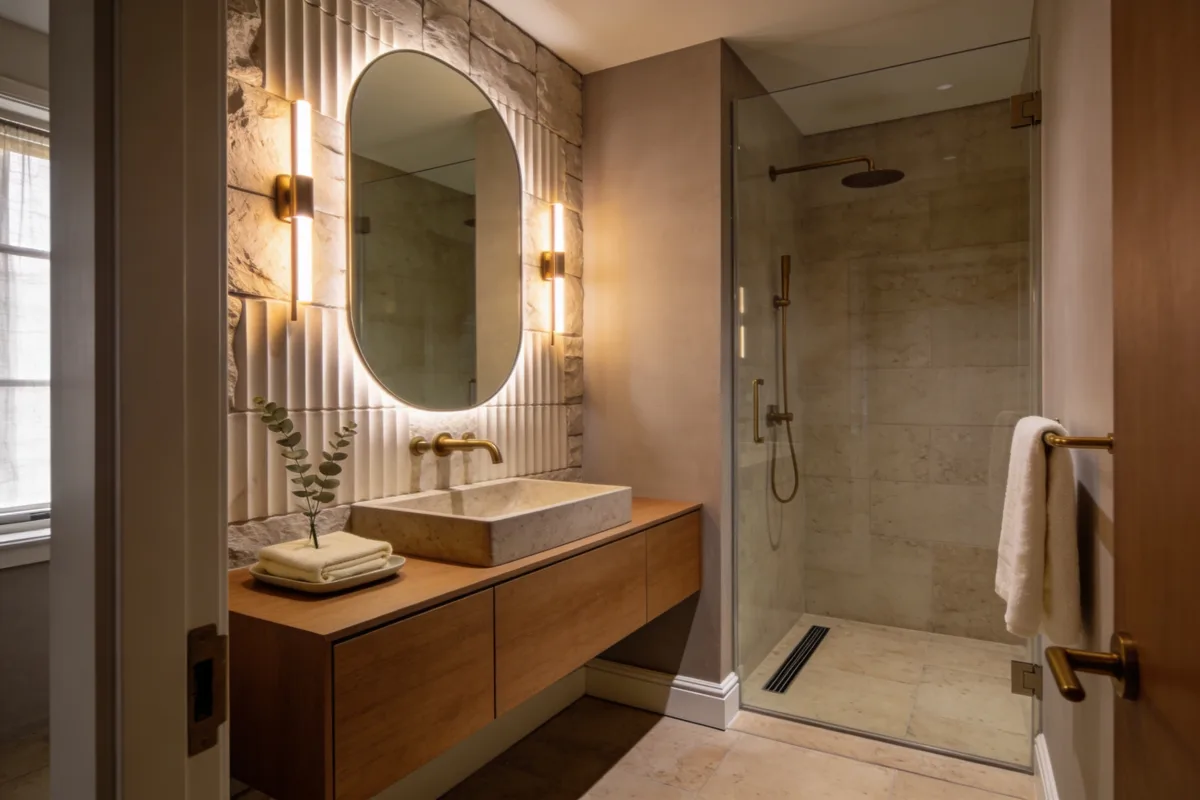
If you love clean lines, texture-rich finishes, and that under-the-radar kind of luxury, this guide is your new mood board. Ready?
1. Sculpted Stone + Warm Wood Spa With Hidden Storage Lines
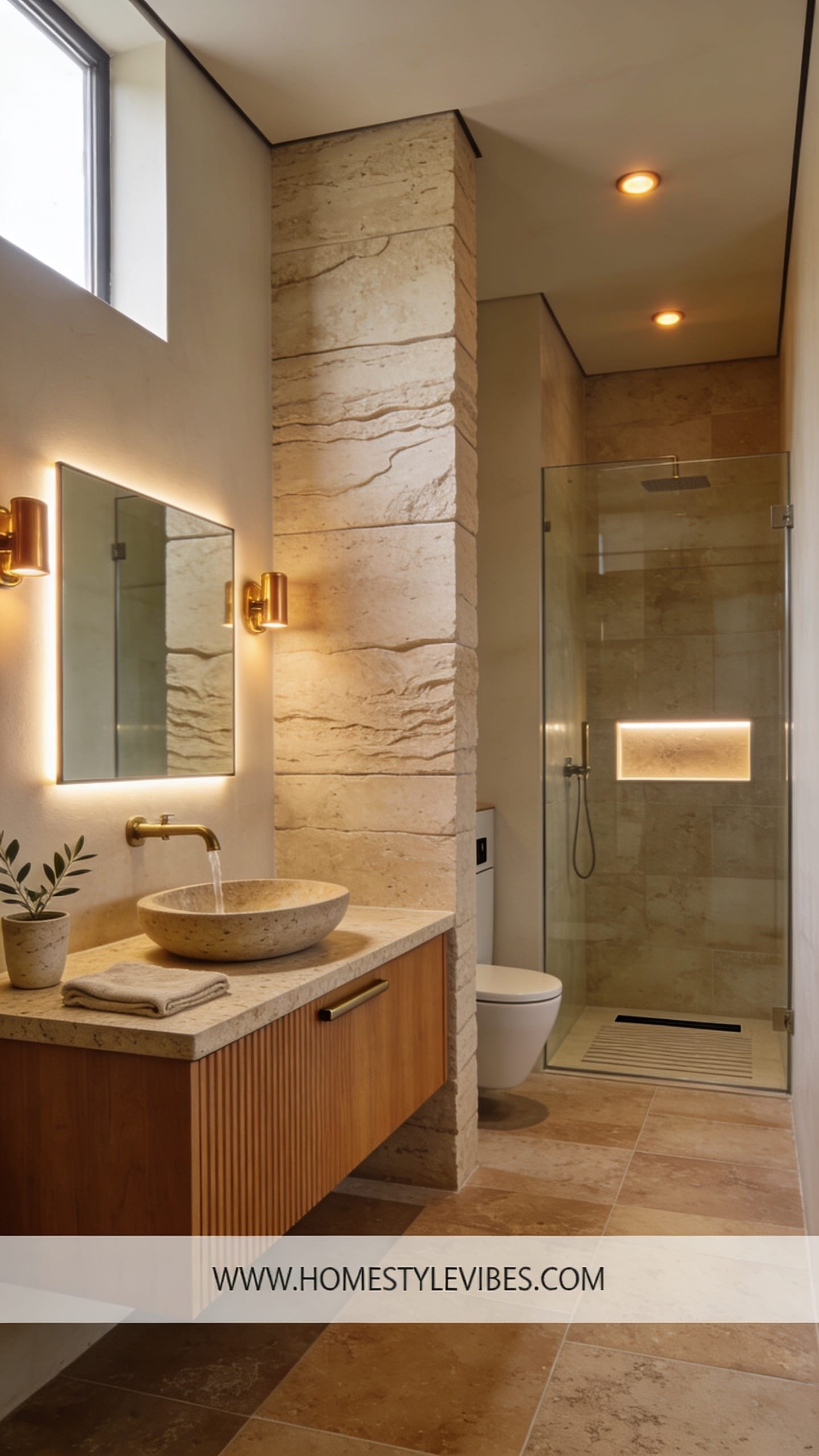
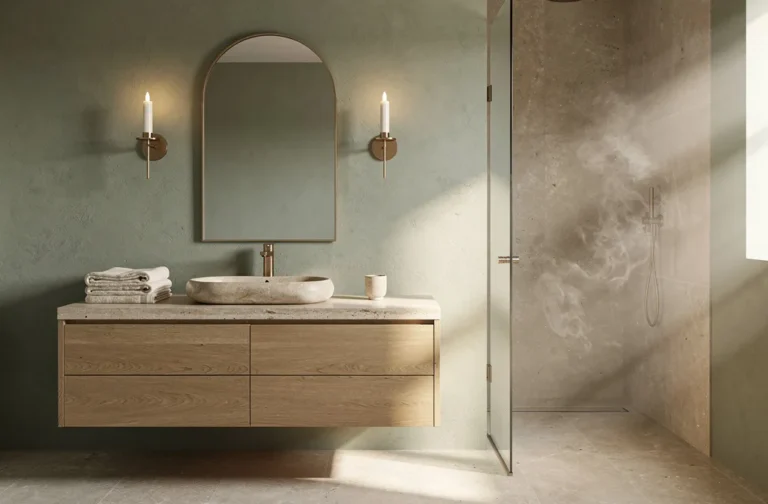
We’ve all been there: you add one nice vanity and a round mirror and it still looks… basic. No soul. No depth. This concept—sculpted stone textures, warm wood, and invisible storage—creates a hotel-spa mood without feeling sterile. It works in real homes because it hides the mess while showcasing natural materials. Lighting stays soft and indirect to flatter the textures: ribbed stone catches warm side-light like a slow exhale.
The materials do most of the visual lifting here: a fluted stone or fluted-tile backsplash, a floating oak vanity, and brushed brass that reads as a glow rather than a sparkle. You get that cloud-soft look in photos because of layered contrast—matte stone against satin wood, warm light grazing the grooves, and a clean sightline with zero countertop chaos. It photographs beautifully because the lines are deliberate and the shadows look intentional. Pro tip: under-vanity LED strips create a floating effect that always reads high-end on camera.
Variation ideas keep this accessible. Budget-friendly: use porcelain tile with a fluted profile instead of carved stone, and swap custom brass for brushed stainless with a soft gold tone. Small-space version: reduce the vanity depth to 16–18 inches and run the backsplash to the ceiling for vertical drama. Renter-friendly: use peel-and-stick fluted panels or a ribbed wallpaper in a moisture-rated finish and install a stock oak vanity with removable legs so you’re not drilling into walls.
Budget Breakdown:
- Fluted porcelain backsplash tile: $8–$22/sq. ft.
- Floating oak vanity (48 inches): $650–$2,200
- Quartz or quartzite countertop: $60–$120/sq. ft.
- Brushed brass faucet and drain kit: $180–$600
- Warm LED strip lighting + driver: $120–$350
- Frameless mirror with backlight: $180–$700
- Hidden hardware organizers/dividers: $60–$180
Total Estimated Cost: $1,850 – $6,000
Best For: Primary or guest baths that crave softness and order; homeowners who prefer calm palettes and no visible clutter.
Key Design Elements:
- Main materials: fluted stone or tile, solid oak or oak veneer, quartz/quartzite
- Color palette: warm whites, oatmeal, light oak, soft brass
- Lighting strategy: indirect LED under-vanity and behind mirror, dimmable sconces at eye level
- Furniture silhouettes: floating vanity with integrated pulls, slim open shelf
- Texture layers: ribbed backsplash, nubby hand towels, matte ceramics
- Accent details: olive branches or a small fern, stone tray, unlacquered brass hooks
How To Recreate This Look:
- Start with a calm base tile and commit to fluted texture on one hero wall.
- Add a floating oak vanity; choose integrated pulls or push-to-open to keep lines clean.
- Layer a quartz counter with a flat polish edge—no ogee, keep it crisp.
- Install a frameless mirror with hidden backlight and under-vanity LED to wash the floor.
- Style with a single stone tray, two matching dispensers, and a soft-brim basket below.
Why This Looks Expensive: The hidden storage keeps every surface serene while the fluted texture throws gentle shadows that feel custom. Floating lines and underglow look architect-driven, not big-box.
Watch Out: Don’t mix too many brass finishes. If your faucet is a warm satin, keep the hardware and sconce finish within the same warmth; mismatched brass reads chaotic on camera and in real life.
Pro Styling Tip: Leave breathing room—one plant, one tray, one candle; let the ribbing and light create the drama.
More into drama than spa vibes? Keep scrolling—there’s a moody option coming that still feels fresh, not cave-like.
2. Monochrome Matte Black Wet Room With Soft Brass Edges
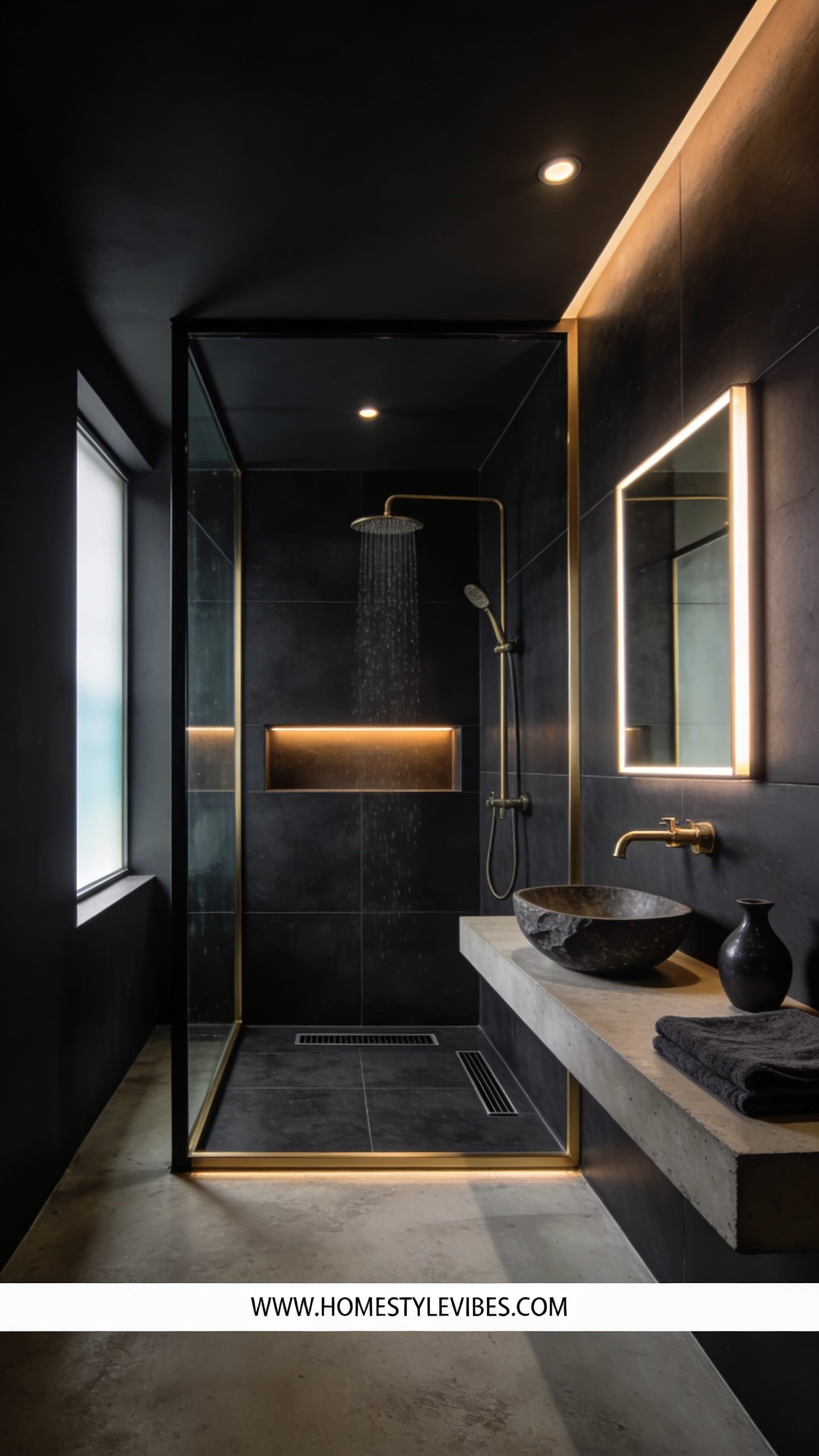
It’s that one corner that always feels off: the tub-shower combo with a curtain that never looks intentional, puddles on the floor, and grout that tells on you. This modern bathroom idea leans all the way in—convert to a wet room look, go monochrome matte black or charcoal, and outline everything with soft brass edges. The mood is strong, editorial, and quietly luxe. It works because the simplified color story forgives small footprints and amplifies architectural lines, and a single drainage plan reduces fussy thresholds.
Lighting carries this room. In a dark space, you need layers: concealed ceiling spots with wide beam angles, wall washers to highlight tile texture, and warm brass accents that gleam just enough. Choose large-format porcelain in charcoal or ink to minimize grout lines. It photographs beautifully thanks to the sharp contrast between matte black planes and softened brass reflections—no glare, just controlled sheen. If you’ve struggled to make a shower curtain look right, this solves it with a fixed glass panel or a ceiling-rail track that actually aligns with the tile grid.
Variations make it feasible. Budget-friendly: use 12×24 matte porcelain with 1/16-inch grout and a premade shower pan rated for wet room install. Small space: run the same tile on walls and floor so the room reads larger; use a single glass panel instead of a full enclosure to keep sightlines open. Renter-friendly: obviously you can’t rebuild, but you can go high-impact with a matte black shower curtain on a ceiling-mounted track, black accessories, and peel-and-stick brass trim along mirrors and shelves.
Key Design Elements:
- Main materials: large-format matte porcelain, brushed brass trims, clear glass
- Color palette: charcoal, ink black, warm brass, soft white towels
- Lighting strategy: wall washers + warm spots + dimmable task light at mirror
- Furniture silhouettes: linear niche shelf, crisp glass panel with minimal clamps
- Texture layers: matte tile, linen shower curtain (if not glass), ribbed bath mat
- Accent details: eucalyptus bundle, smoked amber bottles, slim brass hooks
Budget Breakdown:
- Matte black/charcoal porcelain tile: $3–$12/sq. ft.
- Brass tile trim and niche edging: $8–$18/linear ft.
- Fixed glass panel + hardware: $450–$1,400
- Black shower fixtures: $200–$900
- Lighting (downlights + vanity): $250–$900
- Shower base or linear drain: $250–$1,100
Total Estimated Cost: $1,600 – $5,800
Best For: Compact baths, urban homes, and anyone who wants dramatic, low-maintenance surfaces that hide water spots and daily use.
How To Recreate This Look:
- Start by selecting a single matte tile for walls and floor; run it vertically for height.
- Add a slim brass trim for edges and niches to outline geometry.
- Layer lighting: wall washers in shower, warm spots overhead, and a soft front-lit mirror.
- Install a fixed glass panel to control splash without closing sightlines.
- Style with amber bottles, black towels with a fine brass hook, and a single plant.
Why This Feels Designer: The tight palette with strategic metallic edges announces intention. You’re not defaulting to black; you’re composing with it.
One Thing To Avoid: Don’t pick glossy black tile for a large area. It shows every water droplet and creates harsh reflections that cheapen the effect.
Pro Styling Tip: For photos, angle the camera to catch the brass trim as a thin highlight line—like eyeliner for your shower.
Two ideas in and your brain might be buzzing. Remember, this isn’t about recreating a showroom. It’s about building a bathroom that actually serves your life. If one idea feels like relief, that’s your starting point.
3. Quiet Luxury Limestone with Micro-Edge Details and Curved Corners
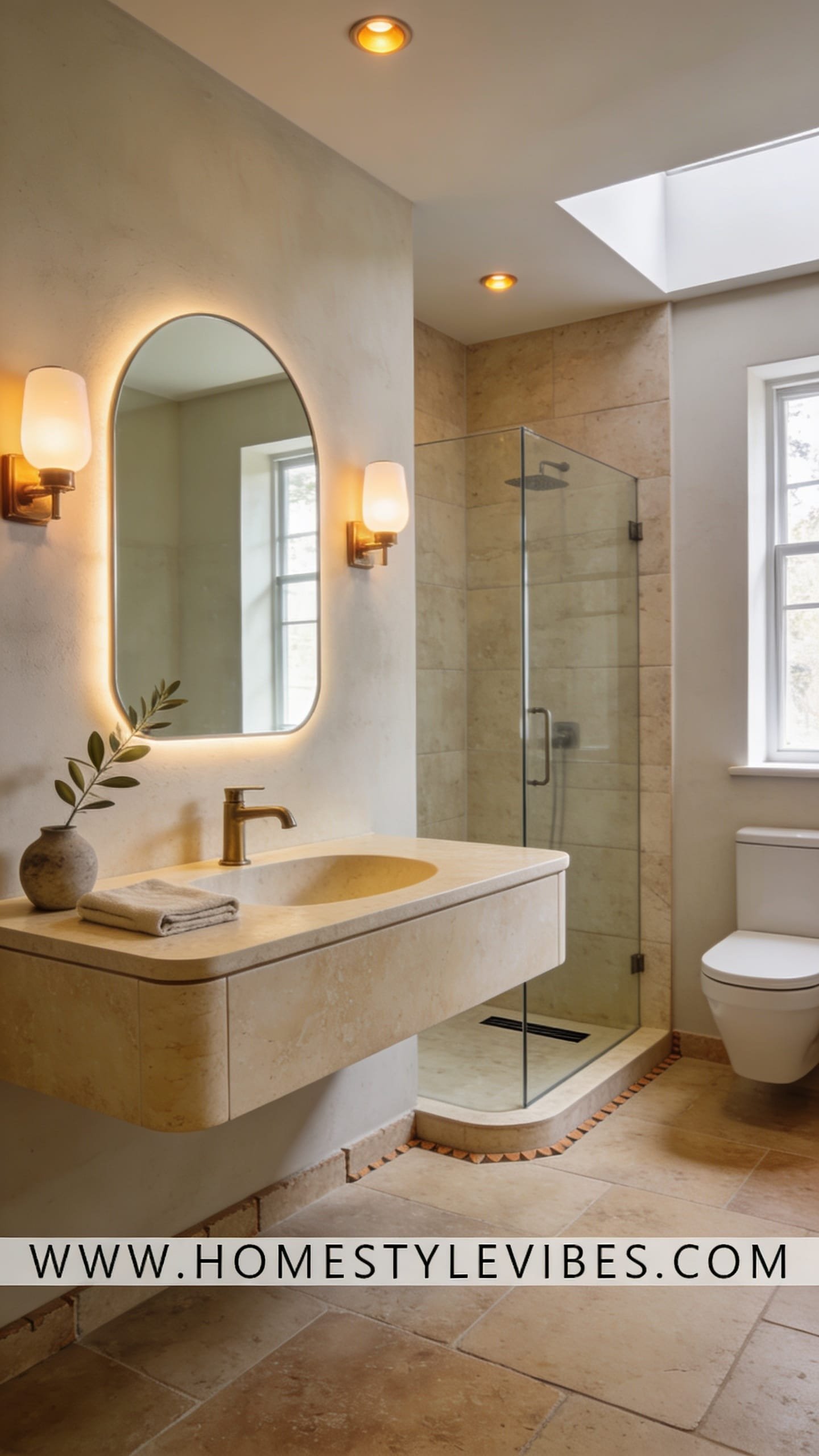
You’ve tried swapping mirrors and faucets, but it still looks builder-basic. The secret isn’t more decor—it’s micro-edits. This quiet luxury look relies on subtle stone, curved corners, and small profile changes that read custom. The vibe: Mediterranean-leaning minimalism with hushed limestone, radiused vanity corners, and zero sharp edges. It works for families because soft corners save hips and toddlers, and for resale because it whispers quality rather than shouting trend.
Lighting matters, but here it’s quieter: concealed linear light grazing limestone to reveal fossil flecks, and a milk-glass sconce that avoids harsh scallops on the wall. Materials dominate with honed limestone or limestone-look porcelain, radiused countertop edges, and a soft-curve niche. It photographs beautifully because light pools along curves and avoids harsh seam lines—shadows look velvet, not busy.
For variations: Budget-friendly means using limestone-look porcelain with a tight grout color match and using a rubber transition strip softened with paint. Small space: use a narrow curved vanity and a rounded corner shower glass. Darker version: choose taupe limestone and oil-rubbed bronze fixtures for warmth without heaviness.
Budget Breakdown:
- Limestone or porcelain-look tile: $5–$22/sq. ft.
- Custom or radiused-edge vanity top: $350–$1,400
- Curved glass panel or round-corner hardware kit: $400–$1,200
- Milk-glass sconces: $150–$500/pair
- Linear wall grazer LED: $180–$450
- Curved niche form (pre-made or custom): $80–$300
Total Estimated Cost: $1,400 – $5,000
Best For: Households craving soft, kid-friendly forms and a serene, timeless palette that won’t feel dated in five years.
Key Design Elements:
- Main materials: honed limestone, porcelain-look limestone, milk-glass, soft bronze
- Color palette: bone, sand, taupe, soft bronze
- Lighting strategy: linear grazing + soft diffused sconces
- Furniture silhouettes: radius corners, rounded vanity edges, curved shelf fronts
- Texture layers: honed stone, boucle bath mat, finely woven towels
- Accent details: curved niche, rounded hooks, oval mirror
Why This Reads High-End: Micro-edges and curves signal custom fabrication. The lack of sharp terminations makes every transition feel quiet, which is the real luxury.
How To Recreate This Look:
- Start by picking a honed limestone or a convincing porcelain alternative in a warm neutral.
- Add a countertop with a soft radius edge and round the vanity corners if possible.
- Layer in a curved niche or rounded shelves to echo the form language.
- Install linear grazer lighting to wash the feature wall and milk-glass sconces at face height.
- Style with oval mirror, folded boucle bath mat, and a clay vase with olive stems.
The Most Common Mistake: Over-accessorizing a quiet palette. More “stuff” reads messy against subtle stone; let the curves do the talking.
Pro Styling Tip: Shoot from a low angle to capture the radius on the countertop—soft edges reflect light like satin, not gloss.
Take a breath. If one of these modern bathroom design ideas unlocked a new direction, save it. You don’t need all six—just the one that makes you exhale.
4. Japandi Timber Grid With Washbasin Ledge and Paper Lantern Glow
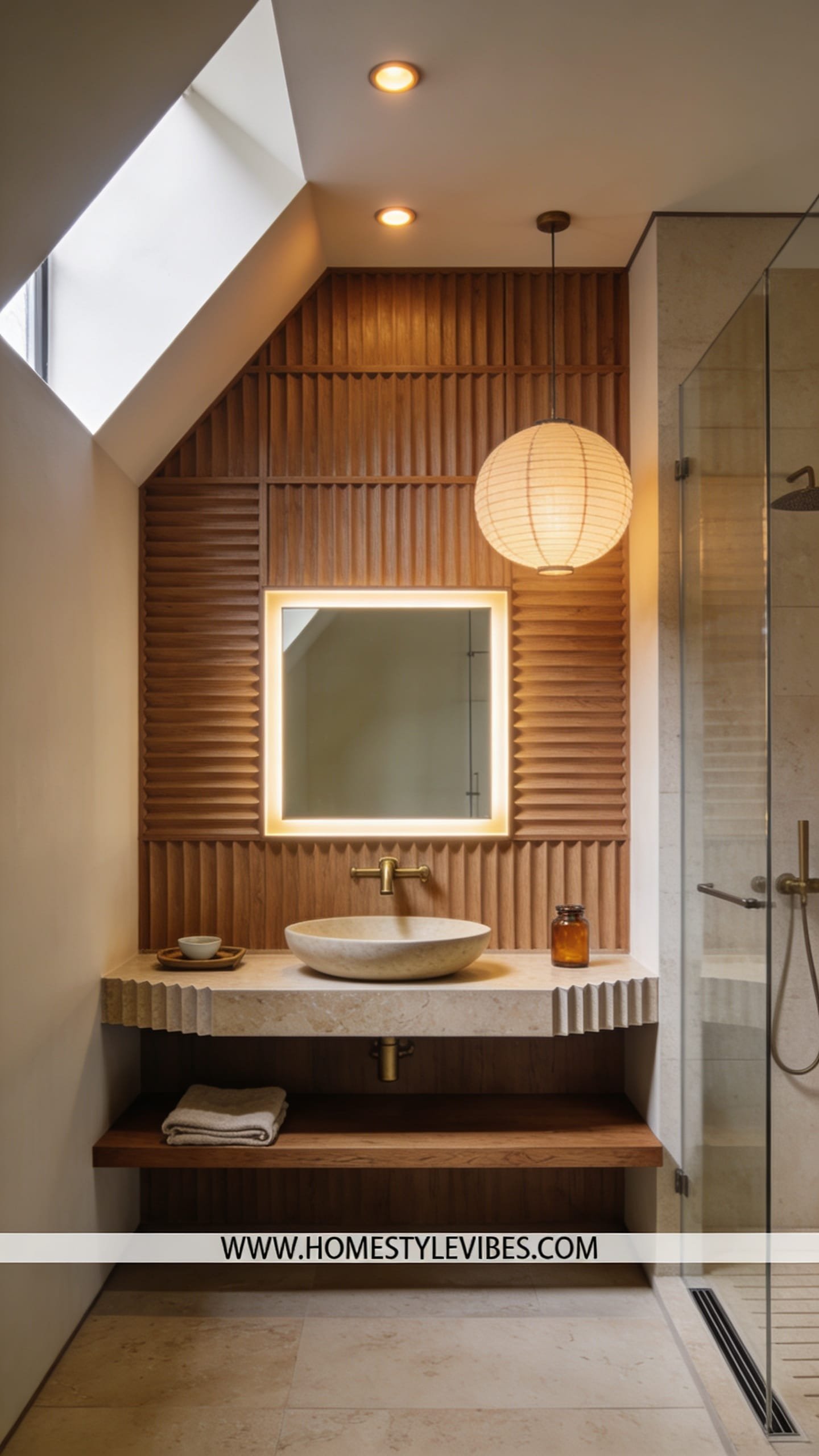
Maybe you’ve collected cute jars and trays, but the bathroom still feels flat. Texture is missing. This Japandi-inspired concept pairs a timber slat grid with a slim washbasin ledge and lantern lighting. The mood is calm-meets-craftsman: structured wood, quiet stone, and a touch of wabi-sabi. It works in real homes because the slat wall adds rhythm, hiding small imperfections and offering easy hook/add-on points, while the ledge corrals essentials without bulky cabinets.
Lighting here gets atmospheric. A rice-paper lantern or opal drum throws a soft ambient glow; add side sconces for task light. Materials dominate: ribbed oak slats, pale plaster or limewash, and a chunky washbasin with a narrow shelf behind. It photographs beautifully thanks to rhythmic shadows between slats, tonal wood, and a strong horizontal ledge line that looks editorial. That’s why editors love it: the grid gives you “lines for days.”
Versions help every budget. Budget-friendly: use pre-finished slat panels; renter-friendly: install a freestanding slat screen behind the vanity and a floating shelf that uses toggles, not studs. Small-space: keep slats only on the upper third of the wall to avoid crowding; paint the lower portion in a matching tone for continuity. Darker version: walnut slats, deep greige walls, and bronze fixtures.
Budget Breakdown:
- Pre-finished oak slat panels: $120–$380 per 2×8 panel
- Floating ledge (hardwood or stone): $80–$450
- Concrete or ceramic vessel sink: $180–$750
- Paper lantern or opal drum: $60–$250
- Matte black or bronze faucet: $160–$550
- Limewash or mineral paint: $50–$140
Total Estimated Cost: $650 – $2,400
Best For: Design lovers who want warmth without clutter; condos and rentals where a dramatic wall treatment needs to be removable.
Key Design Elements:
- Main materials: oak slats, plaster/limewash, concrete or ceramic
- Color palette: warm neutrals, soft black accents, sage greens
- Lighting strategy: lantern ambient + low-glare task sconces
- Furniture silhouettes: low-profile vanity, vessel sink, slim ledge
- Texture layers: ribbed wood, mineral paint, raw linen towels
- Accent details: stacked pebbles soap dish, bamboo stool, small ikebana stem
How To Recreate This Look:
- Start with a limewashed wall for mineral depth; no glossy paint here.
- Add a timber slat grid behind the vanity, keeping a 3–5 mm shadow gap at the edges.
- Layer a narrow ledge (4–6 inches deep) across the width to hold essentials.
- Install a paper lantern overhead and minimal sconces at eye height.
- Style with a vessel sink, one stem in a small vase, and neatly folded towels.
Why This Looks Intentional: The repeated lines and consistent wood tone create rhythm. The ledge acts as a punctuation mark, making everyday items look curated rather than scattered.
Don’t Do This: Don’t run slats floor-to-ceiling in a very small room without a break; it can feel like a crate. Keep breathing space with paint above or below.
Pro Styling Tip: Angle the lantern so it grazes the slats; the shadow gradient adds instant depth in photos.
Halfway there. If your mind says, “That’s gorgeous, but I need more color,” the next concept brings warmth and personality without clutter.
5. Modern Mediterranean Terracotta Wash Room With Plaster Arches
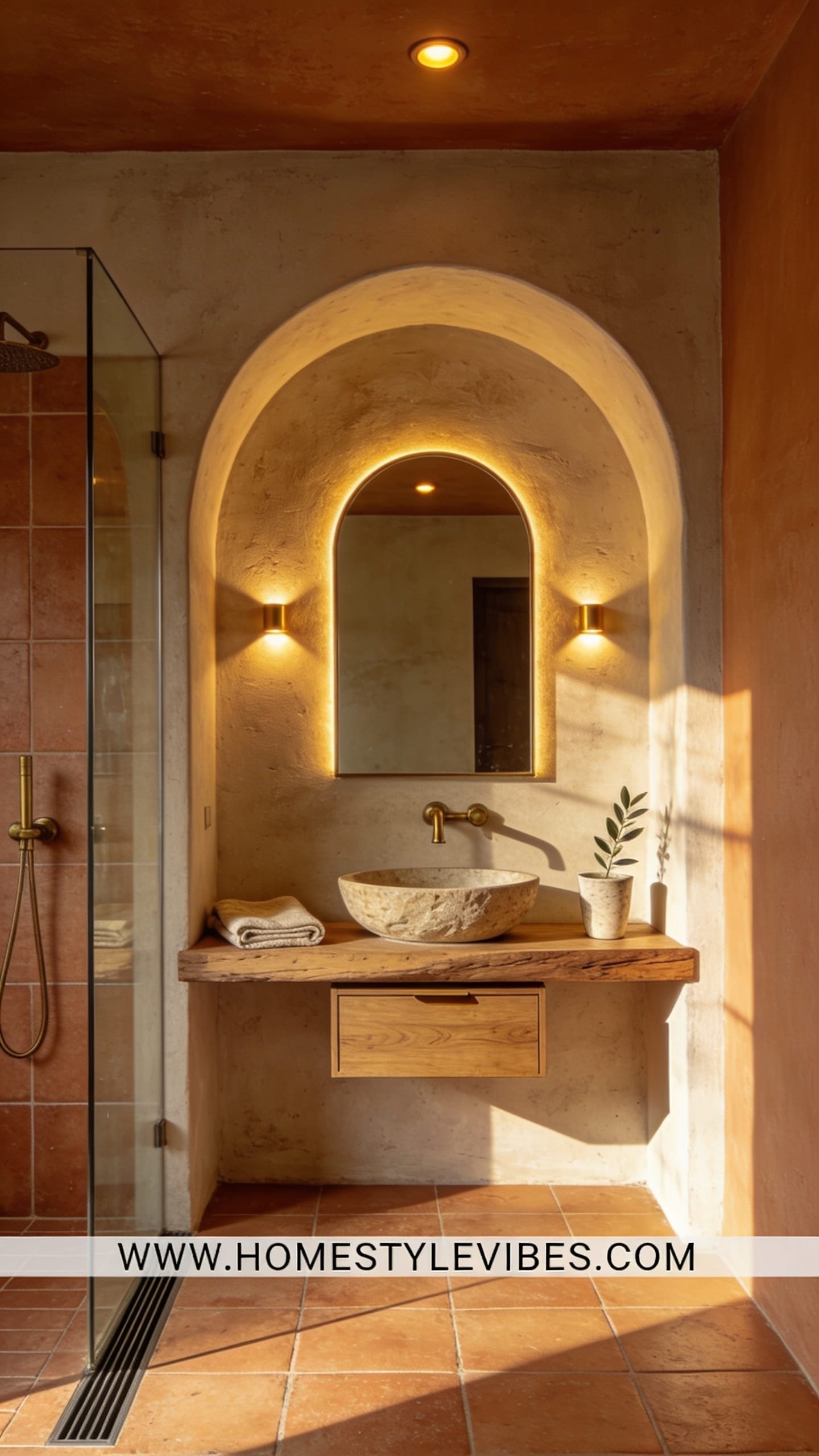
You love color and warmth, but painted accent walls always look cheap after a week. The fix: texture-first color. This modern Mediterranean idea uses terracotta floor tile, a plastered niche or low arch, and aged brass. The mood is sun-kissed, grounded, and friendly. It works because terracotta hides dust and adds instant warmth, while plaster softens lines and catches light in a way paint never will.
Lighting sets the vacation tone: a pair of small uplights on the arch or niche throw golden halos; add a dimmable mirror light for function. Materials dominate—terra cotta pavers or porcelain lookalikes with a natural variation, lime plaster or microcement for the niche, and simple white zellige or square tiles at the sink zone. The photographs practically take themselves thanks to warm color casts, subtle tile variation, and sculptural plaster that reads like a handmade detail.
Variations help you flex. Budget-friendly: use terracotta-look porcelain and a painted faux-plaster technique with a matte topcoat. Small-space: bring in terracotta only on the floor and keep walls pale; add arch detail with a shallow niche above the toilet. Renter-friendly: swap in a terracotta bath mat, linen shower curtain in clay or rust, and a freestanding arched mirror for the vibe without renovation.
Budget Breakdown:
- Terracotta or porcelain-look pavers: $4–$16/sq. ft.
- Lime plaster or microcement material: $120–$500
- Aged brass faucet and hardware: $200–$700
- Small uplights (floor or shelf): $80–$240
- White square tile or zellige: $5–$22/sq. ft.
- Rust or linen textiles: $60–$160 total
Total Estimated Cost: $900 – $4,000
Best For: Sunlit bathrooms, homes with hardwood or saltillo elsewhere, and color lovers who still crave restraint.
Key Design Elements:
- Main materials: terracotta, lime plaster, white zellige/square tile
- Color palette: clay, sand, chalk white, aged brass, olive green accents
- Lighting strategy: uplights on plaster + warm mirror task light
- Furniture silhouettes: simple slab vanity, rounded niche, slim arched mirror
- Texture layers: nubby linen, matte plaster, irregular tile sheen
- Accent details: olive branch, striped hammam towels, hand-thrown soap dish
How To Recreate This Look:
- Start with terracotta on the floor; seal with a matte penetrating sealer to avoid shine.
- Add a plastered niche or create a shallow arch detail over the vanity.
- Layer white square tile around splash zones for contrast and easy cleaning.
- Install warm brass fixtures and two small uplights to graze the plaster at night.
- Style with linen towels in clay/ivory stripes and a single olive stem in a ceramic vase.
Why This Feels Designer: You’re using color via material, not just paint. The depth and variation in terracotta and plaster telegraph “crafted,” which reads more expensive than flat pigment.
Watch Out: Don’t over-seal terracotta with a glossy topcoat; it kills the texture and shows every water spot. Choose matte, breathable sealers only.
Pro Styling Tip: Photograph at golden hour if you can—the clay tones glow and the plaster looks like warm butter.
True talk: I once agonized over a paint swatch for days before realizing the vanity lighting was throwing a blue cast at night. I swapped a 4000K bulb for 2700K and the “wrong” paint instantly looked right. Light first, then color.
6. Floating Marble Shelf System With Backlit Mirror Grid
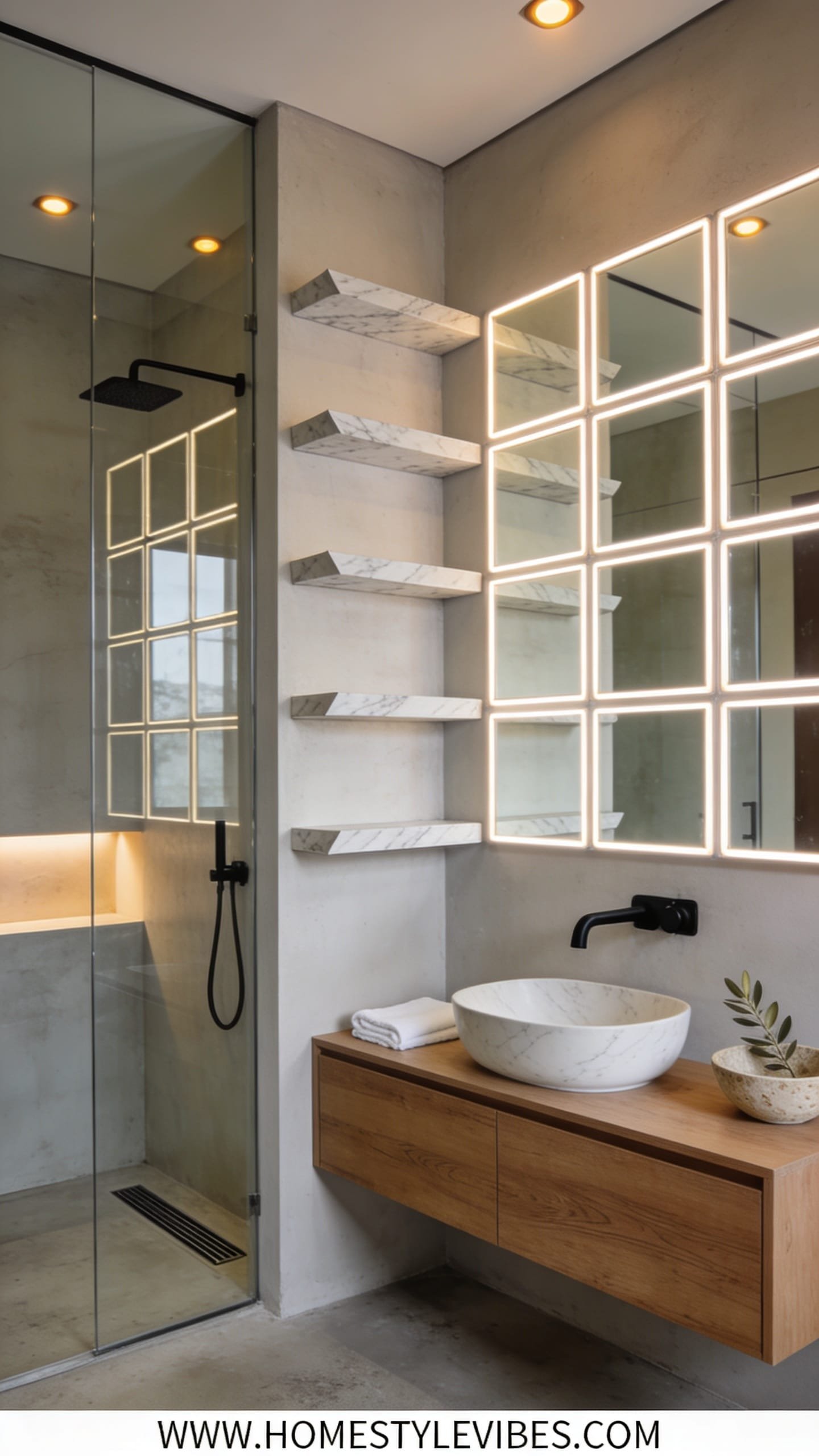
You’ve got bottles. Lots of them. And every time you try to organize, the counter looks like a crowded café. This last modern bathroom design idea creates a sculptural storage wall: floating marble shelves that align with a backlit mirror grid. The vibe is gallery-clean with just enough drama; minimal, but not cold. It works beautifully in small bathrooms because shelves replace bulky cabinets while the mirror grid visually doubles the space.
Lighting becomes architecture here. A set of slim mirrors with integrated backlight casts a soft halo; place floating shelves to intersect them at clean lines. Materials matter: pick a consistent stone, even if it’s porcelain or quartz, and commit to thin profiles (3/4-inch or less) for a refined edge. Photographs love this look because lines meet intentionally, and the backlight outlines objects with a subtle glow. IMO, this layout wins every time for renters, collectors, and skincare enthusiasts.
Variations make it flexible. Budget-friendly: use porcelain “marble” shelves or MDF wrapped in stone-look laminate for dry zones. Small-space: run a single vertical stack of shelves offset to one side of the mirror and leave negative space. Renter-friendly: adhesive-backed mirror panels with LED light strips behind, plus removable shelves with minimal anchors.
Key Design Elements:
- Main materials: marble or stone-look porcelain, slim LED mirror panels, powder-coated brackets
- Color palette: white/gray marble, matte black or chrome accents, soft neutral towels
- Lighting strategy: backlit mirror grid + small puck lights under the bottom shelf
- Furniture silhouettes: ultra-thin shelves, framed grid mirrors, floating stool
- Texture layers: polished stone, waffle towels, matte ceramic canisters
- Accent details: single branch in a lab-style glass, clear decanting bottles, small art tile
Budget Breakdown:
- Stone or porcelain shelves (custom cut): $200–$900 total
- Backlit mirror panels (modular): $250–$1,200
- LED driver/dimmer: $80–$240
- Puck lights under shelf: $50–$150
- Minimal brackets or concealed supports: $40–$180
- Accessory decanters and canisters: $60–$180
Total Estimated Cost: $680 – $2,850
Best For: Product lovers, narrow vanities, and rental baths that need vertical storage without heavy cabinetry.
How To Recreate This Look:
- Start by mapping your mirror grid on painter’s tape—keep lines symmetrical to shelf positions.
- Add thin stone or stone-look shelves at 10–12 inches apart; align with mirror seams.
- Layer LED backlight behind each mirror panel; connect to a dimmer.
- Install small puck lights under the bottom shelf to wash the counter.
- Style with decanted essentials, group by height, and leave negative space between sets.
Why This Looks Expensive: The alignment of shelves and mirror seams looks custom-fabricated. Thin profiles and controlled lighting mimic boutique retail displays, which our brains read as premium.
One Thing To Avoid: Overloading shelves; if every inch is used, the composition collapses. Leave at least 20–30 percent open space.
Pro Styling Tip: Stagger item heights on each shelf: tall-left, low-center, mid-right—your photos will have rhythm instead of chaos.
Quick mindset reset: start tiny. Swap one light, add one texture, or reface one wall. Real homes evolve; the most beautiful ones tell a story of small, thoughtful changes over time.
Quick Checklist
- Commit to one hero material per bathroom
- Match bulb color temperature to your palette (2700K–3000K)
- Use large-format tile to cut grout lines
- Add one indirect light source (backlit mirror or under-vanity)
- Choose one hardware finish and keep it consistent
- Leave negative space on shelves and counters
- Test grout color on a sample board first
- Seal natural stone with a matte penetrating sealer
- Use a shadow gap where wood meets walls
- Group accessories in odd numbers for rhythm
- Dimmer switches on every light circuit
- Stick to 2–3 towel colors max
- Mount sconces at eye level to avoid harsh shadows
- Pick one plant species that thrives in humidity
- Hide daily-use items in a single tray or drawer organizer
Frequently Asked Questions
How much should I budget to make my bathroom look modern without a full gut?
Plan $500–$2,500 for high-impact swaps like lighting, mirror, hardware, and one feature wall. If you add a floating vanity or new tile, expect $2,000–$6,000 depending on materials and labor in your area.
My bathroom is tiny. Which of these six ideas works best for small spaces?
The monochrome wet room (Section 2) and the floating shelf + mirror grid (Section 6) both expand visual space. Keep the palette tight, use large-format tile, and choose a fixed glass panel instead of a full enclosure if possible.
I’m a renter. What can I actually do without risking my deposit?
Focus on lighting, mirrors, textiles, and removable panels. Try a ceiling-mounted shower curtain track, peel-and-stick fluted panels, modular backlit mirrors with adhesive mounts, and matching dispensers to tidy surfaces.
How do I keep natural stone from staining or etching?
Use a penetrating matte sealer and reseal on schedule (usually every 12–24 months). Wipe spills quickly, keep harsh cleansers off the surface, and use pH-neutral cleaners only. If upkeep stresses you, choose porcelain-look alternatives.
What’s the most common mistake when going for a modern bathroom look?
Mixing too many finishes and light temperatures. Keep hardware finishes consistent, choose a tight color palette, and use 2700K–3000K bulbs throughout. Mismatched chrome/brass/black and blue-white bulbs make any bathroom feel chaotic.
Conclusion
Pick one modern bathroom design idea and start there. Swap a mirror, lay a fluted backsplash, or install a dimmer—one small, decisive move will do more for your bathroom than three half-finished projects. The truth is, a modern bathroom doesn’t come from buying more stuff; it comes from better light, honest texture, and restraint.
Let your materials do the talking. Stone, wood, plaster, and a single warm metal can make the room actually feel finished. Add soft, indirect lighting and a clear plan for what lives on the counter. That’s the formula for spaces that look magazine-worthy and still work at 7 a.m. on a Tuesday.
You’ve got this. Start with the idea that made your shoulders drop, and build around it. Simple choices, repeated with intention—that’s how you create a bathroom you love walking into every single day.

About the Author

Krisztina P.Rendes, Founder of Home Style Vibes
Founder of Home Style Vibes
Krisztina Puskásné Rendes created Home Style Vibes as a cozy-modern lifestyle space where homemaking meets inspiration. Her goal is to help women create beautiful, organized, and peaceful homes they truly love — without overwhelm. You’ll find here heart-driven content on home decor, cleaning tips, easy family recipes, organization and decluttering, DIY home projects, plants, and seasonal ideas — all designed to bring more calm, comfort, and style into everyday life.