6 Kids Closet And Clothes Organization Ideas That Actually Work
You want a calm morning, soft light spilling across neatly folded tees, tiny socks paired like a chorus line, and your kid actually putting things away. You hate the avalanche: the half-zipped duffles, the snow of mismatched socks, and the toppling tower of tees that never, ever stays folded. Picture clean color, touchable texture, and smart little systems that whisper “we’ve got you.” These 6 kids’ closet and clothes organization ideas are your fix—photogenic, durable, and doable on a real-life budget within one weekend per project. Expect less arguing, more autonomy, and a space that looks pulled-from-Pinterest but lives like a family. If you crave order with personality (and a closet that behaves even after a playdate tornado), this is your guide.
1. White Melamine Built-In Cubby Wall with Sunrise LED Strip Glow and a Sliding Pocket Hamper
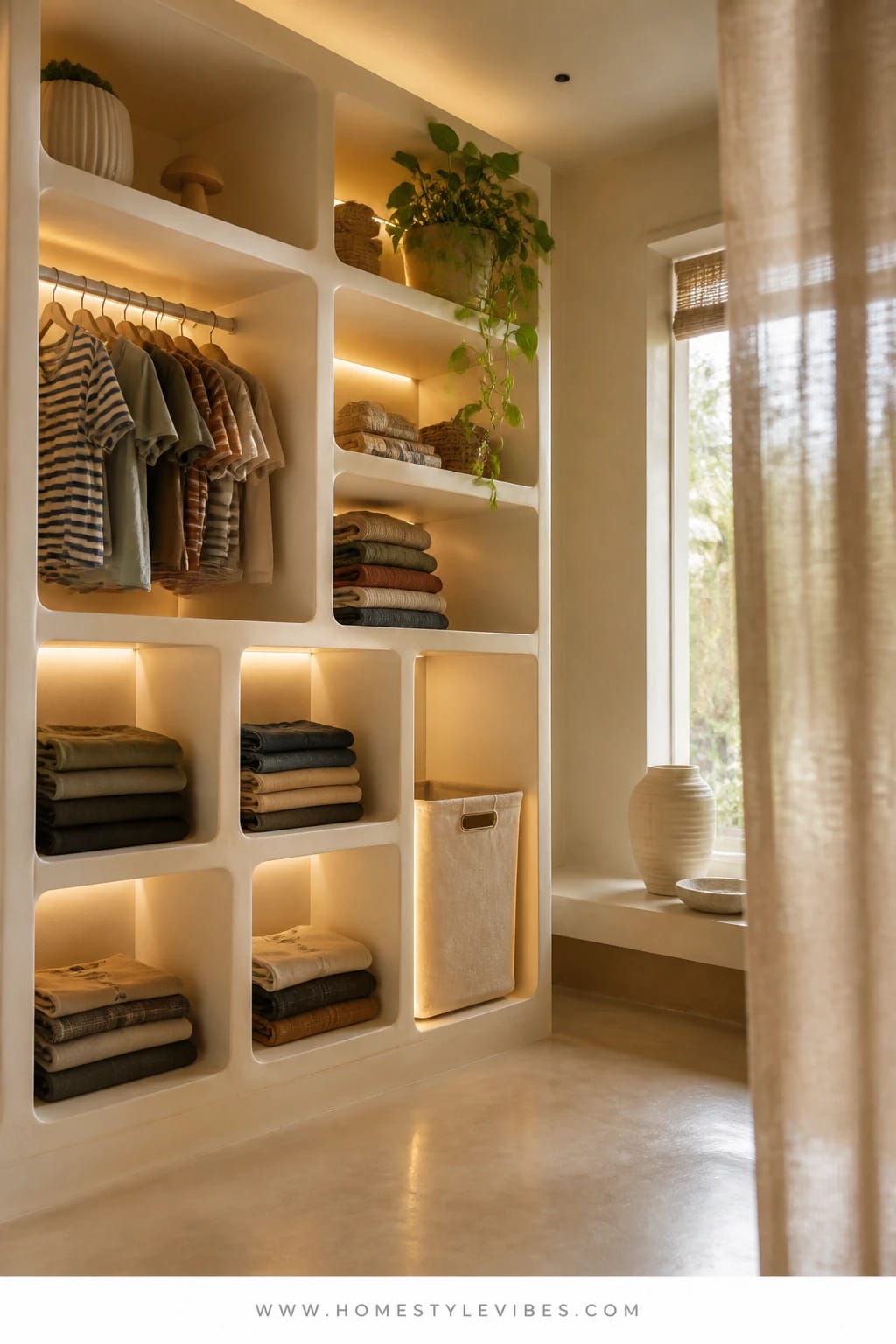
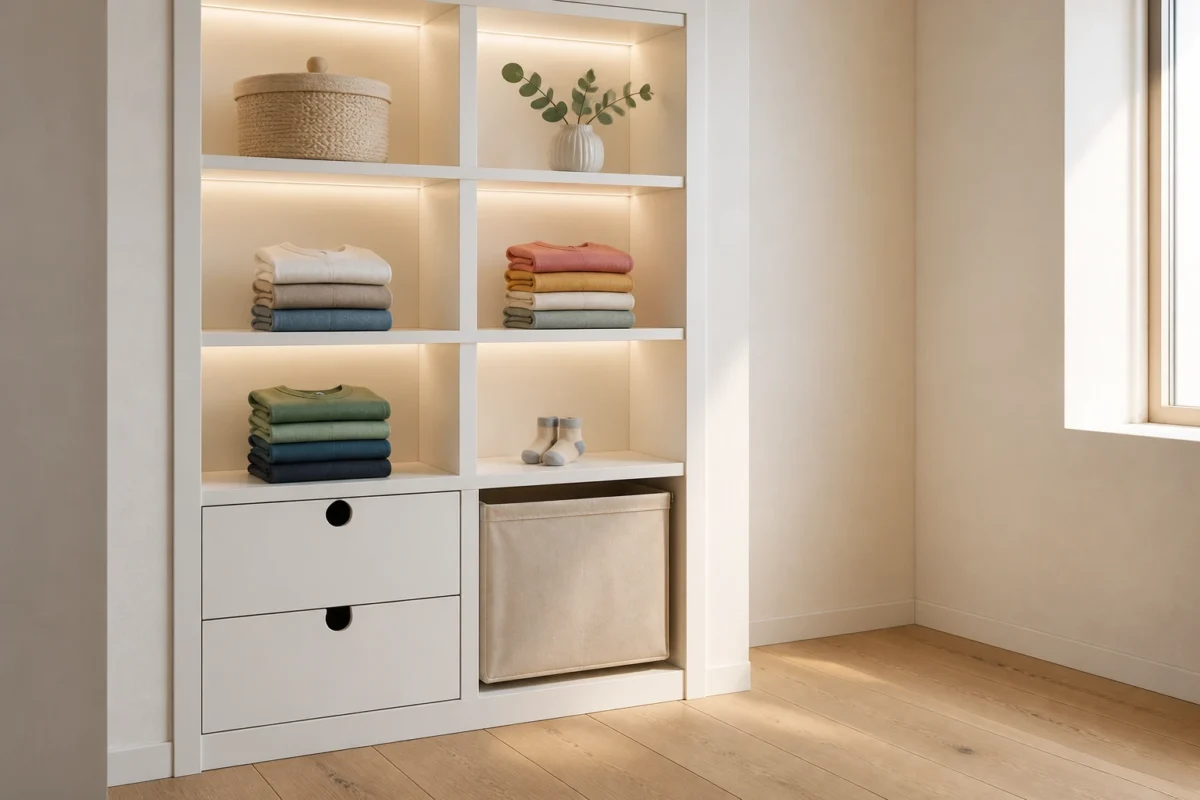
We’ve all been there: you fold everything by color, you label bins, and three days later a small person has tunneled to the back of the closet and pulled everything out “to find the unicorn shirt.” This built-in cubby wall solves the dig-and-destroy cycle by giving every clothing category a defined home at reachable heights, lit so even a sleepy kid can spot what goes where.
The mood skews bright and energizing—think hotel-spa meets kid-friendly studio. White melamine brings crisp edges and easy wipe-down care, while a sunrise-tinted LED strip under each shelf softens the look at 6 a.m. Why it works in real homes: melamine resists dings, the pocket hamper swallows laundry without needing floor space, and the lighting makes this closet photograph like a boutique. The sliding hamper panel? That’s the “no more laundry hills” moment. It’s family-proof and renters can adapt with freestanding cubes and stick-on lights.
Try variations:
– Budget-friendly: Use ready-to-assemble melamine cubes and a rolling laundry sorter behind a curtain.
– Small space: Stack narrow vertical cubbies (9–12 inches wide) and reduce shelf depth to 12 inches so shirts stay tidy.
– Renter-friendly: Go with cube bookshelves and adhesive LED strips; add a tension-rod curtain to hide everything at night.
Budget Breakdown:
- Melamine shelving/cubby system: $180–$600
- Sunrise LED strip kit with dimmer: $35–$120
- Sliding pocket hamper hardware + canvas bag: $60–$180
- Label holders or clip-on tags: $10–$30
- Edge banding and finishing trim: $25–$60
Total Estimated Cost: $310 – $990
Best For: Families craving a bright, boutique look; narrow closets that need vertical zones; morning routines where kids dress themselves.
Key Design Elements:
- Main materials: White melamine, canvas, slim aluminum bracket hardware
- Color palette: Bright whites, butter-warm LED glow, a pop color for labels (teal, coral, moss)
- Lighting strategy: Warm LED strips under each shelf; motion sensor for hands-free on/off
- Furniture silhouettes: Boxy cubbies, low-profile sliding hamper front
- Texture layers: Woven canvas, smooth melamine, soft rubber bin feet
- Accent details: Metal label frames, matching hanger color, a small framed art print inside the closet
How To Recreate This Look:
- Start with measuring the interior width, height, and door clearance; plan 12–14 inch deep cubbies for kid clothes.
- Add the melamine cubbies, anchoring verticals to studs for stability, and include one low bay for the sliding hamper.
- Layer warm LED strips beneath shelves; set the dimmer to a soft morning amber so clothes read true without harsh glare.
- Install the sliding hamper track and canvas bag; label it clearly so socks and tees don’t “accidentally” end up inside.
- Style with matching hangers and clip-on label frames; keep one open shelf for the weekly capsule (5 tops, 5 bottoms).
Why This Looks Expensive: Consistent material and light color create that boutique uniformity. The sliding hamper panel is a custom-feel detail that says “designed, not improvised.”
Watch Out: Don’t skip edge banding on cut melamine; raw edges look cheap and chip easily. Also, keep the LED strip hidden—no visible diode dots.
Pro Styling Tip: For photos, dim the LED to 40% and angle doors slightly open; the side glow adds depth and a soft shadow gradient across folded stacks.
Keep scrolling—next up is how to stop sock chaos with texture that actually works for tiny hands.
2. Natural Rattan Drawer Towers with Cool Daylight Sconces and a Low Bench with Pull-Out Shoe Crates
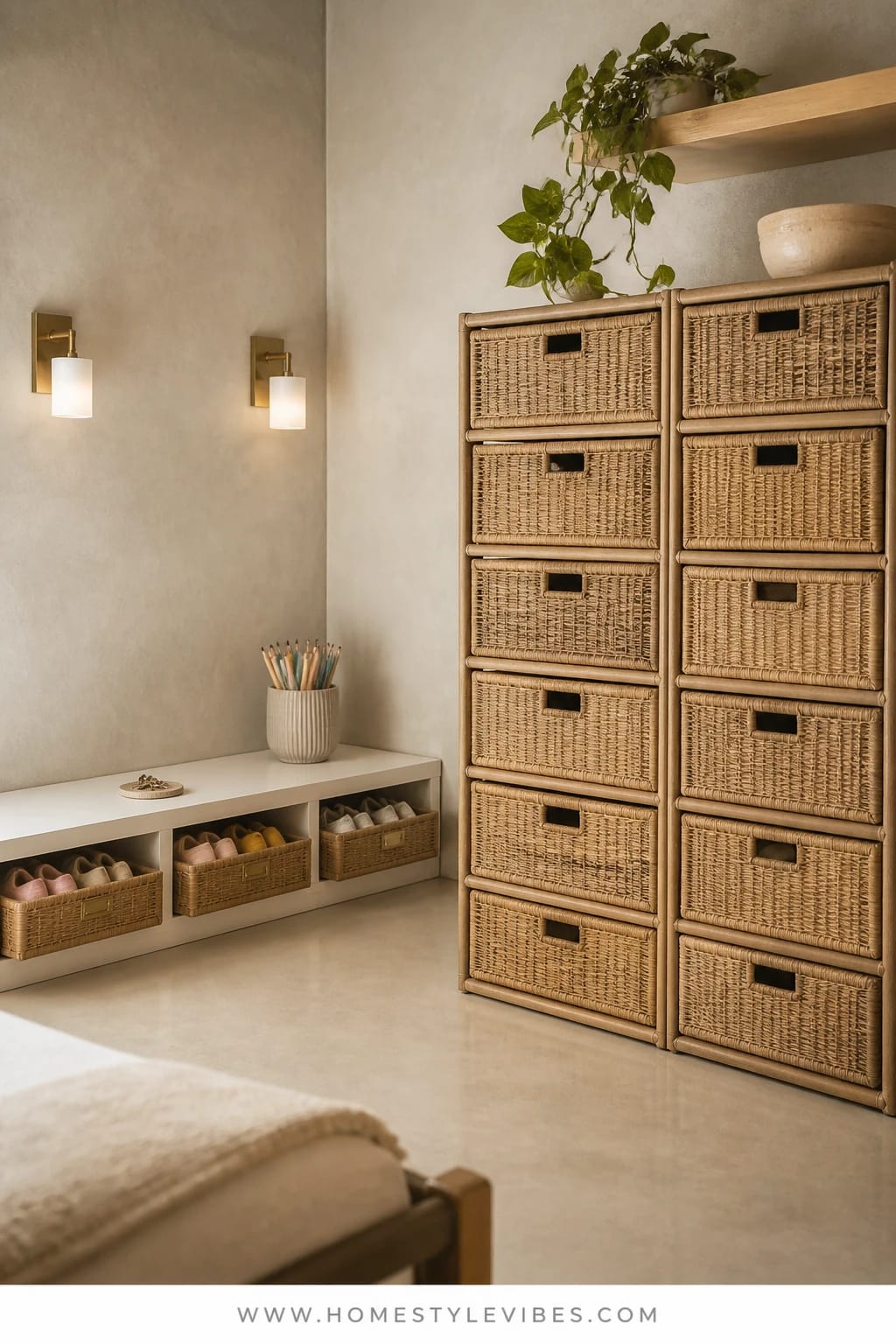
It’s that one corner that always feels off: drawers jammed with socks, hats tangled with leggings, and the pair of glitter boots lost behind a winter coat. You’ve tried plastic bins; they turn into toy soup. Rattan drawers solve the “out of sight, out of mind” problem by being breathable, tactile, and grippy—little hands can grab and put away without slamming plastic.
The vibe leans relaxed-coastal but practical. Natural rattan warms a white closet, while cool daylight sconces on each side keep colors true and the space alert for morning dressing. This combo photographs beautifully because of the interplay between woven texture, crisp light, and the horizontal line of a bench grounding the scene. Real-home perks: easy to dust, drawers don’t show fingerprints, and the low bench with crates makes shoe wrangling a one-motion habit.
Variations:
– Budget-friendly: Go for pine cube shelves with rattan baskets; add clip-on battery sconces with daylight bulbs.
– Darker version: Walnut-stained bench, black metal sconces, and charcoal rattan baskets for a moody, editorial look.
– Small-space: Narrow double-tall tower on one side, single bench on the other—no middle clutter.
Key Design Elements:
- Main materials: Rattan drawers/baskets, solid wood bench, powder-coated metal sconces
- Color palette: Honey rattan, white walls, denim blue labels, a hint of brass
- Lighting strategy: 5000K daylight sconces for true color reads; add a small warm LED under the bench for night
- Furniture silhouettes: Vertical drawer towers, long low bench, crate-style pull-outs
- Texture layers: Woven rattan, canvas labels, smooth wood, ribbed sock dividers
- Accent details: Leather drawer pulls, painted crate numbers, oversized wall hook for backpacks
Budget Breakdown:
- Rattan drawer towers (2–3 units): $160–$450
- Bench with pull-out crate hardware: $120–$350
- Daylight sconces (hardwired or plug-in): $60–$240
- Crates and shoe mats: $40–$120
- Labels/pulls: $15–$40
Total Estimated Cost: $395 – $1,200
Best For: Households with lots of small accessories; kids who need tactile cues; closets that double as mini mudrooms.
How To Recreate This Look:
- Start with two rattan tower units positioned on either side of the closet or along one wall if shallow.
- Add a sturdy wood bench across the bottom; ensure at least two pull-out crates fit beneath with sliders.
- Layer side-mounted sconces at kid eye-level; choose daylight tones for accurate color matching.
- Install simple leather pulls and uniform labels; dedicate one drawer to “out-the-door” items like hats and gloves.
- Style with a backpack hook and a slim tray on the bench for hair ties and morning odds-and-ends.
Why This Feels Designer: Tonal natural materials with consistent light temperature read considered and calm. The bench line unifies the scene and the rattan adds organic depth.
One Thing To Avoid: Avoid mixing basket patterns and colors; it reads messy. Keep to one weave and one label color across the whole setup.
Pro Styling Tip: Angle a couple of drawers open half an inch for photos; the shadow reveals texture and makes the rattan look dimensional.
Before the next idea, a mindset reset: this isn’t about museum-level perfection. It’s about a system your kid can use on a tired Tuesday. If one detail resonates, that’s your starting point. Layer the rest over time.
3. Birch Ply Pegboard Wall with Soft Diffused Pendant and a Rolling Three-Tier Cart
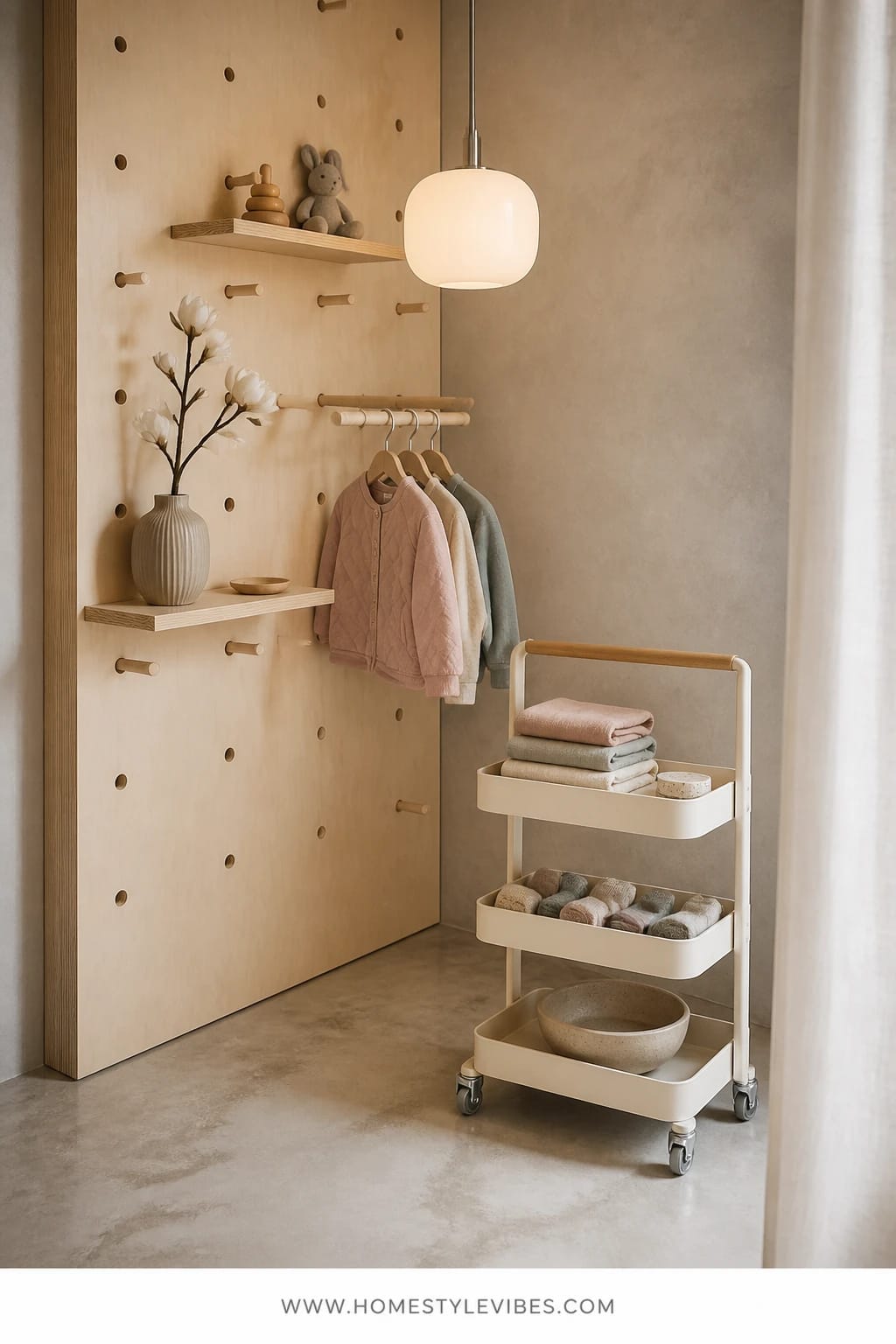
You’ve tried hooks, but they end up overloaded and crooked. Pegboard is the shapeshifter of kids’ closet organization ideas—it adapts as sizes and seasons change. We’re talking birch ply for warmth, removable pegs, shelves, and hanging dowels that rearrange in minutes.
The mood is Scandinavian-workshop meets playroom. The soft diffused pendant light glows like a cloud and casts even, shadow-free light that kids love. This design photographs gorgeously because of the negative space between pegs and the rhythm of repeated shapes. In real homes, the rolling cart is the unsung hero: top tier for “wear again,” middle for pajamas, bottom for laundry supplies or seasonal accessories. When a growth spurt hits, move the pegs up—problem solved.
Variations:
– Budget-friendly: Paint MDF pegboard in a pale clay color and use dowel pegs; add an inexpensive rice-paper pendant.
– Renter-friendly: Mount a freestanding pegboard panel that leans against the wall and anchor with furniture straps.
– Small closet: Keep pegboard to one side and use shallow shelves for shoes to avoid door clearance issues.
Budget Breakdown:
- Birch ply pegboard (custom or modular): $120–$380
- Soft diffused pendant (plug-in or hardwired): $35–$160
- Rolling three-tier cart: $30–$90
- Assorted pegs, dowels, and shelves: $25–$80
- Wall anchors and finish: $15–$40
Total Estimated Cost: $225 – $750
Best For: Rapidly growing kids; visual learners; entry closet hybrids where backpacks and jackets rotate daily.
Key Design Elements:
- Main materials: Birch plywood, powder-coated steel cart, cotton cord pendant
- Color palette: Pale wood, soft white, a pop of clay or olive on accessories
- Lighting strategy: Single diffused pendant to minimize harsh shadows on small items
- Furniture silhouettes: Circular pendant, linear dowels, slim-tier cart
- Texture layers: Raw wood grain, woven cart liners, felt bin inserts
- Accent details: Minimalist peg caps, washi-taped labels, a mini mirror at kid height
How To Recreate This Look:
- Start by mounting the pegboard with proper wall anchors; mark stud locations for heavier zones.
- Add a mix of pegs: a long dowel for hangers, short pegs for hats, and shallow shelves for folded tees.
- Layer the rolling cart beneath; store “wear again” items on top to reduce laundry loads.
- Install a diffused pendant overhead; keep it centered so the pegboard lights evenly.
- Style with two repeating colors (say, olive and clay) for hooks, bins, and labels for a tight, cohesive look.
Why This Reads High-End: Purposeful negative space and a single dominant material (birch) create calm. Moveable parts feel custom and intentional, not cobbled together.
The Most Common Mistake: Overcrowding every peg. Leave breathing room so each category is obvious—visual white space is a system, not wasted space.
Pro Styling Tip: For a photo-ready moment, align three hangers equally spaced on one dowel and tilt the cart at a slight angle for depth.
Halfway check-in: if your brain’s buzzing, you’re normal. Organizing kids’ clothes is part sorting, part psychology. Start with the problem that bugs you the most and solve just that this week.
4. Fluted MDF Wardrobe Fronts with Warm Edison Rail Lighting and a Narrow Ladder Shelf
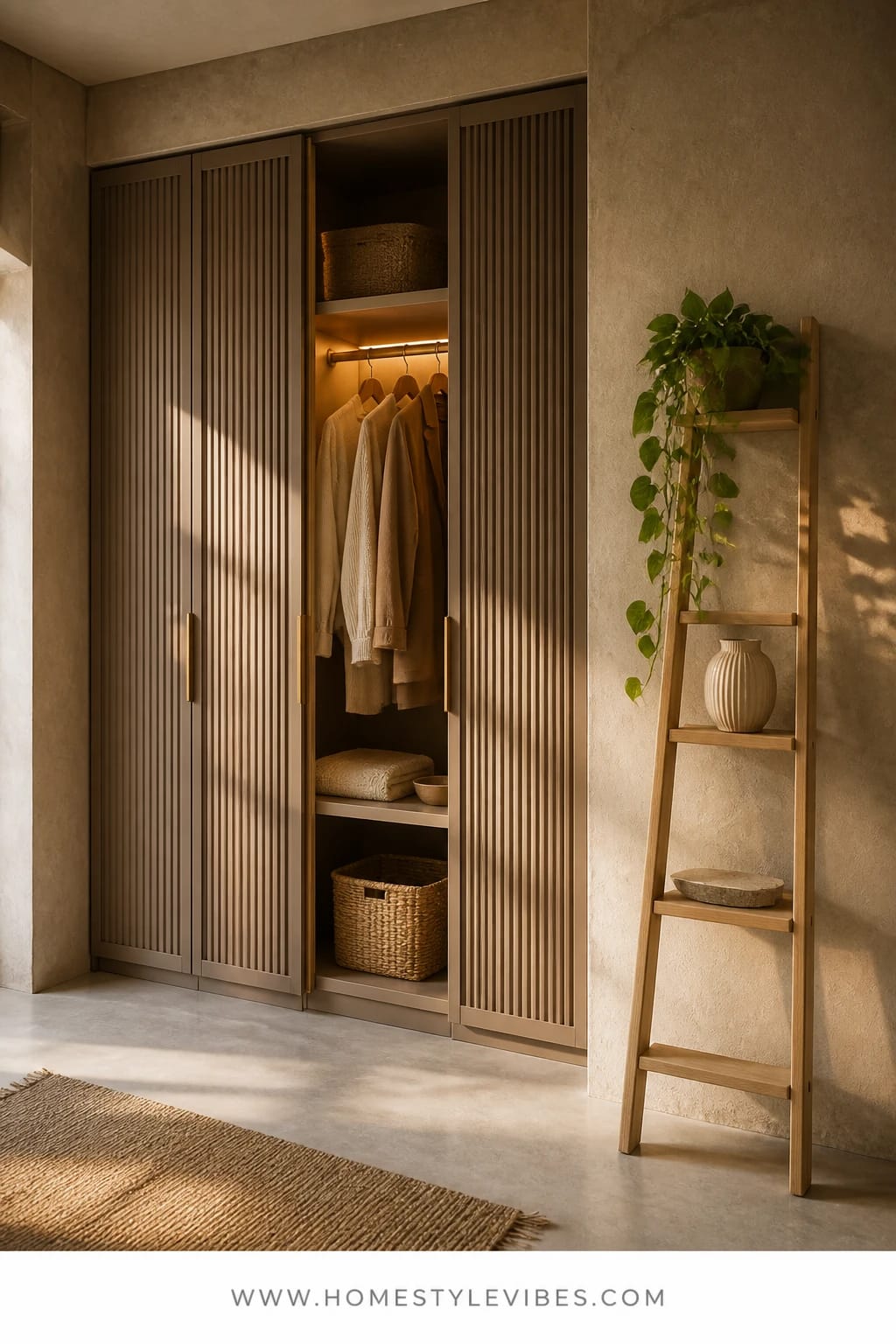
You want a closet that looks like furniture, not storage. But thin doors and rattling tracks? Not the vibe. Fluted MDF doors add texture that hides fingerprints and micro-dings, while a warm Edison-style rail on the interior bathes everything in a cozy glow.
The mood is warm modern with a nod to vintage. Fluting adds shadow play, the Edison rail warms skin tones, and the narrow ladder shelf feels sculptural but practical. Why it works: kids respond to “special”—a closet that looks like a piece of furniture makes them want to interact with it. It photographs beautifully thanks to vertical texture and a warm light source that brings out depth in neutrals.
Variations:
– Budget-friendly: Add fluted peel-and-stick panels to existing doors; use a battery-powered wardrobe bar light.
– Darker palette: Deep olive or navy fluted doors with aged brass knobs; the warm bulb keeps it from feeling cold.
– Renter-friendly: Freestanding armoire with fluted overlay panels attached via removable strips; keep your original intact.
Key Design Elements:
- Main materials: Fluted MDF, matte paint, oak ladder shelf
- Color palette: Mushroom, camel, ivory, aged brass
- Lighting strategy: Warm 2700K rail lighting mounted at the front interior for theater-curtain vibes
- Furniture silhouettes: Tall fluted planes, slender ladder, low baskets
- Texture layers: Ribbed MDF, linen-lined bins, suede label ties
- Accent details: Dome knobs, brass wardrobe hooks, canvas hamper
Budget Breakdown:
- Fluted MDF overlay or doors: $180–$600
- Wardrobe rail light (plug-in or rechargeable): $30–$150
- Narrow ladder shelf: $70–$240
- Paint and hardware: $50–$160
- Linen bins and labels: $40–$120
Total Estimated Cost: $370 – $1,270
Best For: Bedrooms where the closet sits in full view; design-forward families; anyone who loves a tactile, grown-up look that still works for kids.
How To Recreate This Look:
- Start by measuring doors and cutting fluted MDF panels to fit; sand edges for a clean paint finish.
- Add warm paint; choose a shade slightly darker than the walls for subtle contrast.
- Layer a wardrobe rail light just behind the door line; add a motion sensor for hands-free magic.
- Install a slim ladder shelf inside or just outside for shoes, folded hoodies, or baskets of socks.
- Style with linen bins at the bottom and dome knobs or leather pulls to soften the ribbed texture.
Why This Looks Intentional: One dominant vertical texture guides the eye upward. Warm, directional lighting feels like a boutique fitting room and elevates simple basics.
Don’t Do This: Don’t paint fluted panels in high-gloss; it highlights imperfections and toy scuffs. Stick to eggshell or satin for a refined, forgiving finish.
Pro Styling Tip: Photograph with the doors slightly ajar and the light on; you’ll catch a ribbon of warm light that makes the fluting pop.
Quick breather: I once installed fluted panels slightly off-level and spent a week feeling like the closet was tilting. Measure twice, then walk away for five minutes and re-check with fresh eyes. Perfection is sneaky.
5. Powder-Coated Steel Double-Rod System with Crisp Neutral Palette and a Full-Height Mirror Door
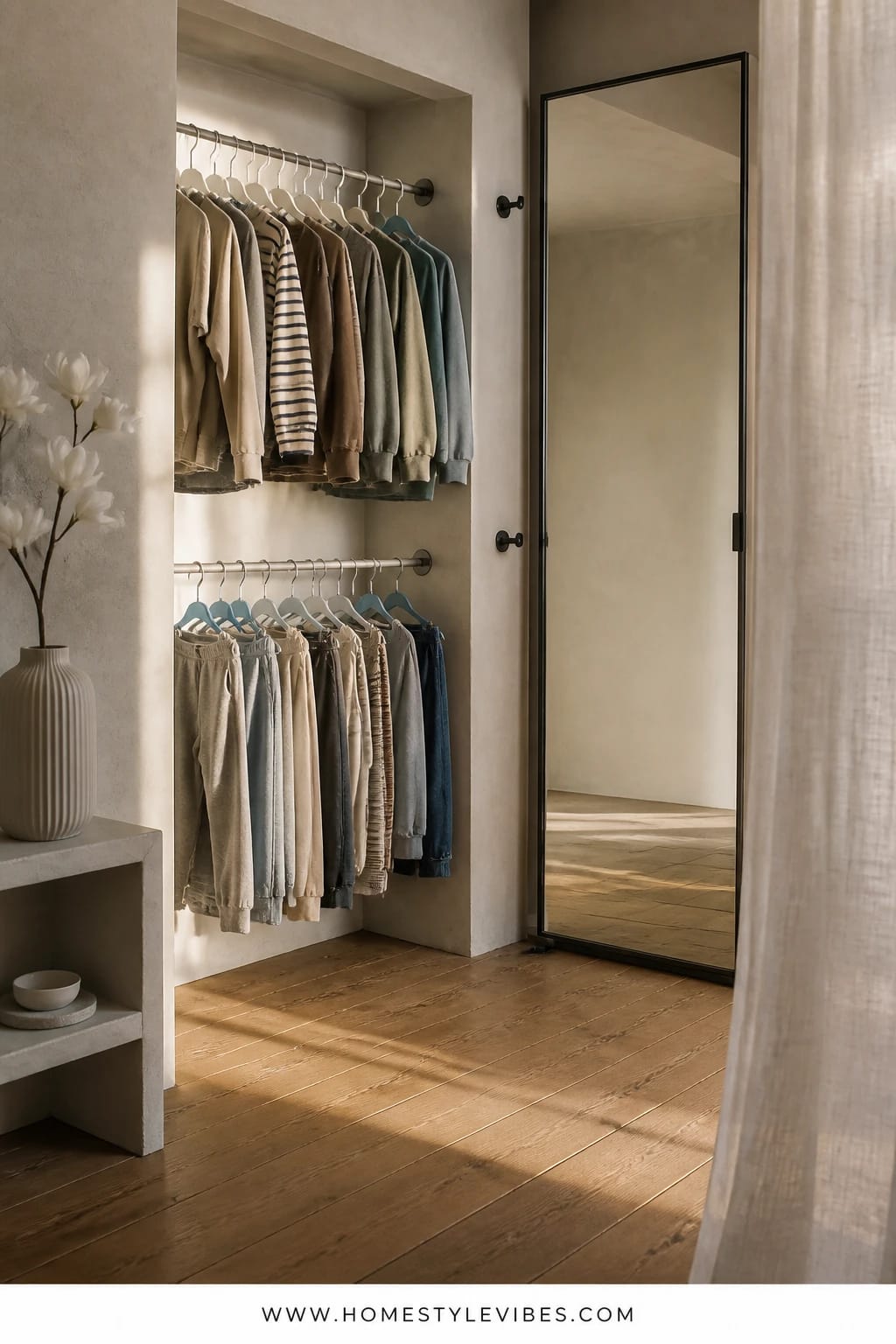
Some kids keep growing out of clothes mid-season, and your single rod turns into a tangle. A double-rod system doubles capacity and makes categories crystal clear: tops above, bottoms below, or current size above, next size waiting below. We pair it with a crisp neutral palette so color-coded hangers are the only “pop.”
The mood is clean urban closet—functional, graphic, and super easy to maintain. Powder-coated steel holds up to rough handling. A full-height mirror door bounces light back into the closet and gives kids that final check before running out the door. This design photographs like a fashion rack: symmetry, strong lines, and room for negative space.
Variations:
– Budget-friendly: Use adjustable tension-rod double hang bars and a peel-and-stick mirror panel on the door.
– Small-space: Shorter lower rod on one half for dresses; leave the other half for a hamper or drawers.
– Renter-friendly: Freestanding double-rod wardrobe with lockable wheels; swap the door mirror when you move.
Budget Breakdown:
- Powder-coated steel rod system (adjustable): $120–$400
- Full-height mirror door or panel: $90–$260
- Uniform kids’ hangers: $25–$70
- Hanging shelf dividers: $15–$40
- Slim rolling bin for extras: $30–$80
Total Estimated Cost: $280 – $850
Best For: Shared closets, capsule wardrobes, fast-growing kids, and homes where mornings run on visual clarity and speed.
Key Design Elements:
- Main materials: Powder-coated steel, glass mirror, felt dividers
- Color palette: Charcoal, white, oatmeal, a dash of sage
- Lighting strategy: Overhead neutral-white bulb to avoid color shift; mirror multiplies light
- Furniture silhouettes: Linear rods, slim bins, flat-panel door
- Texture layers: Felt hangers, canvas bins, brushed metal
- Accent details: Size dividers, uniform label fonts, a slim valet hook
Why This Looks Expensive: Symmetry and repetition. Two rods, one hanger color, and a mirrored surface read tailored and calm—like a tiny ready-to-wear boutique.
How To Recreate This Look:
- Start by installing adjustable uprights and two rods; set the lower rod at kid shoulder height.
- Add a mirror panel to the door; check that it reflects the closet, not just the hallway.
- Layer matching hangers and size dividers; group by clothing type, then by color within type.
- Install felt shelf dividers on any upper shelf to keep stacks from slumping onto the rods.
- Style a thin rolling bin for outgrown items; when it’s full, it’s donation day—no second-guessing.
One Thing To Avoid: Don’t overload the lower rod with heavy coats; it ruins spacing and sags. Keep bulky items on sturdy hooks or an upper shelf.
Pro Styling Tip: Color-block the hangers light to dark within each category for photos; the gradient reads tidy and intentional.
True story: a friend spent weeks buying bins before realizing the clothes-to-hanger ratio was the real villain. Once she added a second rod, the bins went half-empty and mornings got quiet.
6. Soft Linen Curtain Front with Golden Hour Puck Lights and a Deep Drawer Dresser Island
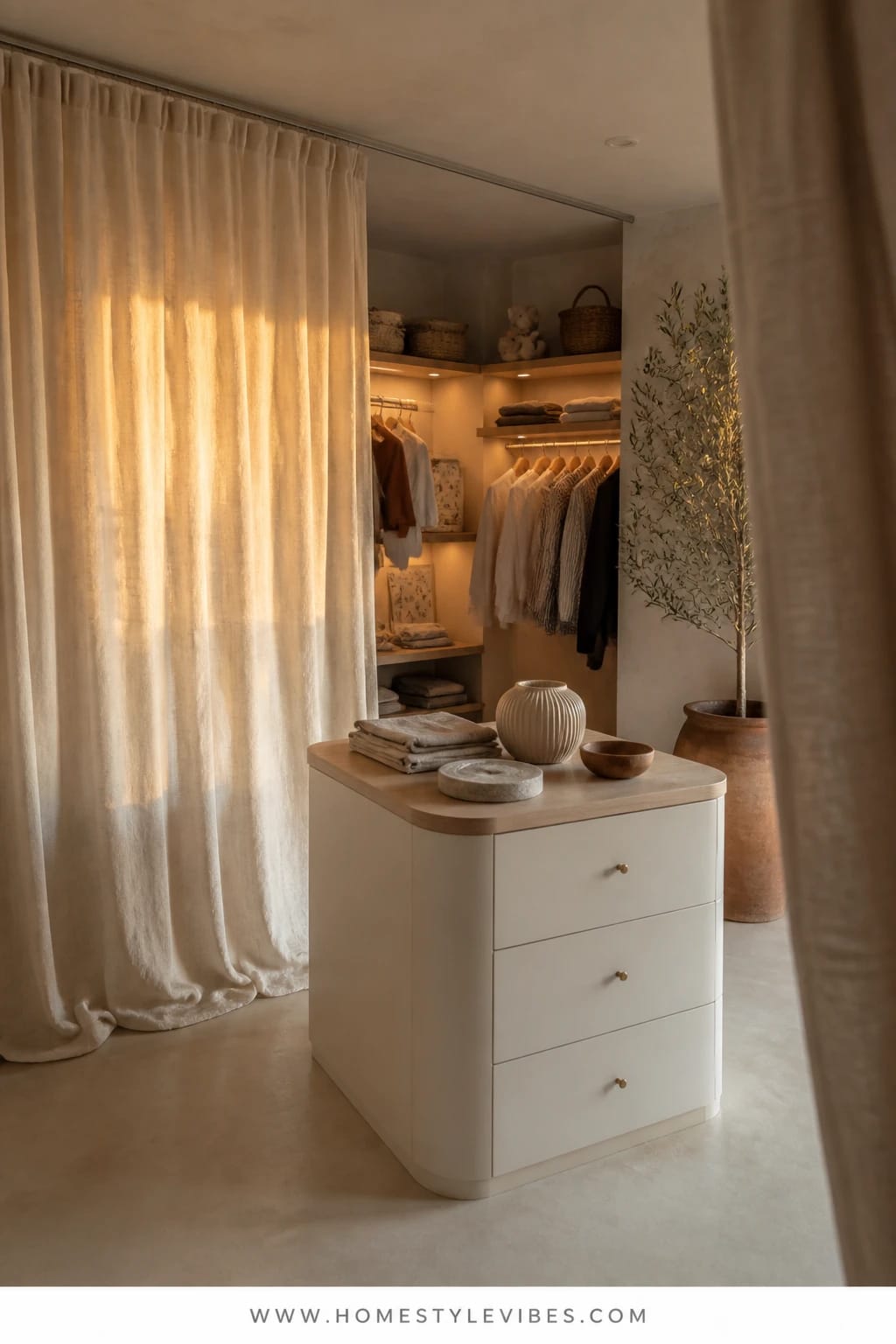
Not every room wants a door. Sometimes kids need open access without the slam and pinch points. Enter: a soft linen curtain that glides, hides, and forgives, paired with golden-hour puck lights that spotlight zones and a deep-drawer dresser “island” inside the closet footprint.
The mood leans boho-meets-bungalow—casual, airy, and tactile. The linen filters light, so the closet never feels harsh. Puck lights cue “stations” and make it easy for kids to navigate: pajamas here, uniforms there, accessories framed like tiny treasures. The dresser island anchors the space, gives real folding depth, and turns a chaotic cave into a mini dressing room. Photographically, the curtain adds movement and softness that plays well with wood grain and folded knits.
Variations:
– Budget-friendly: Use IKEA-style 3-drawer dresser and a tension-rod linen panel; stick-on rechargeable pucks.
– Darker version: Tobacco linen, walnut dresser, warm brass pucks for a moody late-afternoon glow.
– Renter-friendly: Ceiling-mount track with removable adhesive; the dresser stays freestanding.
Budget Breakdown:
- Linen curtain panel + ceiling track: $80–$260
- Rechargeable warm puck lights (set of 6–8): $40–$120
- Deep-drawer dresser (30–36 inches wide): $160–$550
- Drawer organizers: $25–$70
- Small art or pinboard for outfits: $20–$60
Total Estimated Cost: $325 – $1,060
Best For: Alcove closets, rooms where doors conflict with beds or windows, and kids who respond to “stations” more than labels.
Key Design Elements:
- Main materials: Pre-washed linen, warm wood dresser, brass-finish puck lights
- Color palette: Sand, toffee, warm white, sage
- Lighting strategy: Golden 2700–3000K pucks over each zone; optional toe-kick strip under the dresser
- Furniture silhouettes: Boxy dresser, soft curtain wave, simple hooks
- Texture layers: Linen weave, ribbed drawer dividers, woven trays
- Accent details: Cotton rope pulls, dried eucalyptus in a bud vase, a brass clip rail for outfit planning
How To Recreate This Look:
- Start by mounting a ceiling track just outside the closet face; hang a floor-grazing linen curtain.
- Add a deep-drawer dresser centered inside; leave 18 inches clearance around it for easy access.
- Layer warm puck lights above sections: one over drawers, one over each hanging zone, one for shoes.
- Install drawer organizers by category: undies, socks, pajamas, swim, uniforms.
- Style a small clip rail or pinboard on the side wall for weekly outfits and permission slips.
Why This Feels Designer: The curtain brings softness where closets usually go hard-edged. Zoned lighting adds drama and clarity, and the dresser island turns storage into a gentle ritual.
The Most Common Mistake: Hanging the curtain too short. Let it kiss the floor by half an inch; high-water hems look accidental and cheap.
Pro Styling Tip: For a photo, pull the curtain to one side in a clean S-curve and leave one drawer open slightly—texture plus negative space sells the story.
Perspective shift: systems stick when they reduce decisions. If your kid can choose between two bins instead of eight, that’s a win. You don’t need every bell and whistle—pick the rhythm that matches your mornings.
Quick Checklist
- Measure closet depth and door swing before buying anything
- Pick one dominant material to keep the look cohesive
- Choose a single light temperature for all fixtures
- Use matching hangers for visual calm
- Label by category, not person, if kids share a space
- Add one concealed hamper at kid height
- Keep one “wear again” zone to reduce laundry
- Install shelf dividers to prevent stack slumps
- Color-block clothing within categories
- Use zones: tops, bottoms, pajamas, uniforms, extras
- Leave 20% empty space for growth and laundry days
- Audit seasonally; donate when the bin fills
Frequently Asked Questions
How much should I budget to organize a small kids’ closet without custom carpentry?
Plan $250–$600 for modular shelving, lighting, matching hangers, and a hamper. Choose one hero element—like a double-rod kit or rattan drawers—and keep everything else simple.
My closet is tiny and has sliding doors. Which idea works best?
Go for a double-rod system on one side and a vertical rattan tower on the other. Use shallow shelves and puck lights so everything clears the doors without snagging.
We rent—how do we do this without drilling everywhere?
Try freestanding cube shelves, a leaning pegboard with furniture straps, tension-rod double hangers, adhesive LED strips, and a ceiling-mount curtain track with minimal anchors. Everything comes with you when you move.
How do I maintain these systems when my kid refuses to fold?
Switch folding categories to drawers with dividers and use the “thirds fold” for tees or roll pajamas. For the truly fold-averse, assign baskets by item and skip folding entirely—sorted is better than perfect.
What common design mistake makes kids’ closets feel messy even when they’re organized?
Mixing too many bin types and light temperatures. Use one basket style, one hanger color, and a single bulb temperature throughout to keep the visual noise low.
Conclusion
Pick one idea. Not all six. If your mornings feel loud, start with the fix that quiets that one friction point—lighting for visibility, a double rod for capacity, or a dresser island for gentle ritual. The truth is, kids’ closet organization isn’t about fancy labels; it’s about creating a path of least resistance that even a half-awake seven-year-old can follow.
Texture, lighting, and restraint make any kids’ closet look and feel high-end. Choose one dominant material, match your hangers, commit to a single bulb temperature, and leave white space so the system can breathe. From there, you’ll see the space with fresh eyes and know exactly what to tweak.
You’ve got this. Pick a weekend, pick a plan, and watch how quickly the daily scramble softens. When everything has a home—and the light is kind—kids cooperate. And honestly? So do we.

About the Author

Krisztina P.Rendes, Founder of Home Style Vibes
Founder of Home Style Vibes
Krisztina Puskásné Rendes created Home Style Vibes as a cozy-modern lifestyle space where homemaking meets inspiration. Her goal is to help women create beautiful, organized, and peaceful homes they truly love — without overwhelm. You’ll find here heart-driven content on home decor, cleaning tips, easy family recipes, organization and decluttering, DIY home projects, plants, and seasonal ideas — all designed to bring more calm, comfort, and style into everyday life.