20 Kitchen Design Trends for 2026: The Ultimate Guide to Colors, Materials, and Quiet Luxury
If my kitchen could talk—well, actually, my one-year-old daughter doesn’t even talk yet, she just points at the fridge and grunts when she wants cheese—it would probably tell you it’s tired of being “just a kitchen.”
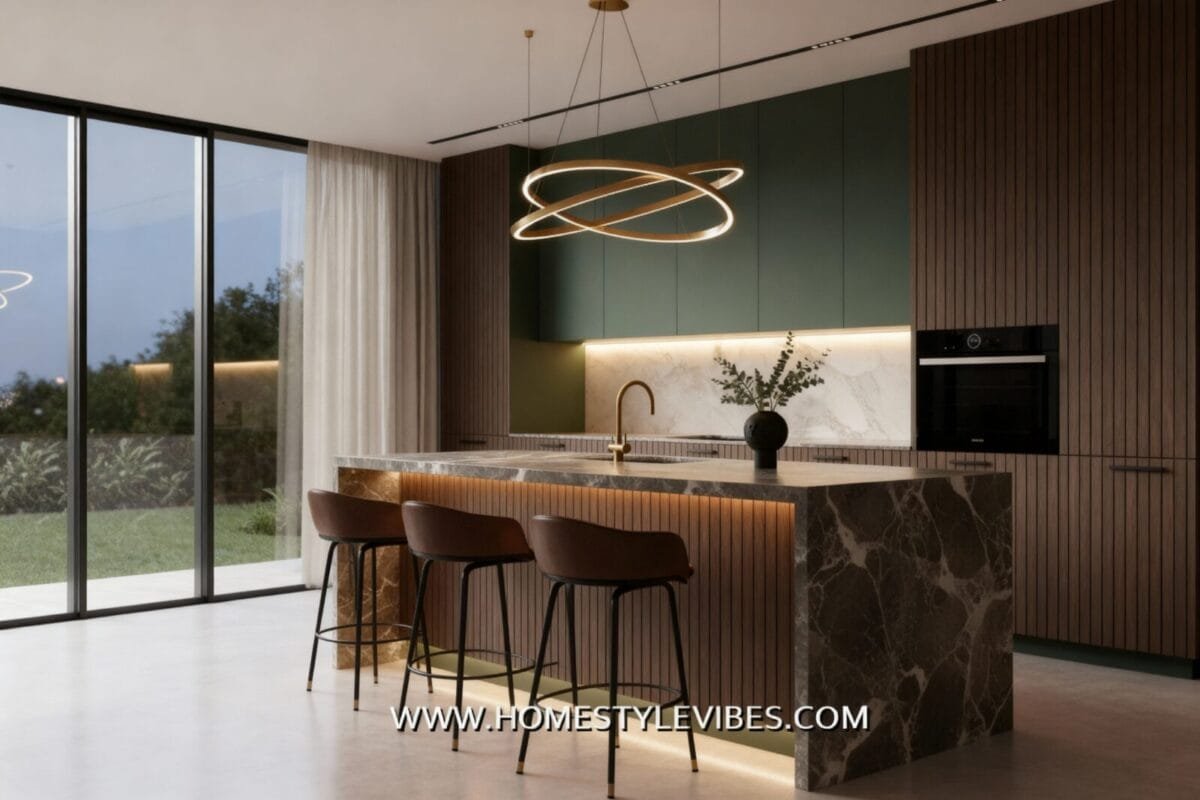
Honestly, for years, we’ve treated this room like a high-stakes laboratory where we battle grease and toddler tantrums. But 2026 is changing the game. We are moving toward a world of “Livable Luxury,” where the room feels less like a workspace and more like a warm hug. Last winter, while I was sitting in my local designer’s office, the receipt for my coffee actually smelled like cinnamon from my latte, and that’s exactly how I want my home to feel—sensory, intentional, and real.
Find Your 2026 Kitchen Soulmate
With 20 trends to choose from, I know it can feel overwhelming. Take 30 seconds to find out which of my favorite looks fits your lifestyle best!
1. What is your #1 priority for your new kitchen?
2. How do you feel about the “Hospital White” kitchen look?
3. Who shares your kitchen with you?
4. What’s your “guilty pleasure” in design?
My Personal Design Roadmap for You:
I’ve spent months digging through the latest reports from places like EuroCucina and the NKBA to figure out what’s actually worth your time and money. Forget the cold, sterile looks of 2019. We are leaning into kitchen design that prioritizes your sanity and your soul. Whether you’re a mom like me trying to hide the “Cheerios-on-the-floor” chaos or a young couple looking for that Pinterest-perfect aesthetic, these 20 trends are the roadmap to a home that actually serves you. I promise this guide won’t be some boring corporate manual—we’re talking real materials, better colors, and the “quiet luxury” hacks I wish I knew three years ago. I’ve curated 20 stunning examples from around the world to show you exactly how these trends look in real life.
1. Walnut Paneling and Hidden World Concepts
If you want to know what “Quiet Luxury” really looks like in 2026, it’s not about flashy gold. It’s about walnut. High-end walnut paneling is taking over entire walls, turning the kitchen into a furniture-grade masterpiece. This trend is all about “Mindful Organization.” The goal is to have a wall of walnut that secretly hides a fridge, a massive pantry, and maybe even a hidden wine bar. It’s the ultimate way to maintain a clean, organized aesthetic when the room is part of an open plan.
Just look at this image. This dark wood luxury is solid, masculine, and incredibly chic. Notice how the storage is completely integrated to maintain a clutter-free aesthetic. I love this because it forces you to be intentional about what you keep. Once I literally couldn’t pay at Aldi because my bag was so full of random stuff I couldn’t find my card—I don’t want my kitchen to feel like that bag! By using full-height panels, you remove the “visual noise” of cabinet doors and handles. Speaking of handles, touch-to-open technology is becoming the standard for this look, making the kitchen design feel like one continuous piece of art.
And guess what? 87% of designers in the latest NKBA report say that concealed pantries are the #1 request this year. We want the function, but we don’t want to see the clutter. It’s about creating a space that feels grounded and permanent, which is exactly what we need in today’s uncertain world. This shift toward rich, dark wood is also bringing back a love for heritage elements, but styled in a way that feels totally fresh.
This grounding in dark, heavy wood naturally leads us back to a style that is being completely reborn for 2026.
2. The Rustic Farmhouse 2.0: Sage and Beams
Let’s be real—the “Modern Farmhouse” of 2018 (you know, the one with the ‘Gather’ signs and white shiplap everywhere) is officially evolving. In 2026, we are embracing the “Authentic Farmhouse.” This isn’t a theme; it’s a lifestyle. We are talking about raw wood beams, traditional black range stoves, and muddier, nature-inspired greens. It’s about creating a home that feels like it’s been there for a hundred years, even if it was built last Tuesday.
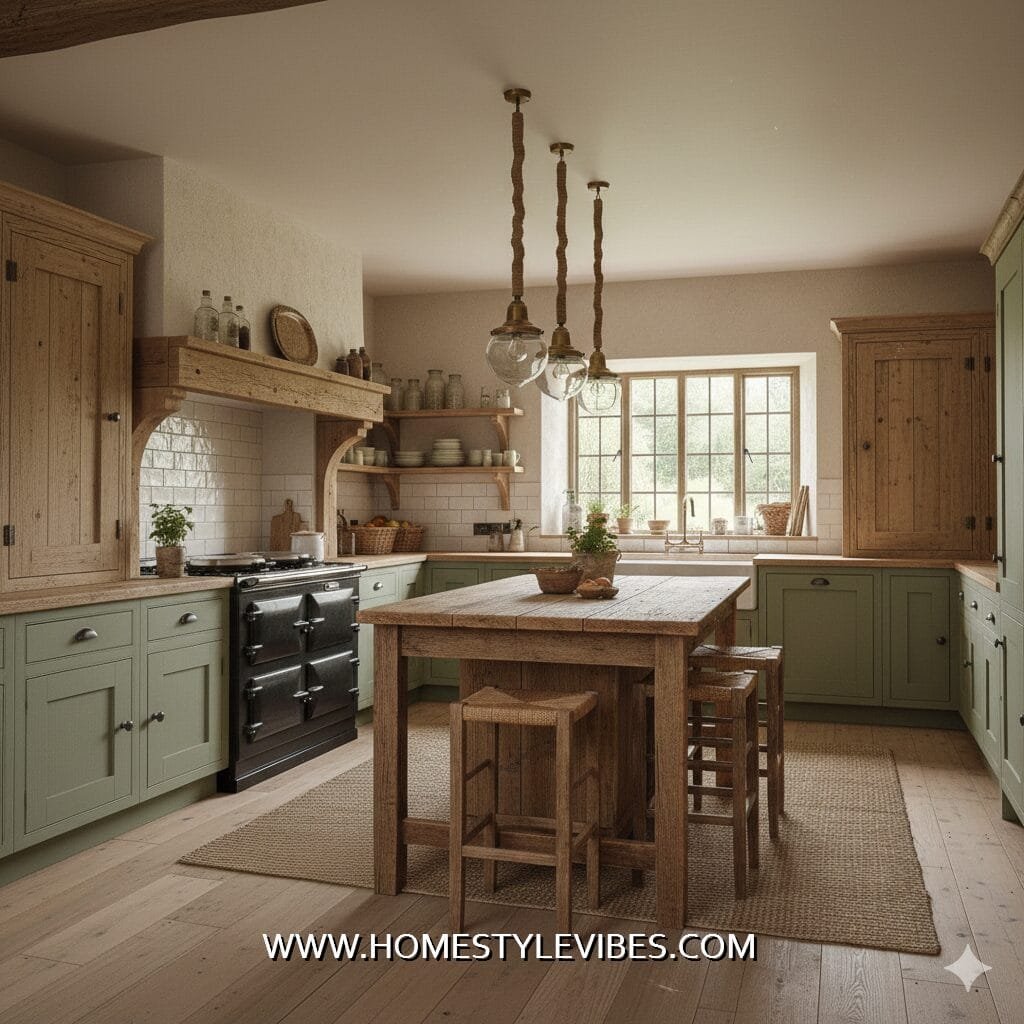
It is the perfect example of this “Modern Heritage” vibe. That soft sage cabinetry paired with the massive, raw wood island is just… wow. It feels timeless. It reminds me of those cozy English country kitchens where someone is always baking bread (even if in reality, I’m just reheating frozen pizza). Using these deeper, earth-inspired greens adds a layer of depth that white cabinets just can’t touch. Honestly, it makes the room feel expensive without needing a million-dollar budget. FYI, sage green is the new neutral—it pairs with almost everything and hides “life happens” marks better than white paint ever could.
We are seeing a move away from “faux” rustic toward materials that patina gracefully. Think unlacquered brass faucets that change color as you touch them, or a butcher block island that shows the marks of family meals. My husband once looked at a slightly scuffed wooden counter and asked if we should sand it, and I told him, “No, that’s called character!” Because life happens, right? And we might as well enjoy the view while it does.
While the farmhouse brings the calm of the countryside, the next trend brings a sun-baked energy that is all about color confidence.
3. Terracotta Saturated Color Blocking
Moving away from the “greige” trap, 2026 is leaning into the heat. We are seeing a huge comeback for terracotta and clay. This isn’t your grandma’s 1970s orange, though. This is a refined, earthy vibrancy. These colors tell a story of renewal and mindful creation. I once visited a small pottery studio in the Southwest, and the smell of the damp clay stayed with me for weeks—that’s the vibe we are desing-ing for here. It’s Mediterranean warmth meets modern structure.
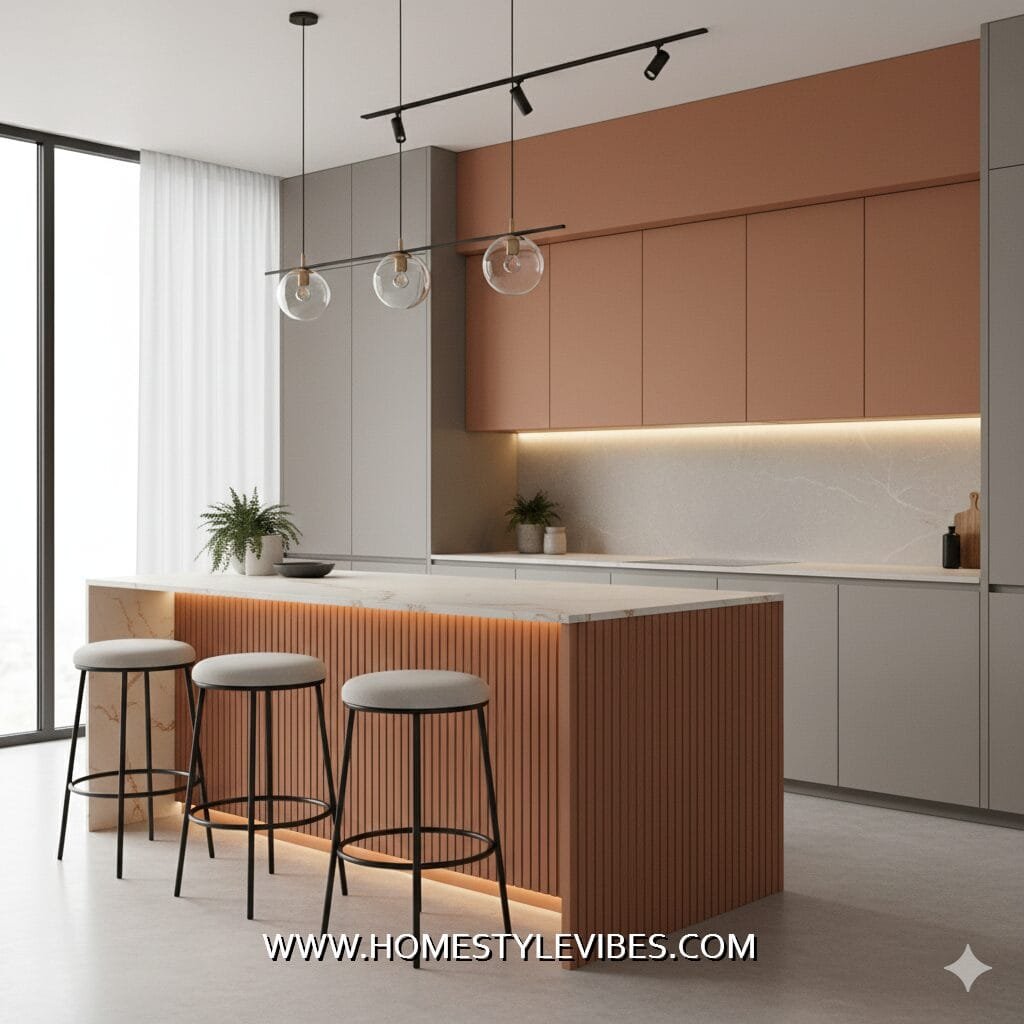
Check out this image. The way the terracotta upper cabinets meet the taupe-gray bases is a masterclass in 2026 color pairings. It’s unexpected but feels totally cohesive. This kitchen design trick uses “color blocking” to define different zones of the room. It’s cheerful but sophisticated. I think it works so well because it honors the history of the home while feeling completely fresh for a modern family. Hold on—wait, did you see how that fluted texture on the island pulls the whole look together? It adds an architectural layer that makes a flat-pack kitchen look like a custom commission.
If you’re nervous about using such a bold color, start with the uppers or even just a pantry nook. Designers are calling this “Zonal Satiation,” where you pick one area to drench in a saturated hue. Pair these warm clay tones with 90+ CRI lighting to make sure the pigments look true and not muddy under yellow bulbs. We want that “golden hour” glow all day long. It makes even the most mundane Tuesday morning breakfast feel a bit more like a vacation in Tuscany.
But the real trick to making these colors pop is the way we use light as a sculptural element.
4. Modern-Organically Sculpted LED Lighting
Lighting in 2026 is no longer just about being able to see where you’re chopping onions. It’s about mood and movement. We are seeing a massive shift toward “Sculptural Geometry” in fixtures. Forget the basic drum shade or the boring pendant. We are talking about LED “loops” and “waves” that float over the island like a piece of contemporary art. It’s tech that feels human, supporting a healthier, happier lifestyle by adjusting to your body’s rhythm.

Look at that artistic LED loop chandelier. It’s more of a sculpture than a light fixture. This trend is all about “Atmospheric Lighting” where the light is layered and adjustable. Smart systems now adjust the “color temperature” of your lights throughout the day—bright, cool white in the morning to wake you up, and warm, amber tones in the evening to help you wind down. It’s tech that actually helps you sleep better. Ha! I wish it could also help my baby sleep through the night, but we’re not there yet. We’re getting closer, though!
Designers are calling this “The Kitchen Salon” influence. We are bringing living room elements—like library sconces and sculptural art—into the kitchen to make it feel less utilitarian. The goal is sufficient light without it being intrusive. You want to highlight the textures of your cabinets and stone without the glare of harsh overhead fixtures. It’s about that soft, diffused glow that makes everyone look a little bit better at dinner time.
This focus on soft, diffused tones is also reflected in the most popular color palette of the year.
5. Mocha and Latte: The Coffee Hue Revolution
I am absolutely obsessed with the “Coffee Palette” for 2026. Think mocha, cappuccino, and latte tones. These colors are warm, grounded, and feel incredibly safe. When you combine these colors with fluted wood details, you get a texture that is both modern and deeply comforting. It adds a layer of “Soft Contrast” that flat paint simply can’t achieve. It’s about creating a kitchen that feels as cozy as your favorite neighborhood cafe on a rainy Sunday morning.

The warm coffee tones and those slatted cabinet fronts create a sophisticated “hotel-luxe” vibe. It feels like you’re on vacation every morning when you walk in to brew your coffee. This kitchen design trend is all about “Textural Mastery.” The slats create a rhythmic pattern that draws the eye and adds a sense of height to the room. It’s a simple trick that has a massive architectural impact. And honestly, it’s a great way to add luxury without spending a fortune on rare stones. At least that’s what worked for us when we wanted a high-end feel on a tighter budget.
One thing to keep in mind: fluted surfaces can be a bit more work to clean if you let grease build up. My advice? Get a good microfiber cloth and do a quick wipe-down once a week. It takes two minutes and keeps those beautiful lines looking sharp. It’s worth it for the look, trust me. It’s that extra bit of soul that makes a house feel like a home. Every. Single. Time. It turns a boring cupboard into a piece of art that makes you smile while you’re unloading the dishwasher.
While warm browns provide the stability, we need a fresh element to balance the heat, which brings us to the coolest stone trend of 2026.
6. Linear Green Elegance and Terrazzo Waterfalls
Texture, texture, texture! If 2025 was the year of “smooth,” 2026 is the year of “tactile.” We are seeing linear glass and slatted details returning in a big way. But the real star here is the combination of halványzöld (pale green) cabinetry with terrazzo waterfall islands. It’s about creating a sense of openness. Even in a smaller space, adding these linear elements can make the room feel twice as large without moving a single wall.
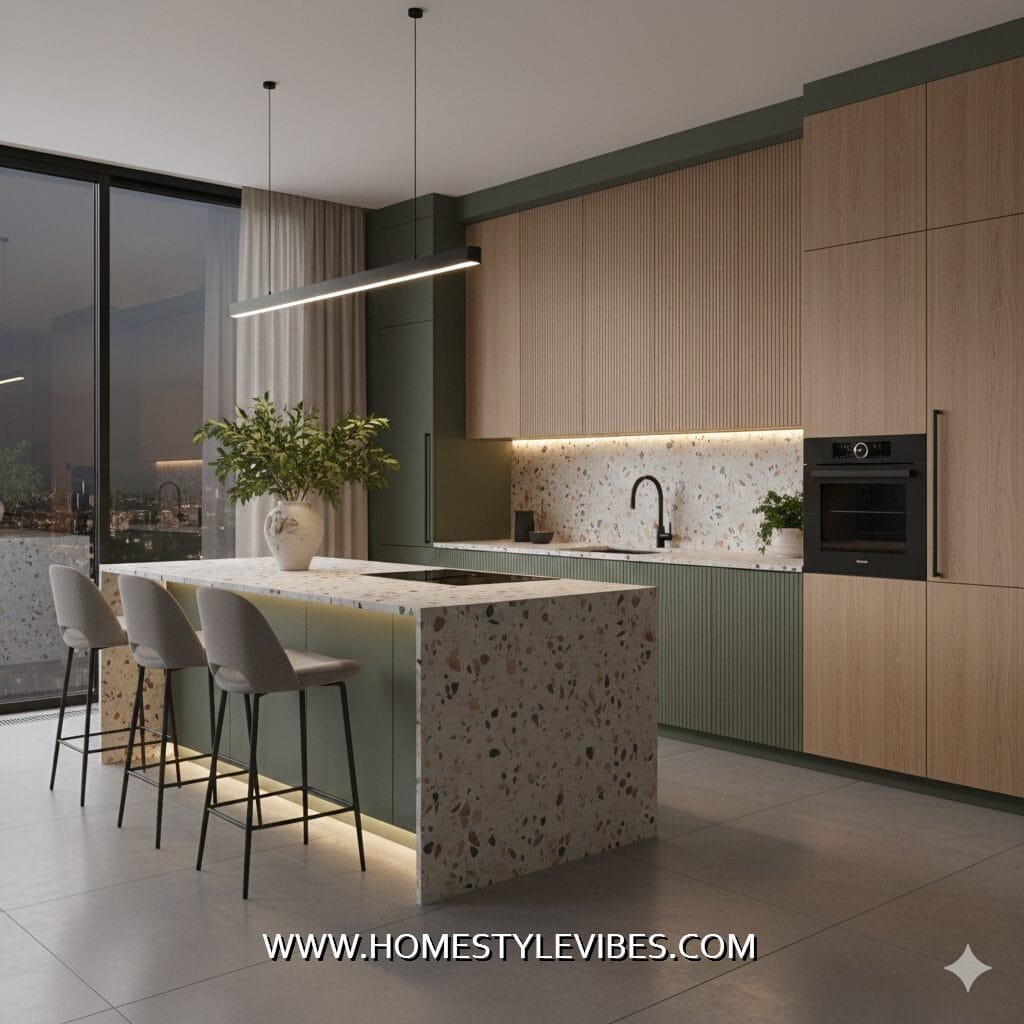
This image is a perfect example of this refined brilliance. The terrazzo island is paired with sleek linear lighting and soft green cabinetry. The way the light catches the different materials is just stunning. I love this approach because it feels “light” in a room that is usually filled with heavy objects. This kitchen design is a response to our need for calm. The grainy terrazzo adds just enough pattern to be interesting without being overwhelming. It’s like functional art that stands up to real life.
Okay, let’s pause for a sec… I know some of you are thinking, “Is terrazzo still a thing?” Honestly, yes—but it’s evolved. In 2026, we are seeing more refined, large-grain terrazzo that mimics natural stone rather than 90s shopping mall floors. It’s durable, easy to clean, and handles the “flying toy” test much better than traditional marble. (My daughter has tested this multiple times—the terrazzo is currently winning). It’s the ultimate visual relief for a cluttered mind.
While pale green is for the minimalists, the next trend is for those who want to turn up the volume on their “Earthy Vibrancy.”
7. Earthy Vibrancy: The Bold Terrazzo Statement
For those who want their kitchen to be the life of the party, 2026 is giving you permission to be bold. We are seeing a move toward “Earthy Vibrancy,” which uses richer, muddier versions of natural colors to prevent a space from looking drab. Think olive green cabinets paired with a terrazzo island that actually has bits of terracotta and clay embedded in it. It’s a total statement of color confidence that feels deeply connected to the natural world.
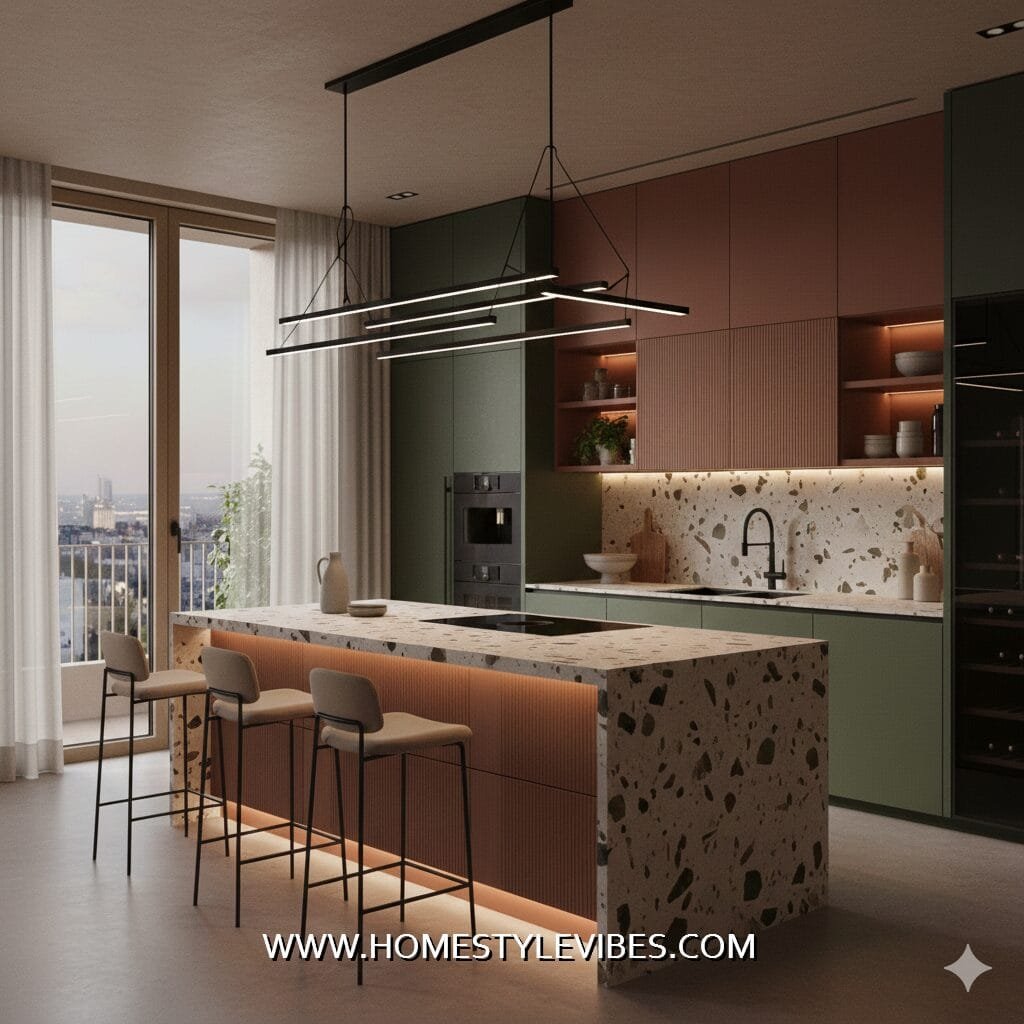
Look atthis image—it is a vibe. It trade-off subtle transitions for high-contrast drama. Honestly, it’s exactly the kind of kitchen design that stops people in their tracks on Pinterest. Terrazzo is also incredibly durable, which, as a parent, is my number one priority. It resists stains, heat, and the occasional spilled juice box. I mean, really — really works for busy households. This look proves that you don’t have to stick to just one metal or just one color. You can mix your metals and your minerals to create a space that is as unique as your own signature.
We’re seeing this “confetti” effect appearing on backsplashes too. It turns a functional surface into a room-defining element. When you use a stone with this much personality, you don’t need a lot of extra decor. The island tells the whole story. At first, I thought this might be “too much,” but when you ground it with olive green cabinets, it feels sophisticated rather than chaotic. It’s about finding that balance between energy and peace.
But if you want to go to the ultimate extreme of “Quiet Luxury,” you have to see what we’re doing with the “Dark Side.”
8. Ultra-Minimal Black Luxury and Marble Drape
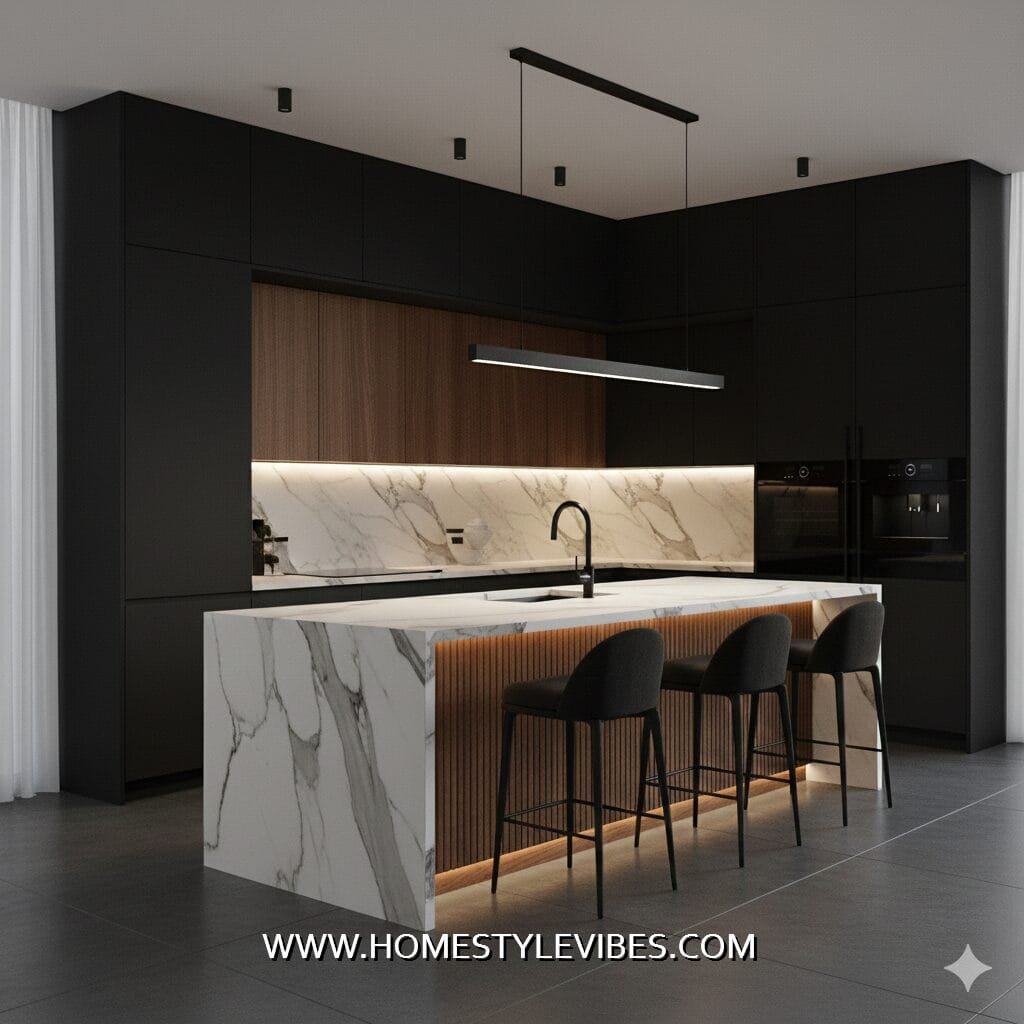
The “Disappearing Kitchen” reaches its peak in 2026 with ultra-minimal black designs. This is the epitome of the “Quiet Luxury” philosophy. We are talking about handleless, matte black cabinets where the cooktops disappear flush into the countertops and the fridge is completely panel-ready. The hero of the room is usually a massive marble waterfall island that “drapes” over the side, showing off every dramatic vein of the stone.
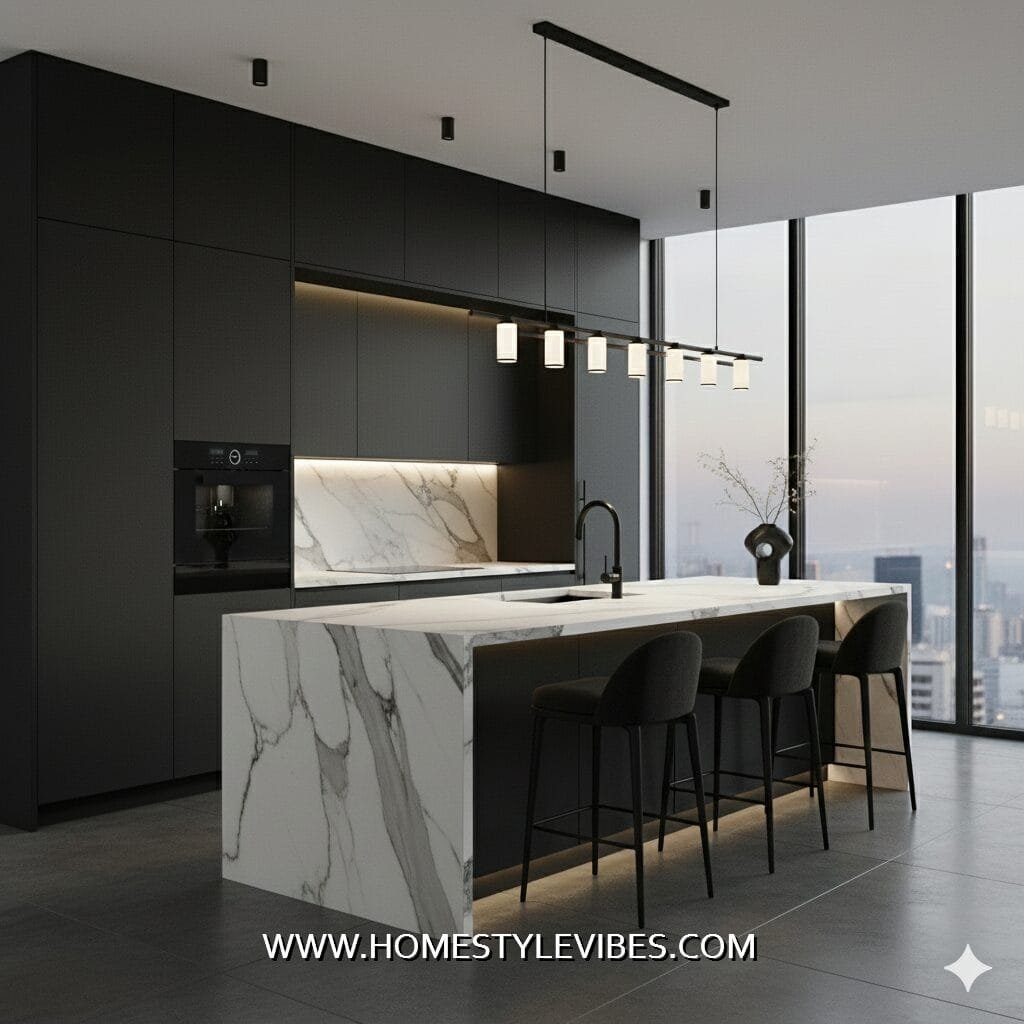
This is the height of this 2026 minimalism. Look at those sleek black cabinets and that dramatic marble island—the appliances are totally invisible. This kitchen design trend uses something called “pocket doors” that allow you to slide entire sections of the kitchen out of sight when you’re not cooking. One mozdulat (that’s ‘one movement’ for my Hungarian friends!), and the room switches from a messy cooking zone to a luxury living space. It’s basically magic. My husband once joked that our house is becoming so high-tech it might start charging us rent, but even he admits this looks incredible.
This trend is perfect for modern life where we are often working from the kitchen table. When the workday is over, you close the “office” (aka the pantry) and you’re back in your cozy home. The dark color palette creates a sense of intimacy and drama that light kitchens can’t match. To make it work, you need high-quality natural stone like Calacatta or Statuario to provide that high-contrast drama. It’s luxury that is meant to be seen, but never heard. It’s the ultimate “flex” for the modern home.
While black luxury is one way to go, we are also seeing a major shift toward a softer, more spiritual kind of minimalism.
9. Japandi Zen and the Rise of Oversized Paper Lanterns
If you haven’t heard of Japandi yet, FYI, it’s the love child of Japanese aesthetics and Scandinavian functionality. In 2026, this trend has matured into something even more beautiful. We are seeing a huge move toward Wabi-Sabi, which is the art of finding beauty in imperfection. Think light wood cabinetry, clean lines, and—this is the big one—oversized rice paper lanterns. It’s a design that prioritizes tranquility above everything else.

Look at how this image captures it perfectly. The light wood cabinetry and those paper lanterns create a space that feels balanced without being cold. It’s functional art. You get the organization of a professional chef’s station with the soul of a meditation retreat. I love this because it feels “light” in a room that is usually filled with heavy objects. When my daughter is having a meltdown (which happens about twice an hour), having a serene, neutral backdrop actually helps me keep my cool. It sounds silly, but a calm room equals a calm mom—well, most of the time! 🙂
And guess what? This isn’t just about looks. Japandi kitchen design focus on L-shaped modular systems that maximize every inch of corner space. It’s about creating a sense of openness. Even in a smaller space, adding these natural wood elements can make the room feel twice as large without moving a single wall. It’s a quiet revolution where warm neutrals and earthy tones lead the way. At least that’s what worked for us when we wanted a zen-like morning routine.
This focus on light and airy details is leading us to a new version of minimalism that is much easier to live with.
10. Warm Minimalism and Integrated Social Hubs
Let’s be real—the clinical white kitchen era is officially over. In its place, 2026 embraces “Warm Minimalism 2.0.” This isn’t about having *less* stuff; it’s about choosing materials that feel human. Think creamy whites, mushroom grays, and soft putty tones that feel grounded. But the biggest layout change? The “Integrated Dining Hub.” We are building dining tables directly into the kitchen island to create one seamless social center.
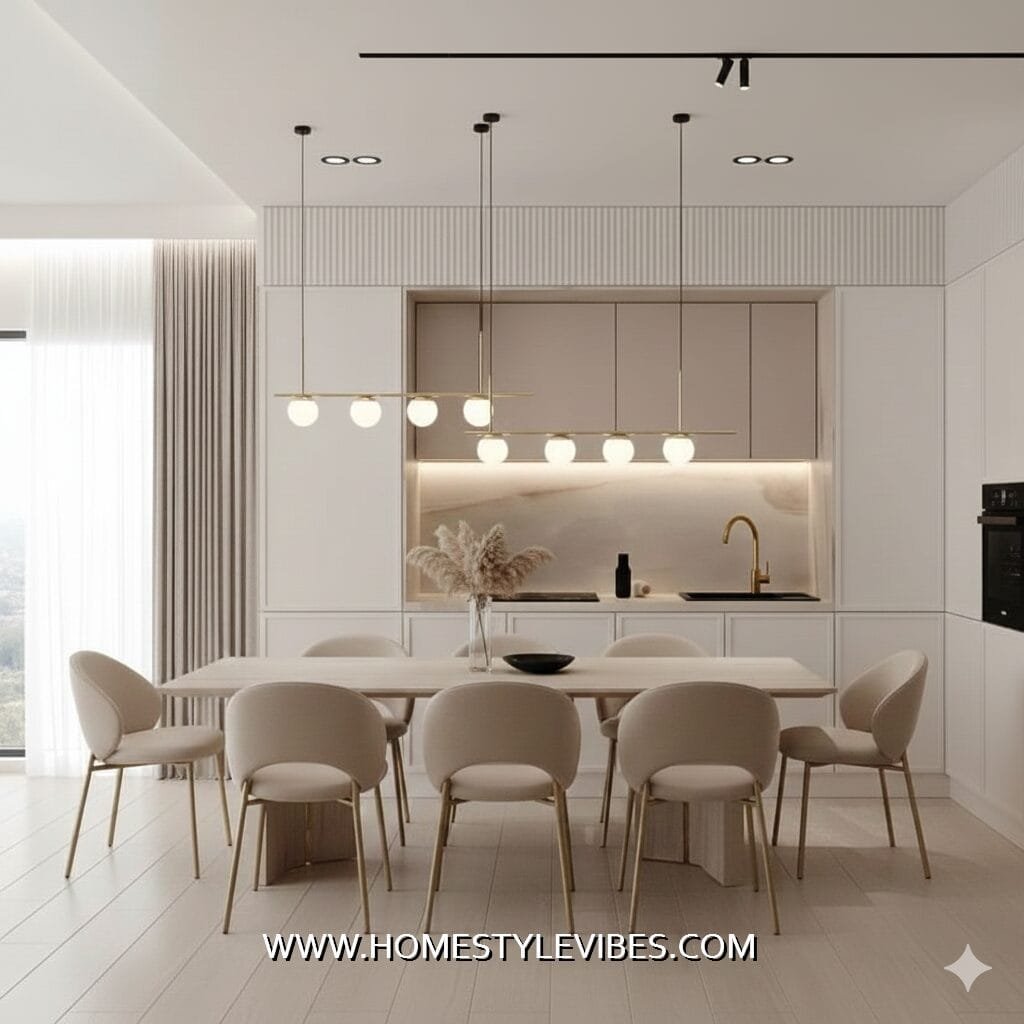
This monochromatic cream palette—often called “Color Drenching”—gives the room a sophisticated, airy feel. It makes small spaces feel huge without needing to knock down every wall. I love this feature because it creates a seamless visual flow. The integrated table means the cook is never left out of the conversation. My husband looked at me like, ‘You’re serious?’ when I suggested we paint our cabinets a “Mushroom” color, but once he saw how it reflected the morning sun, he was sold. It’s a space that looks grounded, feels calm, and quietly runs like a well-designed system every single day.
Designers are using rounded edges on these islands to improve traffic flow. Hard corners are softening, adding a sense of ease to contemporary kitchens. It’s “Livable Luxury” at its best. It’s where we can all be together—working, prepping, playing—without the space feeling disjointed. Honestly, a well-planned integrated dining hub is the heartbeat of a happy home. It’s where the best memories are made, usually over a messy bowl of pasta and a lot of laughter.
But the real trick to making a large room feel cozy is the way we use high-impact contrast because the truth is, a smart home that doesn’t look stunning is just a fancy office, right? Honestly, my husband once joked that our house is becoming so high-tech it might start charging us rent, but even he admits that when the lights dim automatically at 7:00 PM to support our circadian rhythm, the whole mood changes. It’s not about gadgets; it’s about a home that understands you. And that understanding continues as we look at how colors and metals are finally shaking hands after years of fighting for dominance in the world of kitchen design. We’re moving into a phase where contrast isn’t scary—it’s the secret sauce that makes a space feel alive.
11. Navy Contrast and Mixed Wood Bases
One of the biggest shifts for 2026 is the total rejection of the “all-one-color” look. We are seeing high-contrast pairings that create a sophisticated, layered atmosphere. Forget the days when everything had to match perfectly. Now, it’s about mixing dark, inky painted surfaces with warm, natural woods. This creates what designers call “visual tension,” which basically means the room looks interesting enough to keep your eyes moving instead of just glazing over.

Here you can see this navy blue mastery. Those upper units create a striking contrast against the light wood bases, perfectly balancing modern and traditional elements. I tried to do something similar three months ago with a small console table, and at first I totally messed this up by picking a blue that was too “electric.” You want these deep, muddy navies that feel like a midnight sky. It grounds the room and makes the dining area feel like an intentional destination rather than just a corner where you eat. It’s the kind of kitchen design that feels collected over time, not bought in a single afternoon at a big-box store. 🙂
We are seeing “Mixed Metallics” as well. Gone are the days when you had to pick one finish for everything. In 2026, you can have a brass faucet and matte black cabinet pulls. FYI, the trick is to keep the “undertone” consistent. If you go with warm brass, pair it with other warm metals like bronze or champagne. It makes the kitchen feel curated and personal. My toddler was screaming for juice while I wrote that, btw, so let’s hope my focus holds! We’re essentially building a jewelry collection for our cabinets that tells our family story.
This move toward sophisticated pairings is also bringing a specific, nature-inspired duo into the spotlight that I am seeing in every high-end showroom.
12. Two-Tone Mastery: Sage and Deep Walnut
If the navy-and-wood combo feels a bit too bold for your house, let me introduce you to its softer, more organic cousin: Sage and Walnut. This is the “Quiet Luxury” version of the two-tone trend. Sage green acts as a calming, nature-inspired neutral, while walnut provides a rich, dark anchor. This pairing is everywhere in 2026 because it feels expensive without trying too hard. It’s like the interior design version of a perfectly tailored linen suit—effortless and timeless.
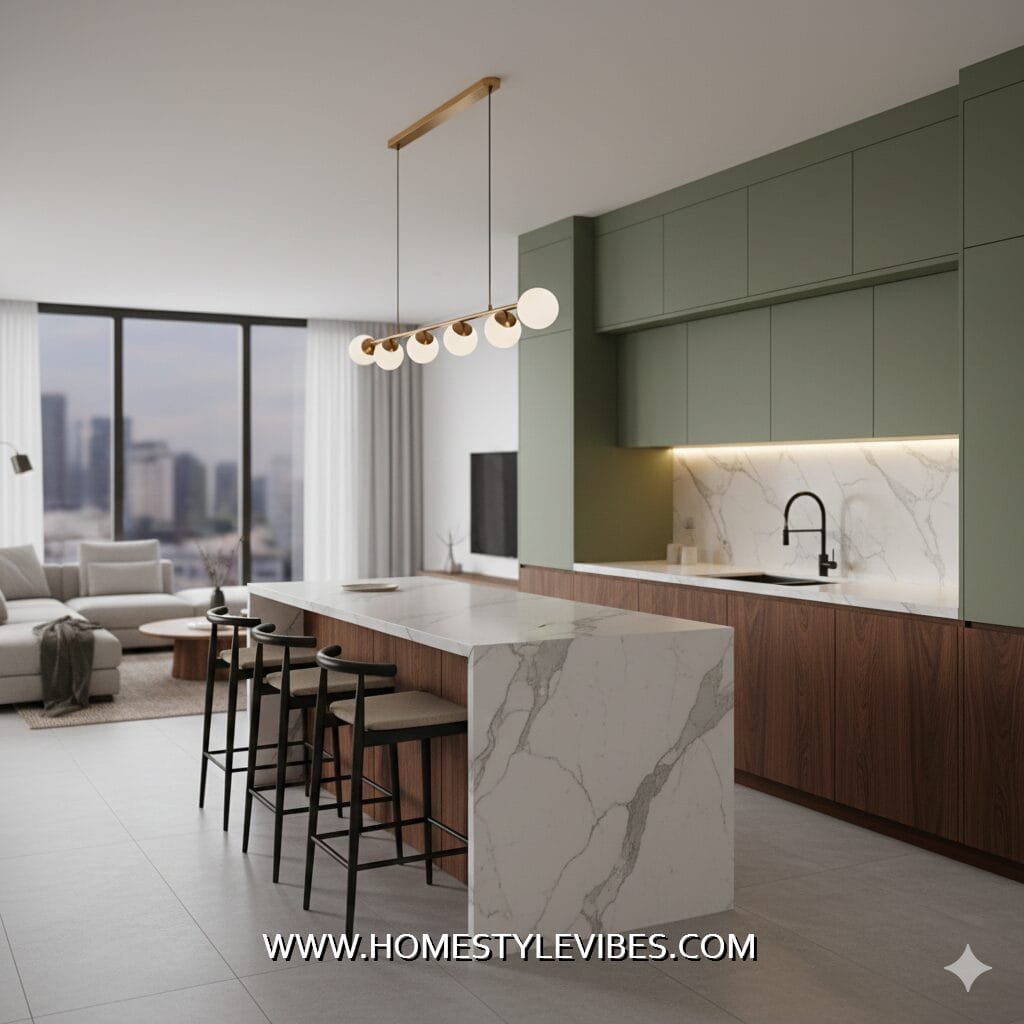
This image is a masterclass in this balance. Notice how the walnut base cabinets provide a sturdy foundation, while the sage uppers keep the room feeling light and airy. They are unified by a dramatic marble island that pulls the whole room together. Honestly, I could stare at this all day. It’s the kind of kitchen design that makes you want to wake up early just to drink your coffee in peace. It feels solid. It feels like a space that will still look incredible fifteen years from now. Plus, walnut grain is legendary for its durability—my daughter once hit a similar wood surface with a plastic hammer and the wood won. Every. Single. Time.
And guess what? This trend works because it respects the “Livable” part of luxury. Sage green is surprisingly good at hiding light dust, and the dark wood adds a sense of history even to a brand new build. We are seeing these two-tone schemes being applied to islands as well, where the island is a different material entirely from the perimeter cabinets, making it feel like a standalone piece of furniture. It breaks up the “wall of cabinets” look that can sometimes feel overwhelming. It’s about building layers of character rather than just a flat showroom look.
Speaking of the island, the way we are treating the “backsplash” is also changing drastically as we move away from traditional tiles toward monolithic slabs.
13. Embracing the “Countersplash” and Full-Height Stone
The tiny 4-inch backsplash is officially dead. (Thank goodness, because cleaning those grout lines was a nightmare anyway). In 2026, we are obsessed with the “Countersplash”—where the countertop material continues up the wall all the way to the upper cabinets or even the ceiling. It creates a seamless, monolithic look that is both modern and incredibly easy to clean. No grout, no seams, no problem. It turns a functional surface into a massive work of art that frames your cooking area.
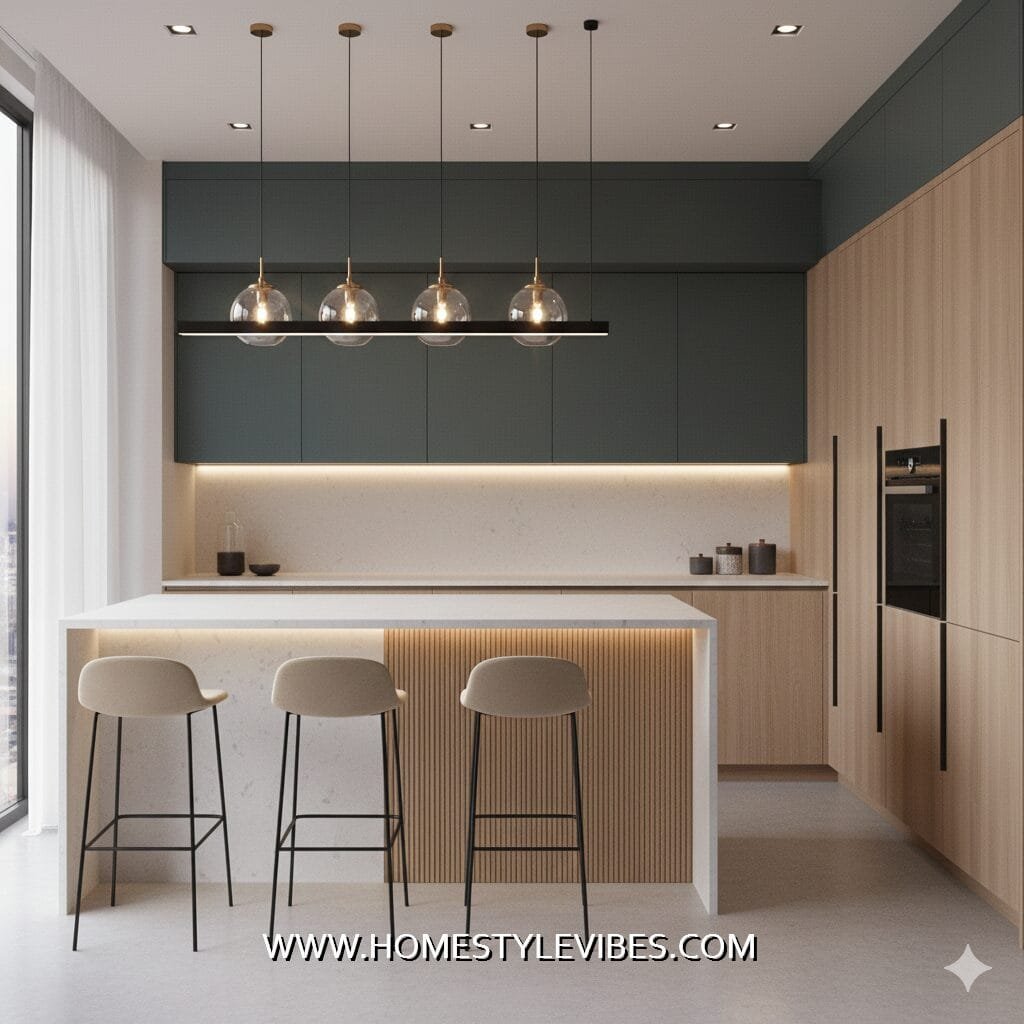
This forest green and oak combination features a full-height marble backsplash that is just… wow. It makes the whole wall feel like a statement piece. This kitchen design move is a favorite for 2026 because it simplifies the visual landscape. When you use a dramatic stone like this, you don’t need a lot of extra decor. The stone tells the whole story. I mean, really — really works to create that “OMG” factor when people walk into the house. It feels like a framed piece of nature right in the middle of your home.
A little pro expertise for you: if you’re doing a slab backsplash, try to “book-match” the veins. This means the patterns on the wall mirror the patterns on the counter. It’s a bit of an investment, but the payoff is huge. It adds a level of intentionality that screams luxury. We’re also seeing this stone “wrap” around range hoods, turning the ventilation system into a hidden architectural feature rather than a bulky appliance. It’s about creating a space that feels curated, not just assembled. At least that’s what worked for us when we wanted to hide the ductwork and make the wall look like a gallery piece!
While the stone brings the drama, the way we light these surfaces is what truly brings them to life throughout the day, which brings us to the “Moody” end of the spectrum.
14. Moody Lounge Luxury: Dark Marble and Gold Circles
For those who want a kitchen that feels like a private lounge, 2026 is delivering some incredible moody palettes. We are seeing a rise in dark marble—blacks, deep grays, and even “swampy” greens—paired with warm under-cabinet lighting. This is the epitome of the “Quiet Luxury” trend. It doesn’t need bright colors to be seen; its presence is felt through the quality of the materials and the depth of the tones. It’s grounded, permanent, and deeply comforting.
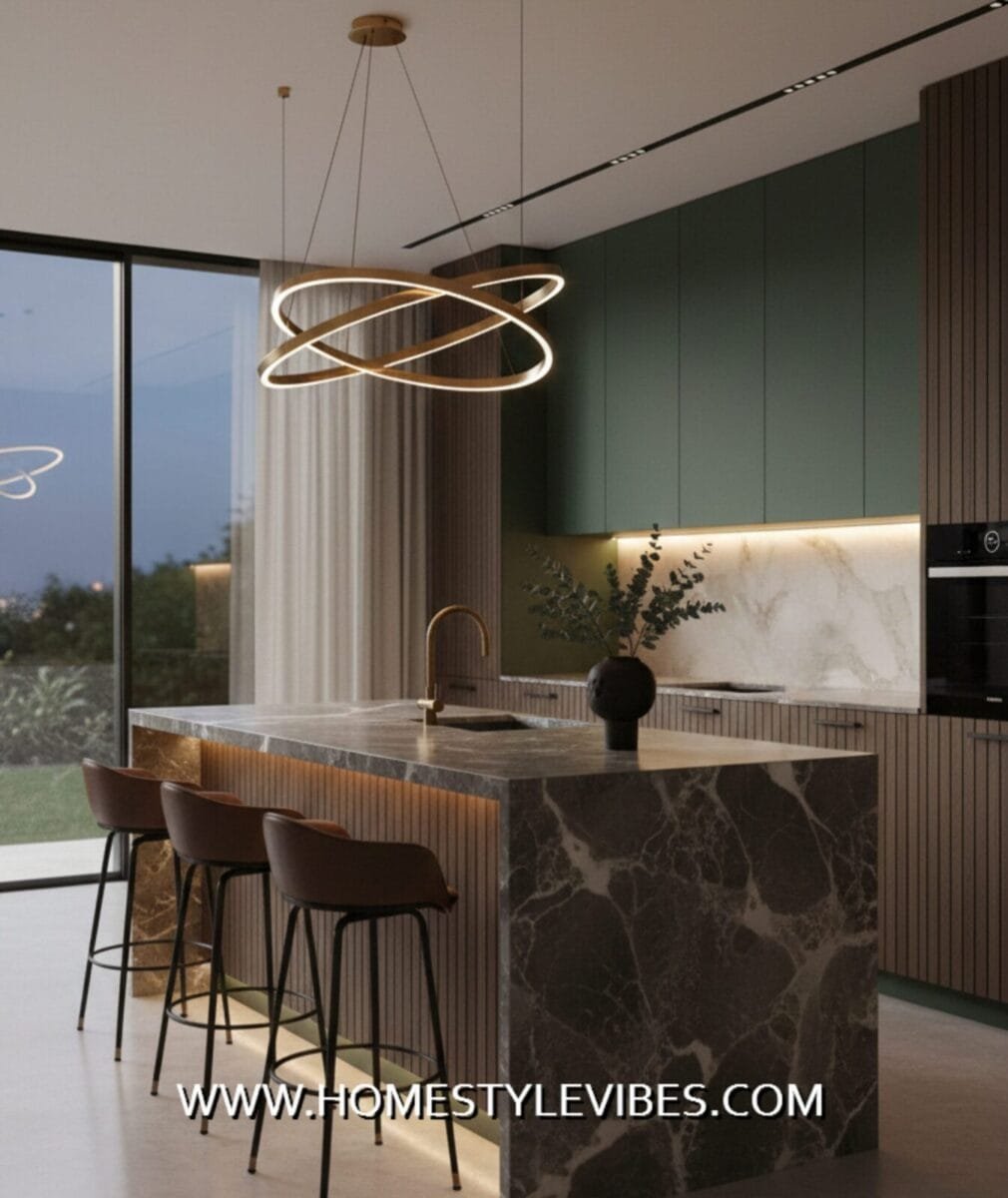
Look at this image. The dark marble island with that sculptural gold light is just… pure elegance. This is a bold kitchen design choice that pays off by creating an intimate, cozy atmosphere. It’s perfect for those late-night conversations over a glass of wine. I once tried to paint a small accent wall in a dark charcoal color, and my husband looked at me like I had lost my mind. But once the lighting was right, it became his favorite spot in the house. Dark colors need good light to work, otherwise, you’re just cooking in a cave. Honestly, it’s about embracing the shadows to make the highlights pop.
We’re also seeing these dark stones being used in a “honed” or “leathered” finish. This means the stone is matte rather than shiny. It feels amazing to touch and, honestly, it’s much better at hiding water spots and smudges. It’s luxury that is actually meant to be touched and used. It’s about creating a sensory experience every time you prep a meal. It feels grounded and permanent, which is exactly what we need in today’s uncertain world. No idea why, but a matte black counter just makes my morning toast feel more sophisticated. It’s the “Slow Living” approach to breakfast.
But if you still love the classic feel, the next trend shows how we are updating tradition with a much more architectural edge.
15. Modern-Classic Navy with Vertical Slats
If you love a modern-classic look, navy blue is your best friend in 2026. But it’s not just flat paint anymore. We are seeing a massive shift toward “Texture Play.” Vertical wood slats (or ‘slats’) on island bases are adding an architectural feel without visual “clutter.” It adds a rhythmic, 3D effect to the room that makes a minimalist space feel rich and expensive. It’s a way to draw the eye without needing a loud color or a complex pattern.
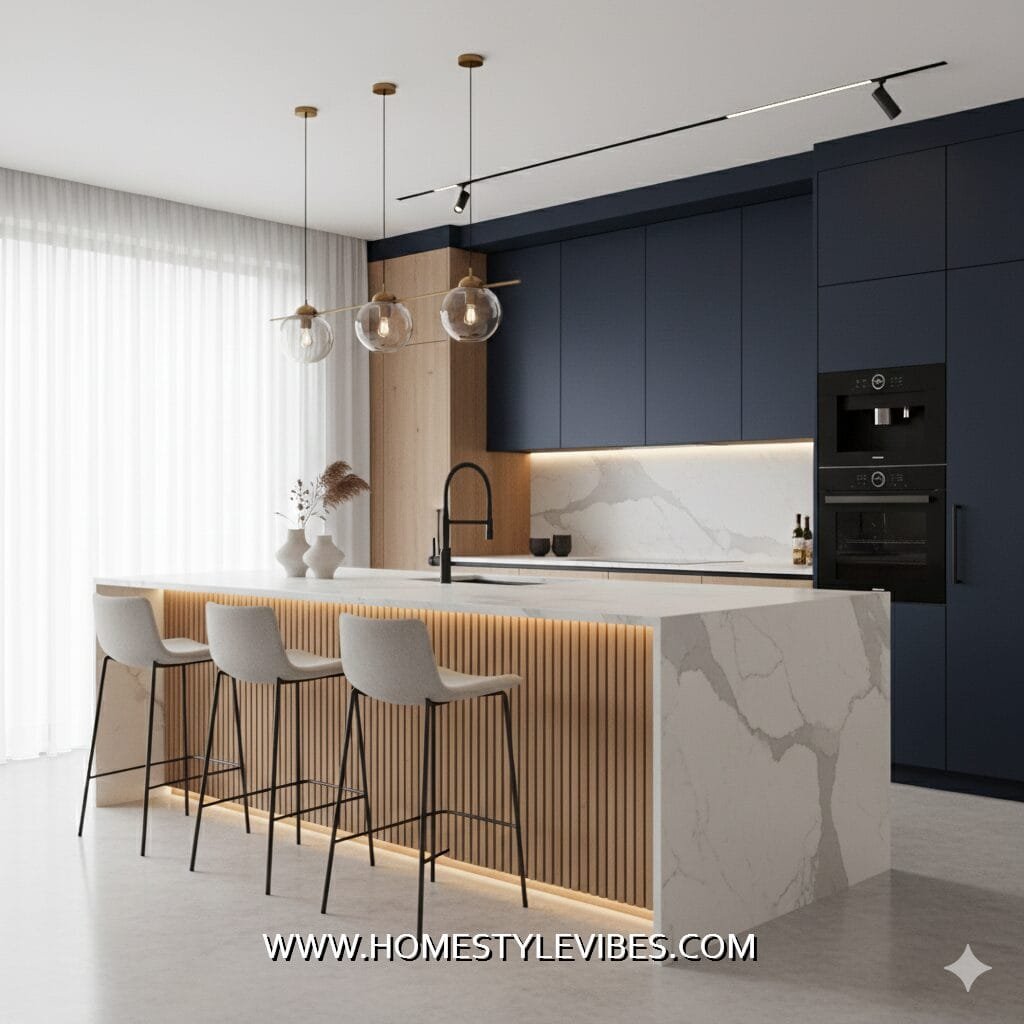
In this image notice how the vertical wood slats on the island create a focal point that feels grounded. This kitchen design method uses texture to draw the eye. It feels refined and “hotel-luxe.” I recently tried to add a tiny bit of fluting to a DIY project, and let’s just say… it’s harder than it looks. But when done professionally, it completely transforms the silhouette from a block of wood into a piece of furniture. It’s these small, thoughtful details that define the 2026 kitchen. Even the simplest layout can be elevated by a slatted detail.
We’re also seeing this on glass cabinetry. Fluted or reeded glass shutters allow you to hide the “not-so-pretty” dishes while still letting light bounce around the room. It breaks up the visual monotony of solid doors. It’s the perfect compromise for those of us who aren’t quite ready for open shelving because, well, my coffee mug collection is a disaster area. Anyway, it’s about layering your textures for that sophisticated, multi-dimensional look that keeps the energy in the room moving.
This focus on texture is also driving us to mix materials in more daring ways, which leads to my favorite “Material Duel” of the year.
16. The Material Duel: Walnut Meets Grainy Terrazzo
Contrast is the name of the game in 2026. Designers are refusing uniform finishes in favor of “Soft Contrasts.” We are seeing rich, dark walnut positioned against nagyszemcsés (large-grain) terrazzo. This opposing origin establishes a welcome dialogue between industrial sustainability and traditional craftsmanship. It’s a curated look that feels more like a collection of beautiful objects than a fitted kitchen range.
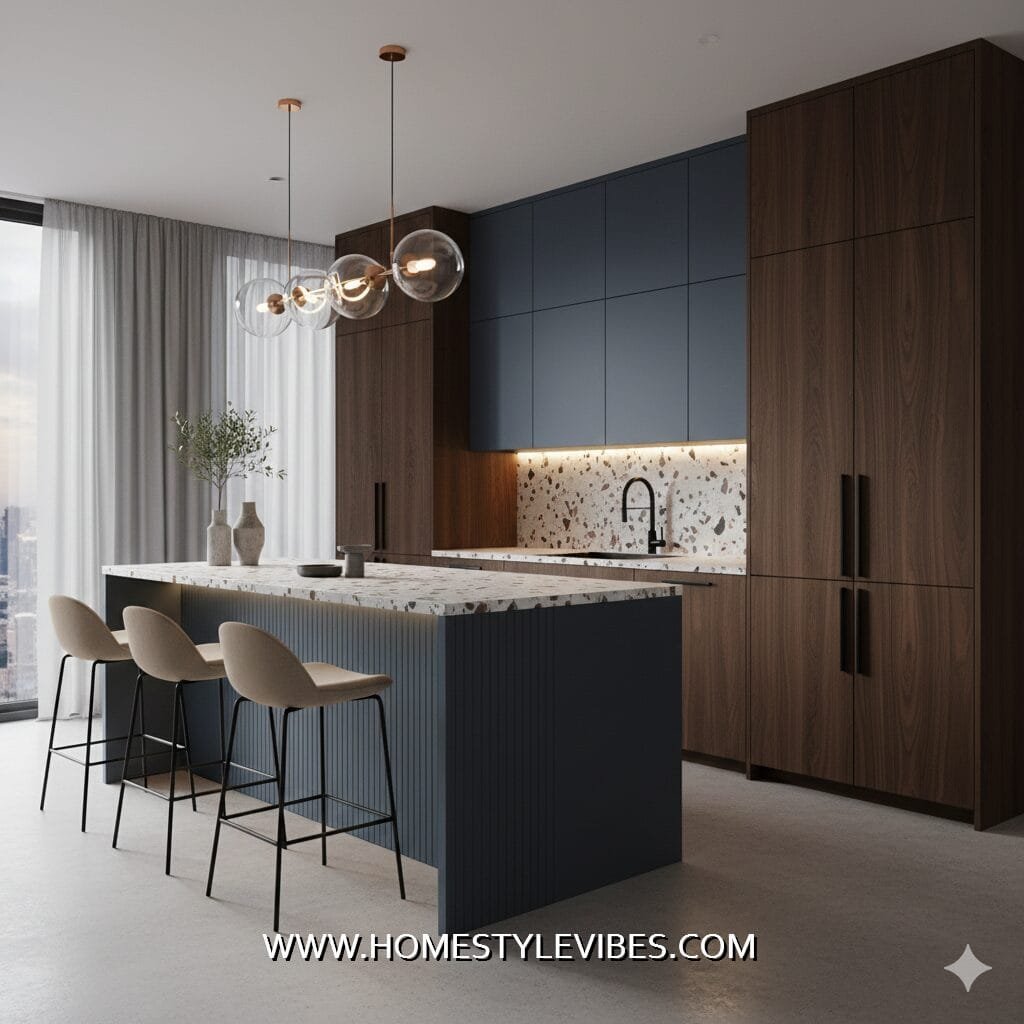
This image shows this beautifully. It proves that mixing materials is the best way to get a curated, high-end look. This kitchen design trend is all about “Timeless Restraint.” Walnut doors bring a sense of permanence and history to a home. It feels solid. It feels like it’s going to age gracefully along with your family. And the terrazzo adds that playful, modern punch that prevents the walnut from looking too “heavy” or “old school.” It’s the ultimate visual balance.
Pro Tip: If you’re mixing materials, keep your palette to 3-4 key elements to avoid chaos. Repeat certain elements—like a brass handle or a specific wood tone—throughout the space for cohesion. It makes the kitchen feel intentional. At first, I was worried about putting terrazzo next to walnut, but once the lighting hit those stone fragments, I was sold. It adds a “jewel-like” surface to the room that changes as the sun moves throughout the day. It’s functional art you can actually live with every single day.
But beyond the textures, we are also changing the very shapes of our furniture, moving away from hard angles toward the curve.
17. Soft Geometry: The Slatted Marble Curve
Say goodbye to sharp, clinical angles. 2026 is all about the curve. We are seeing “Curvaceous Silhouettes” everywhere—from rounded island corners to arched niches. Softening these edges makes the kitchen design feel more inviting and improves the traffic flow. If you have a toddler like me, rounded corners are also a major win for safety—no more worrying about sharp edges during a game of tag! But beyond safety, it just looks *expensive*.
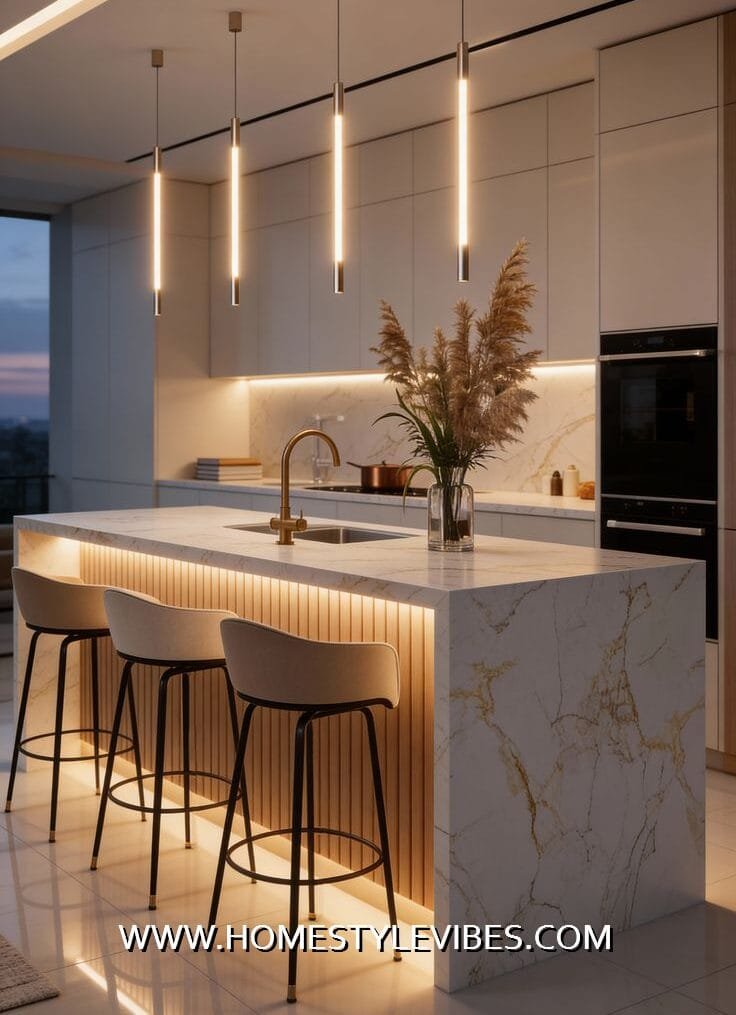
Look at the elegance of this image. The marble island with vertical slats on the curved section is just breathtaking. It turns a functional workspace into a sculptural centerpiece. Designers are calling this “Fluid Geometry.” It creates a natural gathering point that feels way more social than a standard rectangular block. It encourages people to linger, talk, and actually enjoy the space together. Honestly, I didn’t expect it to work this well until I leaned on a rounded island at a party last week. It’s just more comfortable!
The trick here is to keep the rest of the lines simple so the curves can really sing. You don’t need a wavy ceiling—just one or two “hero” curved elements. I’m also seeing a rise in Bullnose edges on countertops, which adds a touch of luxury and a softer hand-feel every time you lean against the counter to check your phone. It’s about that organic flow that keeps the energy in the room moving. It turns a functional space into an environment that invites connection.
This social aspect of the curve is actually part of a much bigger shift in how we lay out our entire homes, blurring the lines between rooms.
18. Seamless Transitions and “Living Room” Kitchens
One of the most profound changes in 2026 is that the kitchen is officially blending into the living room. We are seeing “Seamless Harmony” where the materials from the kitchen—the wood, the stone, the colors—flow directly into the rest of the home. Designers are using furniture-like details on islands to make them look less like a “cooking station” and more like a beautifull table. It’s about removing the architectural boundaries so life can flow uninterrupted.

Notice how the taupe and marble kitchen flows directly into the living area. You can’t even tell where one ends and the other begins. This kitchen design strategy is essential for modern, hybrid living. Whether you’re working from home or hosting a dinner party, the space adapts to your mood. It’s “Livable Luxury” because it allows you to be part of the action, no matter what you’re doing. I love that I can keep an eye on my daughter in the living room while I’m making her a snack—which happens every ten minutes. It’s a lifesaver for my sanity.
To make this work, you have to be smart about storage. You can’t have a seamless look if your counters are covered in mail and boxes of pasta. That’s where the “Appliance Garage” comes in. It’s a dedicated spot for your toaster and blender that you can hide behind a sliding door. It’s about having everything you need, but not having to look at it when you’re trying to relax on the sofa. It’s the ultimate visual relief for a cluttered mind. So yeah, we’re keeping the connection but adding some much-needed visual quiet that lets the home breathe.
And speaking of connection, we are also re-thinking the way we eat together, bringing the table back into the heart of the room.
19. The Integrated Dining Table Hub
The “formal dining room” is officially losing ground to the “Integrated Dining Hub.” In 2026, we are building large wooden tables directly into the kitchen island or the perimeter counter. It combines the cooking and eating rooms into one seamless space without it feeling like a giant, cold hall. It’s about creating “Lifestyle Zones” where daily rituals—like homework, coffee with a friend, or evening meals—can all happen in one place.
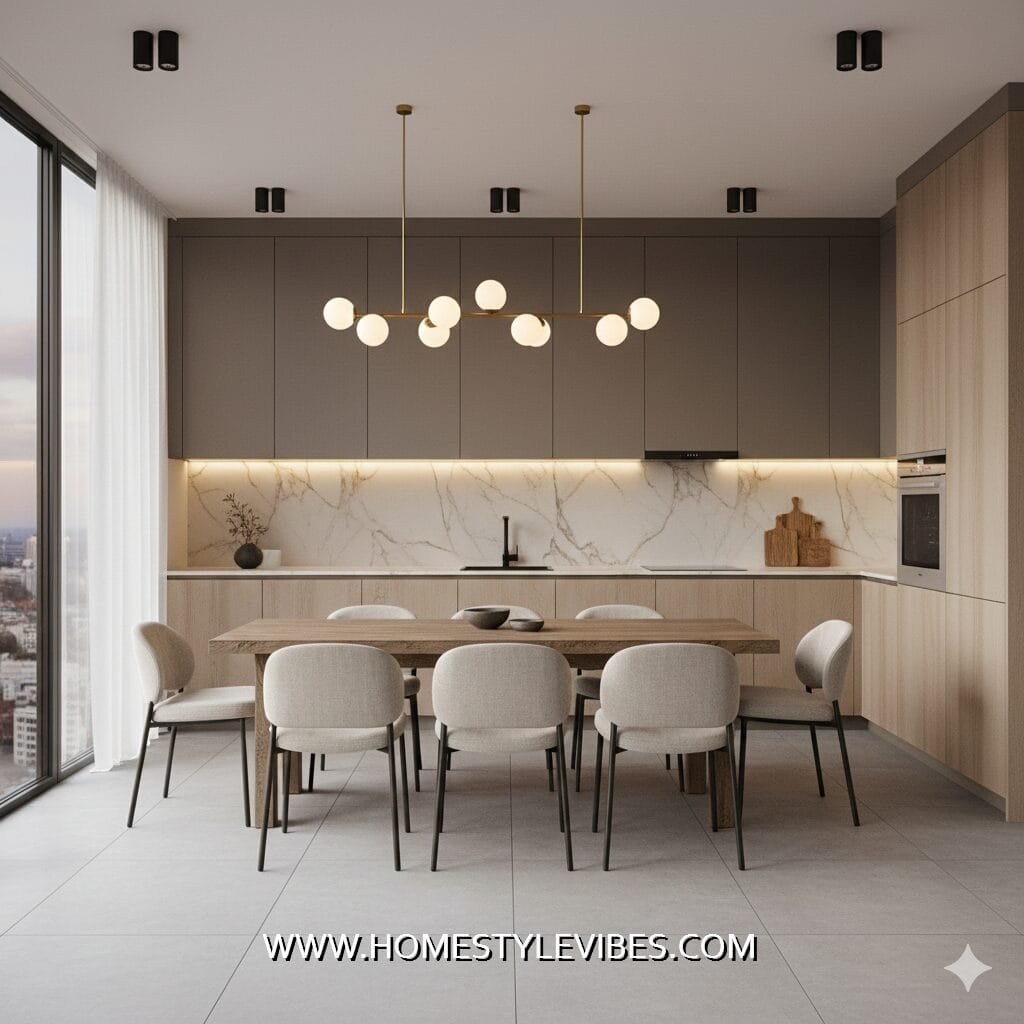
It shows the perfect example of this integrated dining trend. A large wooden table is built right into the kitchen zone, creating a communal hub. This kitchen design approach is “Livable Luxury” at its best. It’s where my husband can work on his laptop while I prep dinner and the baby plays in her high chair—we’re together, but the space feels organized. We are also seeing “pass-through windows” becoming a major trend here, acting as a “framed view” that connects the zones while maintaining a sense of definition.
This layout is highly practical for entertaining, allowing food and drinks to move seamlessly without interrupting the flow of conversation. It gives your home a story and a sense of character that a wide-open space often lacks. I mean, really – really works for families who want to be connected but also need a little bit of order in their lives. It’s the ultimate expression of the modern, social kitchen. It turns a chore into a shared experience.
But beyond the layout and the looks, the most important trend for 2026 is one that we can’t always see, but we can definitely feel in our environmental impact.
20. Sustainability: Moody Minimalism with a Conscience
In 2026, being “Green” isn’t a choice anymore—it’s the baseline of good design. But the good news is that sustainable materials have become incredibly beautiful. We are moving toward bio-based resins, recycled glass, and paper composites like PaperStone or Richlite. These materials offer a velvety matte finish that is warm to the touch and incredibly durable. It’s the “Green Kitchen” with a high-fashion makeover. It proves that you don’t have to sacrifice style for ethics.
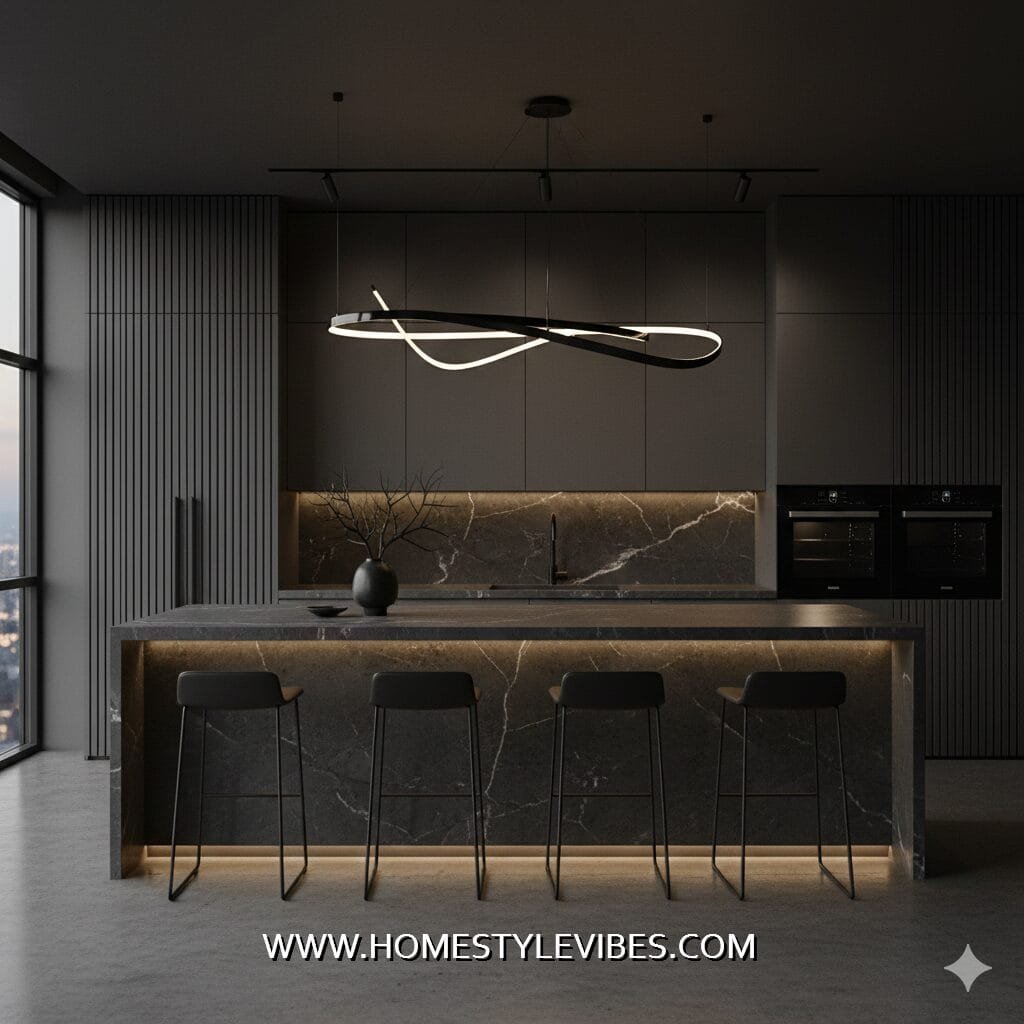
This image showcases this mood perfectly: a kitchen that feels deeply connected to the earth through its materials and dark, natural tones. Sustainability also means “Durability.” A kitchen that lasts 20 years is much more eco-friendly than one that needs to be replaced in five. That’s why we are seeing a massive rise in Sintered Stone (like Dekton or Neolith). These materials are virtually indestructible. They resist heat, stains, and UV light. We’re also seeing a rise in “Refacing”—where you keep the high-quality cabinet boxes and just update the doors. It’s a low-waste way to get a new look for a fraction of the cost.
Actually… wait, no, I take that back. Sustainability isn’t just about the materials; it’s about the air we breathe. We are seeing a huge focus on induction cooking and high-performance ventilation. Induction is safer, faster, and keeps your indoor air quality way higher than gas. It’s a win for the planet and a win for your family’s health. It’s the ultimate expression of “Livable Luxury”: a home that looks stunning and actually takes care of you. Because a happy life really does begin at home, and that starts with a healthy environment for the next generation.
FAQ: Your Burning 2026 Kitchen Questions Answered
Is the all-white kitchen really out?Basically, yes. While white will never “die,” the stark, cold white is being replaced by warmer creams, beiges, and mushroom tones. If you love white, go for a “warm white” with a bit of yellow or gray pigment to keep it feeling 2026-ready. It’s much more flattering and easier to live with long-term.
What is the best material for a low-maintenance kitchen?Honestly, Sintered Stone (like Dekton) or natural Quartzite. They offer the beauty of natural stone without the constant need for sealing. If you have kids or a busy life, these are the clear winners. They handle the “flying toy” test much better than traditional marble.
Are handleless cabinets just a fad?Not at all. With “Touch-to-Open” technology and “Pocket Doors,” handleless designs are becoming more popular because they support the “Seamless Living Room” look. It’s about reducing visual noise and making the kitchen feel like a peaceful part of the home rather than a cluttered workshop.
Wrapping Up: Designing Your Future Sanctuary
Wow, that was a lot to take in, right? Deep breath. Designing a kitchen in 2026 is about more than just picking a color or a counter material. It’s about creating a space that feels like an emotional sanctuary. Whether you’re falling in love with the peace of a Japandi layout, the drama of a terrazzo island, or the magic of a disappearing pocket-door system, the goal is simple: make it personal. Focus on how you want to feel in the room, not just how you want it to look in a photo.
The trends of 2026—from muddy greens to “invisible” tech—are all pointing toward a future where our homes are warmer, smarter, and more sustainable. We are finally desining for the way we actually live, not the way we think we should live for a magazine shoot. So, take your favorite color palette, lean into those textures, and don’t be afraid to mix things up. Because at the end of the day, a happy life really does begin at home. I mean, if I can survive a toddler meltdown while surrounded by beautiful sage cabinets and a perfectly organized pantry, I call that a win. Anyway… you got this. Really.

About the Author

Krisztina P.Rendes, Founder of Home Style Vibes
Founder of Home Style Vibes
Krisztina Puskásné Rendes created Home Style Vibes as a cozy-modern lifestyle space where homemaking meets inspiration. Her goal is to help women create beautiful, organized, and peaceful homes they truly love — without overwhelm. You’ll find here heart-driven content on home decor, cleaning tips, easy family recipes, organization and decluttering, DIY home projects, plants, and seasonal ideas — all designed to bring more calm, comfort, and style into everyday life.